

Written by Mei-Li Hsueh.
Image credit: Taiwan Biodiversity Research Institute, 2025. The “Leopard Cat Friendly Farming” eco-label supports local livelihoods, strengthens social cohesion, and promotes environmental sustainability.
Taiwan features a diverse landscape with mountains, hills, basins, and plains. The Central Mountain Range runs from north to south, with national forests and protected areas covering over 60% of Taiwan’s land area. However, around 55% of protected wildlife and 64% of threatened Red List plant species are found below 1,000 meters elevation. These zones, including coastal wetlands, low-elevation forests, and farmlands, form a mosaic of Satoyama and Satoumi landscapes, serving both human and ecological needs.
In central Taiwan, major rivers such as the Daan River, Dajia River, Wu River, and Zhuoshui River flow into the Taiwan Strait. The region is home to geographic features like the Dadu Plateau, Bagua Plateau, Taichung Basin, and Puli Basin, forming a mosaic landscape of coastal wetlands, low mountain forests, and farmlands—an interconnected Satoyama-Satoumi environment. This diverse landscape not only supports human habitation and agricultural production but also serves as a critical habitat for various Satoyama species, including coastal waterbirds, land crabs, leopard cats, Chinese box turtles, and yellow pond box turtles.
In these human-dominated areas, effective biodiversity conservation depends on local community participation. To address this, the Forestry and Nature Conservation Agency under the Ministry of Agriculture promotes diverse strategies that support eco-friendly farming, local patrols, and species monitoring. These strategies make biodiversity conservation a community-based effort. The following two examples, focusing on the leopard cat and Taiwan’s native freshwater turtles, illustrate how biodiversity conservation in Taiwan is increasingly relying on community-led initiatives. By examining these examples, the article highlights the growing shift toward integrated, community-based approaches that support both ecological sustainability and rural development.
Leopard Cat Friendly Farming: Linking Agriculture and Wildlife Protection
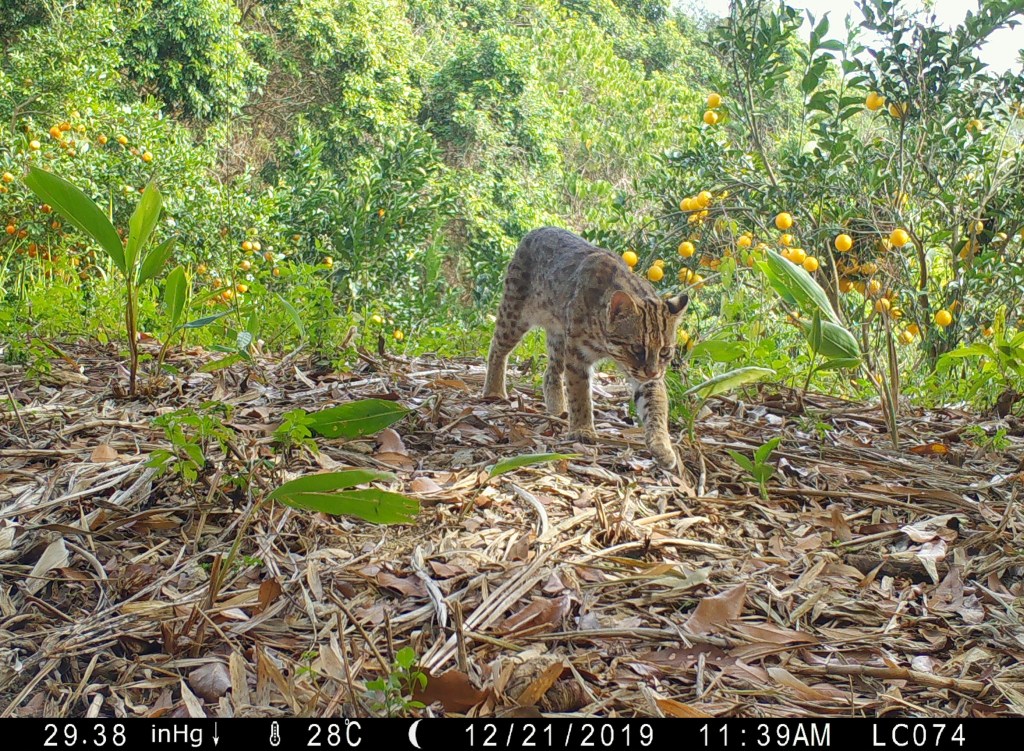
The leopard cat is an umbrella species for Taiwan’s low mountain and stream ecosystems. The population is estimated at only around 600 individuals. Since 2014, FANCA and the Taiwan Biodiversity Research Institute have promoted a “Leopard Cat Friendly Farming” eco-label. It promotes farming practices that minimise the use of herbicides, pesticides, and other substances that harm wildlife. Initially, many community members were unfamiliar with leopard cats and believed they did not exist in the area. However, through the outreach and education efforts of community leopard cat patrol teams, along with images captured by camera traps, a shared sense of awareness and commitment began to grow (Figs. 1, 2). As a result, many residents began to voluntarily join patrols and assist in removing illegal hunting devices. They also began to proactively report injured leopard cats or those found in chicken coops. As of now, 98 farmers across Miaoli, Nantou, and Taichung Counties have joined the eco-label initiative, covering a total farming area of 143 hectares. These areas are spread across key conservation corridors, helping to connect fragmented Leopard cat habitats within complex mosaics of villages, farmlands, and secondary forests. Labelled products have attracted collaboration with large retailers (e.g., Carrefour), encouraging consumers to support Leopard cat conservation while also improving rural livelihoods.

Rescuing Taiwan’s Native Turtles: Community-Led Protection in Yunlin
Community-based conservation efforts have played a crucial role in protecting Taiwan’s endangered native turtle species, particularly the Chinese box turtle and the yellow pond turtle. Among the five native turtle species in Taiwan, these two species face serious threats to their wild populations due to changes in land use, habitat fragmentation and loss, as well as illegal poaching and trafficking. Since 2019, both species have been listed as endangered wildlife. In recent years, community participation in conservation efforts has helped increase the wild population. One notable example is Hushan Village in Yunlin County, which was once home to Taiwan’s largest population of Chinese box turtles. Today, local groups like the Hushan Reservoir Cultural and Ecological Protection Association support conservation efforts to restore the population size. Their community-based activities include habitat restoration, radio telemetry tracking, and patrolling (Figs. 3, 4). The survival rate of the turtles released back into the wild has exceeded 70%. Since 2024, payments for ecosystem services have also been introduced for both turtle species. This policy, launched by the Forestry and Nature Conservation Agency, provides financial incentives to encourage eco-friendly farming practices that support local biodiversity. For example, farmers who adopt turtle-friendly practices—such as avoiding harmful chemicals, bladed weed cutters, and heavy machinery—can receive annual rewards. These measures help create a safe environment for endangered Satoyama species.


In recent years, community engagement and public participation in biodiversity monitoring and conservation have extended beyond traditional patrols and training courses. An increased availability of infrared automatic cameras and acoustic recorders, along with the development of citizen science apps such as eBird and iNaturalist, has empowered residents to easily record, identify and share biodiversity observations. These tools enhance community-based biodiversity monitoring and promote sustainable management of the satoyama and satoumi landscapes and seascapes. This contributes to local economic development, social cohesion, and environmental sustainability.
Dr. Mei-Li Hsueh (薛美莉) is a Research Fellow and Head of the Conservation and Promotion Section at the Taiwan Biodiversity Research Institute, Ministry of Agriculture. As a dedicated researcher with a strong background in plant ecology, forest soil science and wetland conservation, she seeks to contribute to the advancement of biodiversity and carbon sequestration through cutting-edge research and public education. E-mail: shiu@tbri.gov.tw.
This article was published as part of a special issue on ‘Co-Weaving Taiwan Ecological Network: Satoyama in Practice‘.
 Taiwan Insight