
Written by Paulina G. Karim and Kuang-Chung Lee.
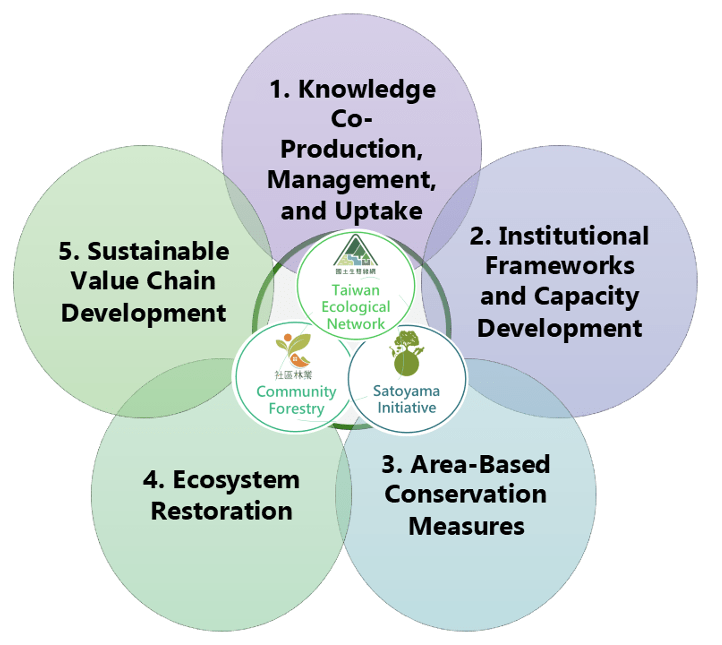
Image credit: Five strategic objectives in the 2023-2030 IPSI Plan of Action. Photo courtesy of the authors.
Year 2025 marks 15 years since the introduction of the Satoyama Initiative to Taiwan. It is a global effort launched in 2010 at the Conference of the Parties to the Convention on Biological Diversity (CBD COP10) in Nagoya, Japan, to realise the 2050 vision of a society living in harmony with nature. To date, the International Partnership for the Satoyama Initiative (IPSI) has grown into a global family of 337 partners (as of April 2025) working on the promotion of integrated landscape and seascape approaches (ILSA) for biodiversity conservation and sustainable local livelihoods. Taiwan is one of IPSI’s most active family members, represented by 31 member organisations from national and local governments, research and academia, NGOs, Indigenous and local community organisations, and the private sector.
National Dong Hwa University had the privilege of serving as a member of the subcommittee for developing the 2023-2030 IPSI Plan of Action (PoA). The document outlines five strategic objectives to be achieved by 2030 in alignment with the United Nations Decade on Ecosystem Restoration, the Ocean Decade, and the Kunming-Montreal Global Biodiversity Framework (KM-GBF). The implementation of the PoA requires coordinated efforts across local, national, and global levels, through inclusive and participatory approaches that involve Indigenous Peoples and local communities (IPLC), women, and youth. In this article, we look at the five strategic objectives and their relevance to the ‘3 in 1’ people-centred strategy for nature conservation in Taiwan – the Satoyama Initiative, Community Forestry and Taiwan Ecological Network.
Strategic Objective #1: Knowledge Co-Production, Management, and Uptake
Moving forward while looking backwards is a useful metaphor for taking stock of existing knowledge and repurposing it for future agendas. In our case, we need to build on the lessons learned from the past 15 years of promoting the Satoyama Initiative. This includes examining both successes and challenges in achieving equitable governance and effective co-management in Taiwan’s socio-ecological production landscapes and seascapes (SEPLS).
Building on the theory and practice of ILSA, Taiwan is proud to have developed its own school of thought and action based on the 5P+S elements of the approach: place-sensitive (area-based and context-specific), people-centred (community-based, cross-sectoral, and multi-stakeholder), problem-focused (working on locally sensitive priority issues), process-driven (adaptive co-management), progress-minded (meant for a long-term engagement), and scaling-oriented (sharing ILSA experiences out, up, down, and deep). Over the next five years, we will continue to make ILSA knowledge applicable, replicable, and useful at various scales.
Unveiling bio-geo-cultural diversity in SEPLS is an emerging priority. In these places, biological, geological and cultural diversity are closely linked. Although most of our vocabulary to date has focused on biodiversity conservation, it is essential to recognise all the multidimensional aspects linked to the lived environment, its local culture, knowledge, and languages. This is an exciting new direction to explore.
Strategic Objective #2: Institutional Frameworks and Capacity Development
Strengthening institutional frameworks and creating a conducive policy environment are essential for scaling up the Satoyama Initiative and ILSA. Since 2018, the Taiwan Ecological Network has created a solid foundation for the cross-sectoral biodiversity conservation action nationwide. This unique experience will contribute to the 2030 agenda while further deepening nexus-oriented partnerships for nature conservation.
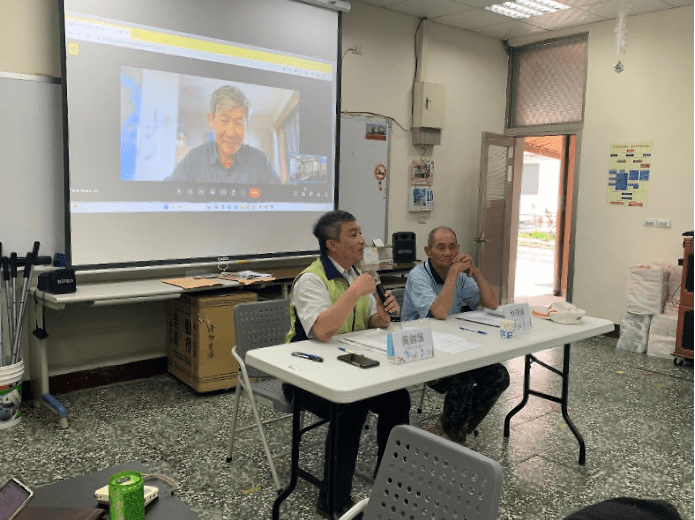
Peer-to-peer learning and knowledge exchange have always been a cornerstone of promoting the Satoyama Initiative in Taiwan, as well as a main pillar of its success. Partnership networks such as the Taiwan Partnership for the Satoyama Initiative (est. 2015), Community Forestry Network (est. 2021), and annual exchange events between Taiwan’s IPSI members (est. 2019) have played a key role in linking individual on-the-ground efforts into an integrated ‘whole of government, whole of society’ approach.
Aligning national strategies with global biodiversity goals requires strong science-policy platforms and institutional capacity. To ensure domestic policies remain relevant to the most recent international concepts and processes, Taiwan must integrate policy recommendations from assessment reports, such as those prepared by the Intergovernmental Science-Policy Platform on Biodiversity and Ecosystem Services, and the 23 Action Targets of the KM-GBF into its national context. In the future, close collaboration between academic and research institutions (e.g., National Dong Hwa University) and government agencies (e.g., the Forestry and Nature Conservation Agency) will support this goal.
Strategic Objective #3: Area-Based Conservation Measures
The 30 by 30 Target (Target 3) of the KM-GBF aims to protect 30% of terrestrial, freshwater, and marine areas by 2030. From the perspective of the Satoyama Initiative, this objective calls for the recognition of SEPLS as other effective area-based conservation measures (OECM) for promoting biodiversity conservation and sustainable local livelihoods. A biodiversity-focused spatial planning database, developed by the Taiwan Ecological Network over the past seven years (2018-2025), will play a pivotal role in delivering this area-based conservation objective.
On 6 June 2025, the Forestry and Nature Conservation Agency launched its new policy, the OECM Certification Scheme, for the recognition of terrestrial OECM sites. Certifying a site as an OECM supports sustainable management practices, such as organic and environmentally friendly farming, towards delivering long-term positive biodiversity outcomes (e.g., maintaining ecosystem services and species habitats). SEPLS are on the frontline of biodiversity conservation in Taiwan’s rural areas, which makes them strong candidates for OECM designation. To support this, outreach and training workshops help make the OECM application process more accessible for SEPLS communities.
Spatial connectivity between SEPLS and their linkages across conservation corridors will be essential for integrating individual area-based conservation efforts into larger landscapes and seascapes. This is where ILSA, with its 5P+S approach, can bring in the diversity of perspectives and actors to seek out various SEPLS-to-SEPLS connectivity pathways (e.g., through inter-community ecotourism networks) and scale successful efforts in various directions (e.g., scaling-out to other SEPLS located within the same conservation corridor).
Strategic Objective #4: Ecosystem Restoration
In addition to protecting 30% of our planet, the restoration of at least 30% of the world’s ecosystems by 2030 (Target 2 of the KM-GBF) is just as important. The United Nations Decade on Ecosystem Restoration and the Ocean Decade emphasise the urgent need to restore and effectively manage the ecological services and functions of degraded and damaged terrestrial, freshwater, and marine ecosystems. In the coming years, during the third phase of the Taiwan Ecological Network (2026-2029), nature-based approaches to ecosystem restoration will be at the centre of attention.
Based on the existing database of 44 priority biodiversity areas and 45 conservation corridors, with a clear understanding of degraded ecosystems and fragile habitats around the island, the Taiwan Ecological Network will promote various types of nature-based approaches to ecosystem restoration. These, among others, will include forest landscape restoration, creation of riparian greenbelts, eco-friendly farming practices, wildlife passages and aquatic corridors, and removal of invasive alien species. These restoration approaches are expected to address a wide range of societal challenges, including climate change, pollution, water quantity and quality issues, food production, and disaster risk reduction.
Fostering cross-sectoral collaboration is crucial for effective ecosystem management. Restored ecosystems must be maintained to sustain their functions and services over time. The participation of IPLC and their ownership of the restoration process will be central to the success of such initiatives and can be supported through policies such as payments for ecosystem services. As various restoration activities are taking place, it is essential to coordinate across themes (e.g., biodiversity, climate, soil health, water, and health) and places (e.g., landscapes and seascapes) through integrated, nexus approaches.

Strategic Objective #5: Sustainable Value Chain Development
Production is a key component of all SEPLS and is what makes the Satoyama Initiative so unique in its approach to biodiversity conservation. It is a bridge between the ecological and environmental elements of a given landscape or seascape and the socio-economic elements. To ensure that the production activities in SEPLS are sustainable – good for people, good for biodiversity and can be maintained for a long time, we need to effectively communicate the diversity of values embedded in SEPLS. Such values include cultural, spiritual and relational significance of rural areas. This is where business engagement, rural-urban connectivity and eco-labelling schemes can play a key role.
One key mechanism is engaging businesses in biodiversity conservation. ‘Carbon Sink and Biodiversity ESG Project Matching Platform’ is a triangular (business-government-community) partnership scheme launched by the Forestry and Nature Conservation Agency in April 2024. The Platform links the ESG (environmental, social and governance) requirements for businesses with the sustainable production activities of SEPLS communities (e.g., sustainable logging and reforestation), fostering long-term win-win arrangements and responding to the Target 15 of the KM-GBF.
Meanwhile, mainstreaming multiple values of SEPLS through relational linkages is growing in importance. In recent years, eco-labelled produce from SEPLS (e.g., ‘Leopard Cat Friendly’ eco-label), community-based ecotourism activities (e.g., Taiwan Ecotourism and Regional Revitalisation Alliance, TERRA), and farmers’ markets for agricultural produce and local crafts (e.g., SOGO seasonal markets) have been instrumental in communicating the diversity of multiple values of SEPLS to the public. Fostering rural-urban linkages by developing a new generation of relational populations can help to protect SEPLS’ nature, culture and values well into the future.

As the IPSI family is preparing for the Tenth Global Conference of the International Partnership for the Satoyama Initiative (IPSI-10) to be held in Riobamba, Ecuador, from 3 to 5 March 2026, we are looking forward to contributing our Taiwan Insight and learning from the Satoyama brothers and sisters from around the world.
Dr. Paulina G. Karim (孫夏天) is a post-doctoral researcher with the Forestry and Nature Conservation Agency and an adjunct associate research fellow at the @ScapesLab: Integrated Landscape and Seascape Approaches Living Lab, the Centre for Sustainable Development, National Dong Hwa University. She can be reached at scapeslab@gms.ndhu.edu.tw.
Dr. Kuang-Chung Lee (李光中) is a professor at the College of Environmental Studies and Oceanography and the director of the @ScapesLab: Integrated Landscape and Seascape Approaches Living Lab, the Centre for Sustainable Development, National Dong Hwa University. Professor Lee is also the leader of the eastern regional exchange base of the Taiwan Partnership for the Satoyama Initiative (TPSI-East). He can be reached at kclee@gms.ndhu.edu.tw.
This article was published as part of a special issue on ‘Co-Weaving Taiwan Ecological Network: Satoyama in Practice‘.
 Taiwan Insight