
Written by Maisnam Arnapal.
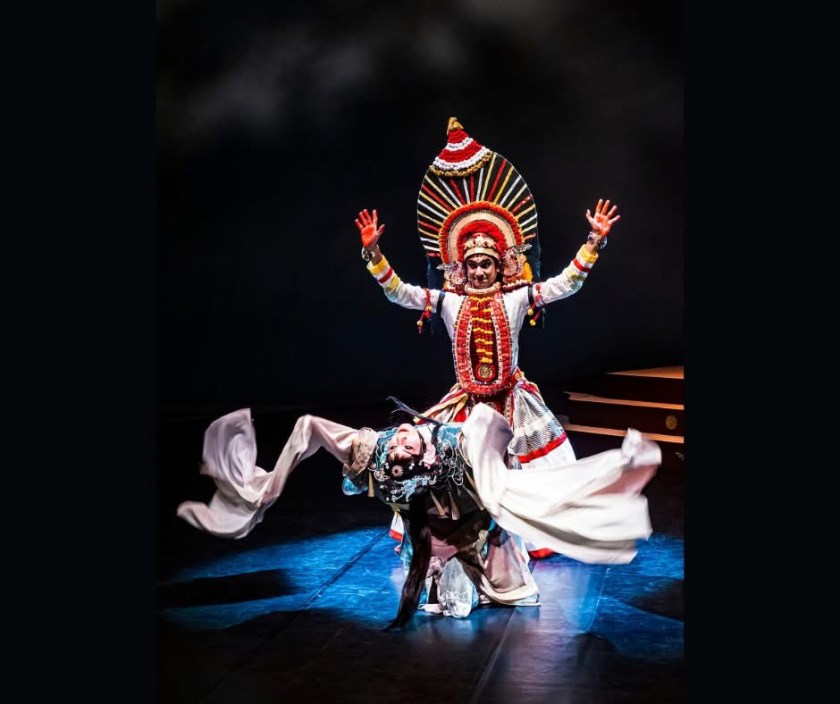
Image credit: A scene from Karna by Shao-Wei Chen. Source: EX-Theatre Asia.
In the early 2000s, Pei-Ann Lin and Chongtham Jayanta Meetei envisioned a theatre company that truly represents the diverse theatrical and performance traditions of Asia. Fresh off the Singapore Intercultural Theatre Institute (ITI), their training in multi- and intercultural Asian theatre merged with previous journeys in their respective regional traditions, they co-founded EX-Theatre Asia in Miaoli County, Taiwan, in 2006. Today, EX-Theatre stands tall with a vast repertoire of plays performed worldwide. Its distinct characteristics include a blending of tradition and innovation through a diverse array of Asian performance traditions, as well as its syncretic methodology, called ‘Theatre of Essence’, which draws from multiple cultural philosophies and practices.

Listed as one of the thirty-two outstanding theatre groups according to Taiwan Top under Taiwan’s National Culture and Arts Foundation, EX-Theatre has gained a distinct position as an established intercultural Asian theatre hub within Taiwan and beyond. In this endeavour, EX-Theatre holds several promises for globalising Taiwanese and Asian soft power worldwide, as demonstrated by its impact since 2006. The Center for Taiwan Studies at the University of California, Santa Barbara, looks forward to celebrating the twentieth anniversary of EX-Theatre Asia next year. The latter’s journey in mapping Taiwan in the world of theatre and performance coincides with the Center’s history and mission of promoting Taiwanese culture both regionally and globally. As members of the Center, we engage with Taiwanese culture and theatre, laying the groundwork for a broader conversation on Global Asia and beyond. This article serves as an example of such an engagement, and it also illustrates how the Center draws inspiration from various fields of study and plans our events.
Founded by Pei-Ann, who hails from Miaoli, Taiwan, along with Meetei, from Manipur at the India-Myanmar border, EX-Theatre’s journey can be aptly called an Asia-in-the-making through the various creative blends and aesthetic experimentations. As a veritable intercultural theatre, it incorporates Western realist traditions, Rasa theory from classical Indian theatre, Nanguan Chinese opera, and elements from Jayanta’s own Meitei/Manipuri traditions, such as thang-ta (martial arts), among others. The prefix ‘EX’ stands for a list of meanings such as ‘experiment,’ ‘exchange,’ ‘explore,’ etc., while “Asia” signifies a “geographical source of rich physical language and contextual metaphor.” In the words of the Taiwanese cultural critic, Tsu-Chung Su, driven by “dynamic exchanges, appropriations, hybridity, and syncretism. EX-Theatre has become a training and experimental ground for budding theatre talents of Taiwan.”
EX-Theatre Asia, as a hub of intercultural theatrical syncretism, pushes us to rethink globalisation and transnationalism that de-centres the West. In an era where global political orders are shifting and globalisation is already widely accepted as a multi-polar phenomenon, EX-theatre merits special attention. However, Taiwan’s geopolitical interests have long been a topic of debate in both the West and the East; its growing and novel influence in the arts and culture sphere warrants further discussion. Herein, EX-Theatre Asia emerges not just as a critical case study, but a site of creative experimentation and new theoretical-methodological analytique. As the world looks toward the East, and the rest of Asia looks up to Taiwan for both soft and hard infrastructure, EX-Theatre Asia’s story deserves our undivided attention. I will explain this concisely in a few key points (not an exhaustive or definitive list).
EX-Theatre’s story wouldn’t be complete without acknowledging the places the co-founders come from. Both Miaoli in Taiwan and Manipur, located on the India-Myanmar border, are relatively unknown places within their own territories. Particularly noteworthy is Meetei’s journey of initially training in the Manipuri theatre and then transitioning to the mainland Indian Sanskrit theatre. Meetei’s and Pei-Ann’s training in intercultural theatre in Singapore, following their mastery of their own regional, yet diverse, and Western traditions in the early 2000s, has given rise to this profound cross-regional and cross-cultural collaboration. Meetei simply didn’t decide to settle in Miaoli; rather, he brought all the decades of training in various theatre and performance traditions to collaboratively found EX-Theatre Asia with Pei-Ann. This real-life couple and theatre personalities make their marriage worth a thousand reasons.

What follows is the exchange, exploration, and experiment — the ‘EX’ — that make up what EX-Theatre Asia is today in its nearly twenty years’ journey. From incorporating multiple perspectives and methods into training to creating bilingual adaptations of classic plays and literary works, the company has a long list of innovations to its name. This is exemplified by one of the recent magnum opus, Karna, which is based on the anti-hero of the Mahabharata, the world’s longest epic. The play incorporates multiple performance traditions, such as thang-ta (Meitei martial art), Chinese opera, and mainland Indian dance dramas, as well as Sanskrit dramaturgy, which is an unusual yet harmonious blend of diverse performance traditions and innovations.
While cultural, ethnic, religious, and national boundaries are being increasingly entrenched in today’s precarious world, EX-Theatre’s significance is multifaceted with far-reaching impacts. While cultural globalisation is often marked as a flow from the West to the East, recent phenomena like the Hallyu are often deemed alternative or Asian modernity. EX-Theatre’s exchange and experimentation traverse multiple temporalities and spaces, which a linear or vertical model of culture and knowledge flow cannot explain. To categorise the entire oeuvre of EX-Theatre along axes of regions and origins may prove futile, as the multiple layers of syncretic experimentation and innovation over the last two decades have given rise to a unique grammar and philosophy of an intercultural Asian theatre. In doing so, it further redefines what ‘Asia’ means beyond the dominant framework of Inter-, Intra-, and Global Asias.
As EX-Theatre Asia completes its twentieth anniversary in 2026, the UCSB Center for Taiwan Studies will soon begin preparations to host the former and deliberate on EX-Theatre’s role in Taiwan Studies through various disciplinary approaches. A range of events, including masterclasses, workshops, and possibly a performance (subject to budget and logistics), is in the pipeline, with expressions of interest from other departments at UC Santa Barbara. While the Center continues to explore multiple facets of Taiwan in a relational world, stories such as that of EX-Theatre Asia stand out. From its humble beginnings to the magnitude of its theatrical innovations, revitalising performance and philosophy worldwide from Taiwan, the theory and practice of EX-Theatre Asia can rightly relay Taiwan’s distinct and multitudinous cultural boom.
Maisnam Arnapal is a PhD candidate in Feminist Studies with a Global Studies emphasis at the University of California, Santa Barbara. He belongs to the Meitei community of Manipur, a transnational Indigenous group with a presence across India, Myanmar, and Bangladesh. His research engages queer/trans (Asian) studies, peace and conflict studies, and Indigenous studies, with a particular focus on the far eastern borderlands of India.
This article was published as part of a special issue on ‘Cultures and Conversations: Taiwan Studies at UC Santa Barbara‘.
 Taiwan Insight