
Written by Chit Wai John MOK.
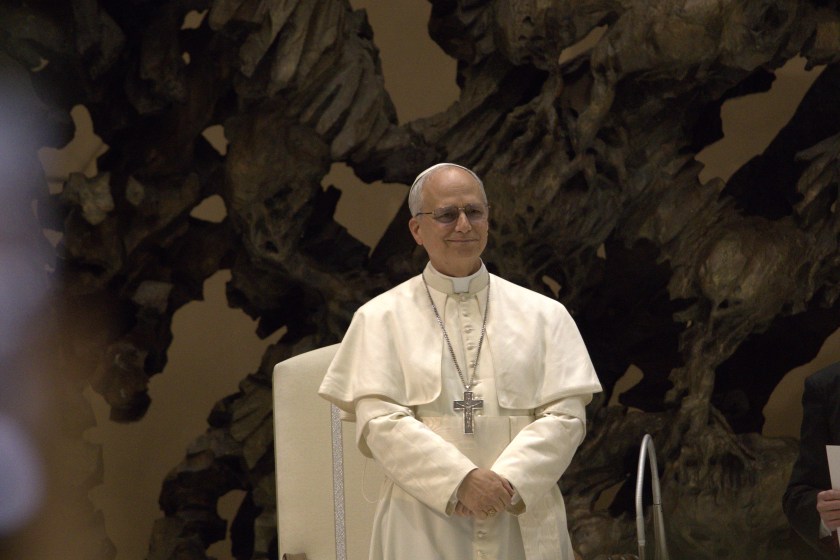
Image credit: Pope Leo XIV 3.png by Edgar Beltrán, The Pillar/ Wikimedia Commons, license: CC BY-SA 4.0.
On 8 May 2025, Cardinal Robert Francis Prevost was elected the 267th Roman Pontiff of the Roman Catholic Church. Taking the name Leo XIV, the new Pope paid tribute to Leo XIII, the Pope who wrote the encyclical Rerum Novarum and established the tradition of social teaching in the modern history of the Church. Leo vowed to follow the path of Pope Francis in defending human dignity and pursuing synodality. Yet, he also demonstrated his taste for preserving certain traditions. The Chinese-speaking world is rightly concerned with how Sino-Vatican and Taiwan-Vatican relations will evolve under the new Pope. I will argue that as a canonist with a missionary zeal, Leo is more likely to make his chess moves with caution than to stir the waters.
Leo has already made clear his determination to continue and extend the somewhat controversial path of synodality established by his predecessor, Francis. However, he also made several significant gestures that were praised by the more conservative (or even traditionalist) factions in the Church. For instance, just days after his election, Leo replaced Archbishop Vincenzo Paglia with Cardinal Baldassare Reina as the grand chancellor of the Pontifical John Paul II Theological Institute for Marriage and Family Sciences. Archbishop Paglia was heavily criticised for muddling doctrines concerning contested issues such as assisted suicide. In another symbolic move, Leo appointed Cardinal Robert Sarah, a vocal critic of Francis and a traditionalist liturgist, as his special envoy to France. Yet, the new Pope has yet to make his stance on China clearly known.
There are two facts that we know. First, Leo had been to China. In an interview given after the conclave, Cardinal Stephen Chow SJ, the Bishop of Hong Kong, revealed that Leo once travelled to China and was therefore “not completely ignorant” of the situation there. We do not know in what capacity Leo made the trip. However, as he was once the Prior General of the Order of Saint Augustine, the leader who oversaw the order’s chapters worldwide, it would be safe to guess that he was in China to visit his fellow Augustinians. As reported by AsiaNews, Augustinians have long had a presence in the Province of Hunan. Both Bishops Michael Yang Gaojian and James Li Shu-ren were Augustinian friars. Additionally, according to the website of the Congregation of the Augustinian Missionaries Sisters, they currently have four Chinese sisters in China.
Second, Cardinal Prevost was the Prefect of the Holy See’s Dicastery for Bishops from 2023 until he was elected Pope. He had been a member of the same Dicastery since 2020. The Dicastery is primarily responsible for handling “all matters concerning the appointment of diocesan and titular Bishops, Apostolic Administrators and, in general, the provision of the particular Churches.” We can hence safely argue that Leo has extensive knowledge of bishop appointments worldwide. This experience would undoubtedly assist him in dealing with Beijing, as the bishop appointment is a core issue concerning Sino-Vatican relations.
Despite the above two facts, one should not assume that Leo is very familiar with the Church in China. The heads of consecrated orders often travel around the world to visit local chapters and fellow members. These visits do not necessarily make them experts on local situations. As a matter of fact, Fr. Prevost has travelled to other Asian countries as Prior General, such as the Philippines, Indonesia, India, and Japan. Such international exposure is certainly an asset when it comes to governing the global Church. However, tackling the problems faced by the Church in China requires much more than one or two previous trips.
A commentator from Hong Kong argued that as Cardinal Prevost was the head of the Dicastery for Bishops, he must have been involved in the negotiations between the Holy See and Beijing, and would therefore completely agree with Francis’ approach. This ground for such speculation is shaky. Most observers of Sino-Vatican relations know very well that, as China is still regarded as under missionary jurisdiction, its bishop appointment is governed by the Dicastery for Evangelisation (formerly the Congregation for the Evangelisation of Peoples), not the Dicastery for Bishops. On the other hand, the formulation and signing of the Provisional Agreement on Bishop Appointment between the Holy See and Beijing in 2018, as well as the related negotiations, were led by the Holy See’s Secretariat of State. While the agreement focused on establishing a model of bishop appointment in China, it is very unlikely that Cardinal Prevost had direct involvement in the negotiation process and the reviewing of the agreement.
It is still too early to predict what Leo’s China policy would look like. On 11 June, Bishop Joseph Lin Yuntuan took possession of the episcopal office as auxiliary bishop of Fuzhou. The Holy See announced that Leo appointed Bishop Lin on 5June under “the framework of the dialogue regarding the application of the Provisional Agreement between the Holy See and the People’s Republic of China.” (It is worth noting, however, that the Holy See’s communique clarified that Lin was ordained a bishop in 2017, i.e. before the signing of the agreement.) This move demonstrates that, at least during this transition period, Leo is willing to abide by the existing framework laid down by the agreement.
Moreover, how Leo handles two pressing issues will further signal his overall direction. The first is the appointment of the new Secretary of State, who is primarily responsible for the Holy See’s diplomatic and political activity. Pope Francis appointed Cardinal Pietro Parolin as the Secretary of State seven months after his election. This appointment set the tone of Francis’s diplomacy throughout his papacy. Indeed, Cardinal Parolin was the mastermind behind the abovementioned agreement with Beijing. In addition, the removal of Archbishop Savio Hon Tai-fai, a hardliner towards Beijing, as secretary of the Congregation for the Evangelisation of Peoples in 2017 further indicated Francis’ willingness to court Beijing. If Leo keeps Parolin as his Secretary of State, then we can expect that future Sino-Vatican negotiations will continue, or even accelerate, under the extant framework. If Parolin is replaced, then we should expect changes.
During the period of sede vacante two months ago, the Chinese authorities held two “elections” as scheduled. Fr. Wu Jianlin and Fr. Li Jianlin were “elected” auxiliary bishops of Shanghai and Xinxiang, respectively. That the Chinese government carried out the “elections” as planned despite the passing away of Francis demonstrated how Beijing was determined to uphold the principle of “independence and self-administration” (獨立自辦) of the Church. Leo has yet to decide the fate of the two Chinese clerics. Leo is unlikely to announce an outright rejection of the “elections.” Instead, he would probably either recognise the two bishops under the framework established by the agreement, or delay in giving a clear indication until he has concretised his own China policy.
Maintaining diplomatic relations with the Holy See under Leo is likely to be a major concern for Taipei. There have always been claims that the Holy See will soon establish full diplomatic relations with Beijing (中梵建交) and sever ties with Taipei (臺梵斷交). In 1999, Cardinal Angelo Sodano, the then Secretary of State, said that the Holy See was ready to move its nunciature from Taipei to Beijing overnight. A lot has changed since then. At this point, it should be clear that under Francis’ papacy, diplomatic relations were far from the top priority in the negotiations between the Holy See and Beijing. The signing of the provisional agreement and its subsequent renewals show that Beijing was willing to set aside sensitive diplomatic issues and focus on the bishop appointment. There is little reason to believe that Leo would want to stir the waters and prioritise formalising diplomatic relations. Cutting ties with Taipei will inevitably provoke international outcry — a price not worth paying for. Cardinal Parolin had on several occasions mentioned the possibility of setting up a permanent office in China. But even that proposal fell short of establishing formal diplomatic ties.
Leo is a member of the Order of Saint Augustine, a long-time missionary, and a canonist who specialises in the Church’s canon law. His missionary experiences in Latin America allow him to share Francis’s zeal in spreading the faith to the periphery and promoting social justice. He certainly has the desire to further connect the Church in China with the universal Church. His expertise in canon law, however, will likely drive him to seek greater clarity in complex situations, reduce ambiguities, and put the brakes when necessary. Community is at the core of the Augustinian charism. Leo may therefore prefer well-informed collegial decision-making to adventurous attempts. For the Churches in China and Taiwan, Leo is perhaps the right shepherd for this moment.
Chit Wai John MOK is a research assistant professor at the Department of Applied Social Sciences, the Hong Kong Polytechnic University. He specialises in the studies of the Catholic Church in China and Sino-Vatican relations.
 Taiwan Insight
