
Written by Dr. Zsuzsa Anna Ferenczy.
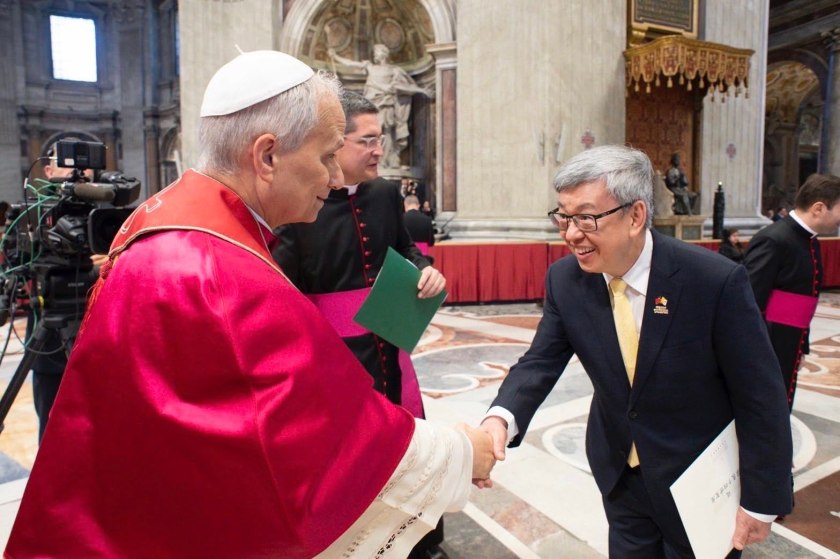
Image credit: 陳建仁 Chen Chien-Jen/ Facebook.
In recent years, Taiwan’s international profile as a robust democracy and technologically advanced economy has increased. The European Union (EU) and Taiwan have seen an unprecedented momentum in mutual awareness. They see each other as reliable partners and are deepening ties with concrete cooperation. While the Holy See remains Taiwan’s sole formal diplomatic ally in Europe, its ties have seen less momentum. On the contrary, they have come to be defined by the Vatican’s reluctance, due to its balancing between formal commitment to Taiwan and pressure from Beijing, as well as its interest in China’s estimated 12 million Catholics.
This May, Taiwan’s President Lai Ching-te did not attend Pope Leo XIV’s inauguration, but Former Vice President Chen Chien-jen did. Nor did Lai attend Pope Francis’ funeral in April. Instead of trying to decode the Vatican, it is more practical to consider the big picture and focus on what, or rather who, has real weight to help expand Taiwan’s international space, even without official diplomatic relations. Therefore, the question to ask is not how Taiwan can keep the Vatican close, but how it can bring Europe closer?
Capitalising on the momentum in informal partnerships with European countries has paid off, and the EU has elevated Taiwan on its agenda. Yet, this won’t last unless both sides go beyond symbolism. Taiwan must be more pragmatic; stay focused on bringing substance to its ties with European partners and cooperate with the Holy See wherever this helps boost its global profile and fosters global peace. This should include pursuing shared humanitarian objectives, but also human-centric artificial intelligence (AI), an area that Pope Leo XIV himself identified as a priority and a “main challenge for humanity”. These priorities align naturally with Taiwan’s identity.
A Papal Rebuff
The inauguration ceremony of Pope Leo XIV as the new leader of the Catholic Church was held on May 18 at the Vatican. Taiwan’s President Lai Ching-te appointed Former Vice President Chen Chien-jen as the Presidential Envoy to represent Taiwan at the inauguration ceremony. Reportedly, weeks of lobbying by Taipei for Lai to attend Leo’s papal installation were unsuccessful. “We look forward to building on our diplomatic ties with the Holy See, 83 years strong, to advance peace, justice, solidarity and benevolence,” Lai wrote on X.
According to a press release of Taiwan’s Ministry of Foreign Affairs, Former Vice President Chen has a close relationship with the Vatican. Still, the decision to send a presidential envoy, rather than the president himself, raised questions about the state and value of Taiwan-Vatican diplomatic relations. Although it hasn’t been officially confirmed, the China factor had a lot to do with the papal rebuff.
Weeks earlier, following Pope Francis’ passing on April 21, the same was believed to hinder Taiwan’s president from attending his funeral on April 26. Some noted, the decision not to allow the president to attend the inaugural ceremony was driven by the Vatican’s reluctance to annoy Beijing. Others said the Vatican is probably afraid of a backlash from China. Yet others emphasised that Taiwan must accept that the Holy See doesn’t care about its sovereignty.
The Holy See and Beijing – Where is the Trust?
The Vatican forged official diplomatic relations with Taiwan in 1966 and has had no formal ties with the PRC since then. Relations with the latter have been infused with suspicion and distrust due to a core dispute over who has the authority to select and ordain bishops in China. Yet, the Vatican has been keen on reinvigorating ties with the PRC since Beijing broke them in 1951. Pope Francis was reportedly driven by a desire to see détente, which finally arrived in 2018, when they signed an agreement on the selection of bishops of a united Catholic Church in China. According to the deal, China would propose candidates for bishops, and, holding veto power, the pope would select them.
The Vatican hoped the agreement would lead to the gradual merger of the Underground Catholic Church, which is loyal to the Vatican, into the state-supervised Chinese Patriotic Catholic Association (CPA). At the time, the Vatican press release noted the agreement was the fruit of a gradual and reciprocal rapprochement. According to experts, the Vatican has for long cultivated the dream “to establish a regular presence in China through stable diplomatic ties”. Establishing official relations would also mean the Holy See abandoning Taiwan, a diplomatic victory for Beijing.
Critics of the agreement have feared it would leave the clergy vulnerable to state pressure at a time of heightened religious oppression under Xi Jinping. Members of the Underground Church have been systematically persecuted, and several of their bishops died in prison. Replacing the Ten Commandments with Xi’s speeches in churches has been a frequent occurrence in Henan province and beyond. Underground Church leaders said the government wants them to “preach in a Communist way”.
In October 2024, following three renewals of the agreement, Vatican News reported the agreement opened a “historic chapter” in bilateral relations, “allowing all bishops to be in full hierarchical communion with the Pope”. By renewing a secretive deal with Beijing, however, the Holy See was “effectively endorsing the Chinese government’s perversion of religions and is dangerously close to being complicit in the country’s deepening rights abuses”, others warned.
In reality, in November 2022 and April 2023, China appointed two bishops without the knowledge or approval of the Vatican. In response, the Vatican accused China of violating the agreement. Still, the two sides renewed the agreement, signalling Beijing’s resolve to manage the catholic church in China independently of the Vatican, and the Vatican’s willingness to keep trying, despite Beijing repeatedly challenging its trust.
More recently, it was reported that on April 28 2025, days after Pope Francis’ passing, Father Wu Jianlin was confirmed as auxiliary bishop in the Diocese of Shanghai, and officials in the Diocese of Xinxiang in Henan province chose Father Li Janlin for the same role. Both selections were made through a state-managed process involving only a single candidate, without Rome’s approval, which goes against the agreement. The appointments occurred during a sede vacante, a period when the Apostolic See is vacant following the death of Pope Francis, a time when the Holy See is unable to ratify episcopal nominations.
Taiwan and Europe, Partners in Peace
Since 2016, Taiwan has aligned itself with like-minded democracies and joined global efforts to tackle global challenges. By urging dialogue and rejecting coercion across the Taiwan Strait, Taiwan has contributed to upholding peace and stability in the Indo-Pacific. By coordinating with EU member states and the EU as a whole, Taiwan’s government and society have helped counter the pandemic and withstand Russian aggression.
The support during the pandemic laid the groundwork for the help extended following Russia’s aggression. The Taiwanese government signed up to international sanctions against Russia and has encouraged expanding cooperation in asymmetric warfare with European partners, particularly in the unmanned aerial vehicle industry. Drones are considered key to Taiwan’s national security, just as they have been vital for Ukraine’s resistance.
Taiwan knows it has lessons to absorb from Ukraine, and is investing in its ability to counter China’s grey zone warfare with asymmetric capabilities, or large numbers of small, dispersed, mobile and lethal weapons. The government is focusing on building a domestic drone manufacturing industry, including drones equipped with AI and machine learning abilities. Cooperation in the drone industry, including joint product development, has been signed with France, Lithuania, Latvia, Poland, Czech Republic.
Most recently, Taiwan sealed a partnership deal with US and German-based Auterion for drone software battle-tested in Ukraine, which could eventually lead to technology being used in drones for Taiwan. Such business-to-business cooperation is providing real substance to EU-Taiwan relations. This is the support Taiwan truly needs. It is therefore important that the government invests in efforts that empower EU member states and companies to get a better understanding of Taiwan’s technical capabilities and help promote its products in Europe.
These collaborations have emerged just as the EU’s relations with China have deteriorated. Beijing used the pandemic to promote an alternative governance model, which damaged its image. Yet, while European governments have grown more sceptical, Chinese firms continue to invest in Europe, and some are scaling up. With a transactional White House, Europe could become more conciliatory towards Beijing. This may impact EU-Taiwan relations, hence the urgency to consolidate them now.
Nonetheless, China’s support for Russia damaged its standing in Europe. Beijing has been Moscow’s most significant backer, with Chinese companies providing dual-use components. Beijing has denied supplying drones to Russia, but experts stressed Russia’s critical dependency on the supply of Chinese spare parts for both tactical and long-range drones. By positioning itself as a lifeline to its economy, Beijing has secured Russia as a stable strategic partner to support its strategy to take Taiwan and build an anti-Western world safe for authoritarian leaders.
Taiwan is Isolated. Or Is It?
Since 2016, Taiwan has improved its visibility across Europe. During the same period, ten nations have ended their diplomatic relations with Taiwan and switched recognition from the Republic of China (ROC, Taiwan) to the PRC. Meanwhile, the PRC has reemerged as an economic superpower with a world-class military, seeking to regain centrality over global governance. This strategy will, however, be incomplete without Taiwan. Peeling the Vatican away from Taiwan is in Beijing’s national interest.
Following Pope Francis’ passing, the Chinese Foreign Ministry expressed its condolences, adding that the 2018 agreement has been “implemented smoothly”. In the future, the Vatican should expect similar claims that may clash with the reality on the ground. How the Vatican will manage appointments made without Rome remains an open question. How Taiwan will navigate ties with the Holy See remains to be seen. Yet, Taiwan must be pragmatic and focus on areas and partners that matter most for its own future.
It must cement cooperation with Europe, so that it can rely on partnerships built on transparency that offer predictability, and work with the Vatican on shared goals. Reaffirming the importance of peace remains a shared commitment. Pope Leo XIV identified AI as the main challenge for humanity and insisted that AI remain human-centric so that decisions about when to use weapons remain made by humans, not machines. As Taiwan is positioning itself as the driver of efforts to build a secure, values-driven alliance for AI, priorities visibly overlap.
EU-Taiwan joint cooperation to stand with Ukraine sent a message to Beijing that Europe and Taiwan matter to each other as partners in peace. These considerations should guide Taiwan in navigating ties with the Vatican and in bringing Europe closer.
Dr. Zsuzsa Anna FERENCZY is Affiliated Scholar at the Department of Political Science of the Free University of Brussels, Research Fellow at ISDP Stockholm and Fellow at Agora Strategy in Münich. Based in Taiwan since 2020, Zsuzsa is an Assistant Professor at the National Dong Hwa University in Hualien. Between 2008 and 2020, Zsuzsa worked as a political advisor in the European Parliament. Her latest book, “Partners in Peace. Why Europe and Taiwan Matter to Each Other” was published in October 2024.
 Taiwan Insight