
Written by Ritika Passi.
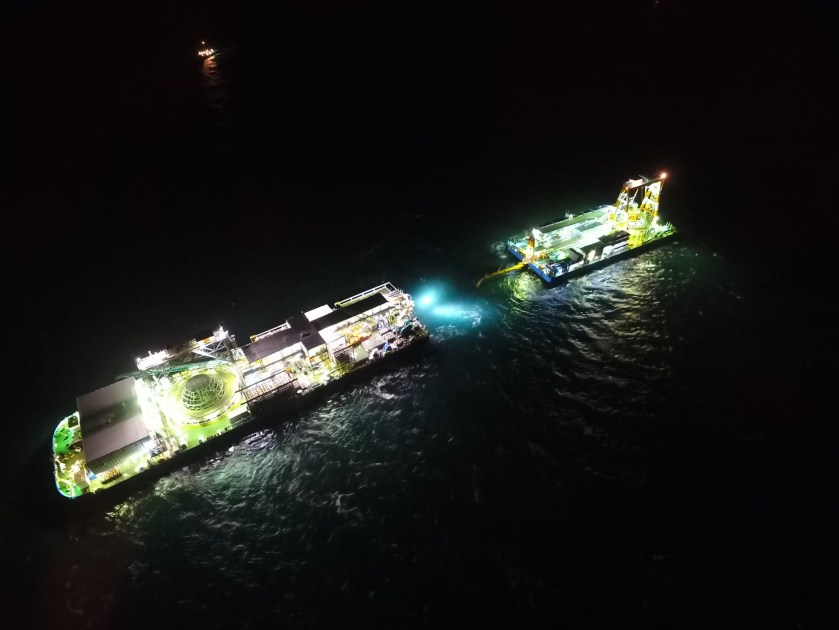
Image credit: 臺澎海底電纜 by 台灣電力股份有限公司. / Wikimedia, license: Government Website Open Information Announcement.
The 2025 India-Pakistan crisis is the latest test case of the new parameters of conflict, from an increasing dependency on drones to the use of narrative warfare. Critically, India’s suspension of the Indus Water Treaty – which continues even after the end of kinetic action – is indicative of another emerging feature – weaponisation of economic chokepoints.
Beyond lessons for military preparedness and cognitive warfare, this last is of particular relevance to Taiwan – raising considerations of Taiwan’s own chokepoints and reinforcing concerns of economic security and resilience, a conversation all the more germane in today’s era of geoeconomic warfare. Two chokepoints are worth assessing: the Taiwan Strait and subsea cables.
Understanding Chokepoints
A chokepoint is a bottleneck. Consider them as fault lines ripe for exacting leverage, or pressure points that engender vulnerability.
Traditionally geographic in nature – narrow passages such as straits, canals, mountain passes – that allow for military disruption and control, they today include a wider set of critical economic infrastructure and logistics – commercial, financial, digital, technological. If blocked or controlled, they can profoundly impact the movement of resources, goods, services, and information. Dependencies allow for their weaponisation for political, economic, or security outcomes.
Water: Chokepoint in spotlight in the India-Pakistan conflict
New Delhi suspended the Indus Water Treaty (IWT) – a water-sharing agreement that governs the water usage of 6 major tributaries between India and Pakistan – as part of its retaliation for the Pahalgam terrorist attack. It heralds mounting frustration and a shift in its approach: by equating “blood and water”, it hopes to raise the costs of Pakistani inaction on terrorism. But it is also an attempt to exploit what can be considered a chokepoint for Pakistan – as a lower riparian state, 80% of river water in Pakistan passes through or originates in India.
Pakistan is a highly water-stressed country and is in a fragile economic condition. The Indus is a lifeline. Nine in every 10 Pakistanis live within the Indus basin. Its three western tributaries water more than 90% of the nation’s crops: agriculture accounts for 22.9% of its GDP and 24.4% of Pakistan’s exports, sustains over two-thirds of its rural population, and employs 37.4% of its labour force. The Indus basin is the source of one-fifth of the country’s electricity from hydropower, and the rivers provide drinking water to its major cities. Pakistan’s minimal storage capacity (only 10%) and few alternative water sources effectively make it dependent on India’s control upstream.
How much of a cost is India’s decision bringing to bear on Pakistan? A month after the treaty’s suspension, satellite imagery and flow data revealed that India had intensified dam flushing operations – previously objected to by Pakistan – which have caused fluctuating water flows into the downstream neighbour. While a short-term irritation, the fact that India has stopped sharing notifications of maintenance or water data could hamper Pakistan’s water management. A true test will emerge if India deprives Pakistan of any flood warnings. Two months since, and a news report cites a 20% drop in river water flow in Pakistan, as compared to the previous year, affecting the ongoing summer crop planting period in Pakistan. The monsoons, however, are expected to rectify this drop.
A sober analysis of the topography and the current state of India’s upstream infrastructure reveals limited on-ground effectiveness of India’s open intent to weaponise water and imperil Pakistan’s economic security in both the short and long run. Whether Indian steps to optimise use of Indus basin waters, and alongside restrict water flowing into Pakistan – by expediting hydropower projects, expanding canal network, building diversion structures, and improving existing reservoirs, in the face of any Pakistani steps to increase its own storage capacity – achieve India’s objective of making Pakistan stop cross-border terrorism, in a timely, credible fashion, is up for debate. But a former Indian High Commissioner to Pakistan calls India’s decision “the most powerful sanction” and “very powerful political and strategic message”, underscoring how Pakistan’s identity as a lower riparian to an adversarial country “weighs far more in Pakistan’s strategic mind than [those] in India understand”. And indeed, reactions from Pakistan indicate rising water panic – from initially declaring India’s decisions as an act of war to sending multiple missives to India to reconsider its decision. As one Pakistani senator said back in May, “This is like a water bomb hanging over us and we must defuse it”.
Taiwan’s Chokepoints
Taiwan’s existential struggle is different from the bilateral territorial conflict between the two sovereign South Asian countries. And it is already on the receiving end of China’s economic coercion and broader grey zone tactics.
But bringing the lens of chokepoints bears merit. Taiwan, the Taiwan Strait, and its semiconductor industry are all recognised as critical to the world’s economy – and thus chokepoints in their own right. But what bottlenecks can China disrupt – to punish Taiwan’s economy, to gain leverage, to change the status quo? And how feasible and effective would they be? Two dependencies/vulnerabilities stand out: one traditional and one modern.
Geography as Chokepoint
The Taiwan Strait is a classic embodiment of a chokepoint. It is a maritime corridor vital for global trade, accounting for over $2.45 trillion worth of goods – one-fifth of global trade – in 2022. And it is an indispensable artery for Taiwan’s economy, which has no other significant alternative supply chain route. Case in point: Taiwan’s ports handled $586 billion worth of trade in 2022, including transshipments.
Nearly all of Taiwan’s imports and exports – finished goods as well as raw materials, components, and industrial machinery – are shipped through this waterway, underlining Taiwan’s heavy reliance on free passage. Indeed, the island is far more dependent on trade than most other leading economies – as per CSIS, its exports account for about 70% of its GDP (just its semiconductor production accounts for around 15%). As a comparison, exports account for about 8% of US GDP and 20% of China’s GDP. On the other end, Taiwan imports 98% of its energy needs, with almost all coal, petroleum, and natural gas imported by sea. It also imports about 70% of its food.
The costs – in the event of a Chinese blockade, or a full invasion – for Taiwan are clear. Trade paralysis, impact on all industrial and consumer sectors, stranding of essential imports leading to shortages and food and energy insecurity: in short, an imperilled economy. As per one estimate, a blockade could cost Taiwan a 12% loss to its economy in the first year; another pegs the contraction closer to a staggering 40%.
However, the fact that the Taiwan Strait is a global chokepoint raises the costs of any disruptions – first and foremost for China itself. One: a staggering $1.4 trillion worth of Chinese trade passed through the strait in 2022 – far more than any other country. Interestingly, over half of all trips were from one Chinese port to another, indicating the significance of the strait for domestic supply chains within China. Two: China remains Taiwan’s largest trading partner. Recent export controls and China’s indigenous efforts notwithstanding, about a third of Taiwan’s chip output makes its way to China and Hong Kong. China’s role as the world’s largest exporter of ICT goods and automotive products would be jeopardised without Taiwan’s chips, not to mention a broader impact on industry and competitiveness. Three: to say nothing of knock-on and cascading costs – from loss of trade finance to international sanctions.
Of course, this only makes grey zone tactics more appealing, from quarantines to cyber attacks on maritime infrastructure. In fact, Taiwan’s National Security Bureau clocked a doubling of Chinese cyberattacks in 2024 for the year prior: these included efforts to infiltrate and compromise Taiwan’s ports.
Digital Critical Infrastructure as Chokepoint
Subsea cables are a 21st-century chokepoint. They are the lifelines of modern economies, carrying more than 95% of the world’s internet data traffic. As a highly industrialised, export-driven island economy, all of Taiwan’s business sectors – from trade and finance, entertainment and manufacturing to education, research and healthcare, and of course, semiconductors – rely fundamentally on the uninterrupted operation of these information superhighways. What is more, Google runs one of its only three data centres in Asia in Changhua, and Amazon Web Services has recently launched a cloud region in Taiwan. And this is to say nothing of the national security needs fulfilled by these cables, like military communication and ISR capabilities.
In short: “Taiwan, for its own sake just as for the world’s, must be kept online.”
Taiwan is connected to the world through 14 international and 10 domestic subsea cables. These are routed through areas near the island’s territorial waters, forming a concentrated, easily targetable area. Furthermore, airborne or satellite alternatives cannot, at present, match the capacity, quality, or stability of fibre-optic cables lying on the seafloor, thus making the cables collectively a potential single point of failure. Adding to Taiwan’s vulnerability is the fact that it depends on foreign cable repair ships, which can stretch for weeks.
Recent instances have raised the spectre of Chinese interference. In February 2023, Chinese maritime vessels severed two undersea cables serving Taiwan’s Matsu Island. Internet access was cut off for weeks as repairs took 50 days and cost $2.9 million. No evidence was found of deliberate sabotage, but it was odd that these cuts happened within one week. In January of this year, a vessel severed the Trans Pacific Express cable: what followed was a hunt to find a vessel using three digital identities. And in February, a Togolese-flagged vessel was found to have been deliberately drifting near the cable it damaged. In a first instance, the Chinese captain was convicted.
Even as Taiwan begins to take initial steps – increased maritime surveillance, expansion into satellite internet and expanding international partnerships – more can be done to strengthen the resilience of this digital chokepoint. China denies any involvement and calls such instances routine maritime accidents. But consider instances of research vessels, survey ships, and Chinese-flagged vessels loitering near key cable locations. Consider the fact that recent Chinese research and patented technologies include tools to locate breaks, better repair cables – but which could also be used to disrupt cables in the first place. Or that earlier in March, China openly unveiled a deep-sea cable-cutting device created for civilian salvage and deep-sea mining – but also capable of piercing through steel, rubber, and polymer sheaths that make up subsea cables.
No wonder there are fears that submarine cable disruptions could be “dry runs” for a digital blockade of Taiwan.
Ritika Passi is a geoeconomic analyst focusing on trade, technology, and connectivity. She was a MoFA Taiwan Fellow in 2024.
This article was published as part of a special issue on ‘India-Pakistan Conflict: Strategic Insights for Taiwan‘.
 Taiwan Insight