
Written by Raian Hossain & Ping-An Wei.
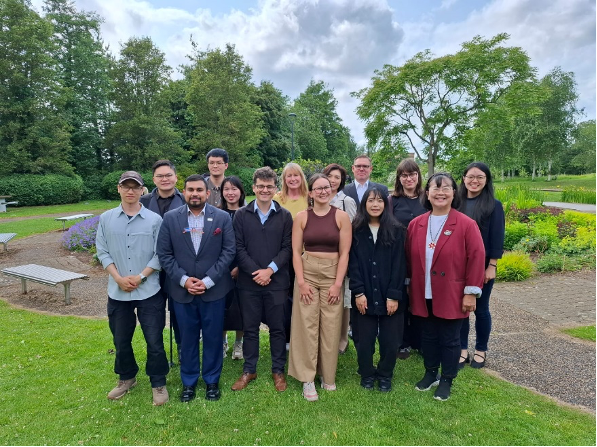
Image credit: Group photo at Millennium Garden of the University of Nottingham. Photo courtesy of the authors.
The first edition of the Early Career Scholars workshop on Taiwan Studies, organised by the Taiwan Research Hub (TRH) of the University of Nottingham (UoN), was held on 4th June 2025. The workshop was organised under the leadership of two early-career scholars (Raian Hossain and Ping-An Wei) affiliated with the TRH of UoN. This day-long workshop brought together master’s students, PhD candidates and post-docs across different universities in the United Kingdom and Europe. Presenters came from a range of institutions, including the University of Oxford, Leiden University, UoN, University of Portsmouth, The School of Oriental and African Studies (SOAS), University of Glasgow and Cardiff University. This multidisciplinary workshop featured presenters from various fields, including Gender Studies, Foreign Policy and International Relations, Geopolitics, Political Economy, Labour and Migration Studies, Media and Cinema Studies, and Sociology. We also invited three academic advisers: Dr Ming-Yeh Rawnsley (Editor in Chief, International Journal of Taiwan Studies and Non-Resident Fellow of TRH, UoN), Professor Jeremy Taylor (Professor of Modern History, Resident Senior Fellow of TRH at UoN) and Dr Chun-Yi Lee (Associate Professor at the School of Politics and International Relations at UoN & Director of TRH) to provide their advice and insights. TRH provided partial travel funding for presenters joining from outside Nottingham (within the UK). This workshop paved the way for a fruitful and stimulating cross-disciplinary exchange of knowledge, ideas, and debates. In short, this workshop provided a unique opportunity and platform for ECSs whose research is related to Taiwan to come together under one umbrella, share their current research projects, and receive feedback and comments from peers and academic advisors.
Goal and Motivation of the Workshop
The initiative for organising the workshop correlated to the idea of establishing an Early Career Scholars Network (ECSN) under TRH. This ECSN is assumed to provide a platform, mainly led by ECSs themselves, for Master’s and PhD-level scholars from different disciplines working on any Taiwan-related projects across the UK and even the whole English-speaking world to network. With the establishment of ECSN, the next generation of scholars with similar interests can receive support to hone their skills in several aspects, including leadership, teamwork, and administration. In short, ECSN can be a skill enhancement and professional development opportunity. Networking can lead to potential collaborations on research projects, publications or interdisciplinary studies. Additionally, ECSN can increase visibility for ECSs by providing chances for presenting or publishing.
For TRH of UoN, establishing ECSN would also bring multiple benefits. Firstly, advertising symposiums or workshops will increase the visibility of TRH to academia as a whole. Besides, the creation of ECSN is expected to encourage ECSs to contribute writings for the TRH online magazine ‘Taiwan Insight’. ECSN can also help to attract promising future early career scholars (potential PhD candidates), mostly master’s students in the UK and beyond. The ECSN can further foster THR’s existing interdisciplinary research collaboration and connect future researchers from different disciplines. A strong ECSN can make TRH more competitive for grants and funding opportunities, as providers of funds often look favourably at institutions that invest in developing ECSs.
Achievements and Outcomes of the Workshop
The impetus for establishing ECSN made this workshop for early career scholars happen. The most highlighted feature of the workshop is that it was completely arranged by the leading ECSs, namely Raian and Ping-An. In this case, ECSs were granted the opportunity to decide the theme for the event, giving those who work on cutting-edge topics that may not fit into existing research topics or fields a niche for promoting their research findings and attracting more ECSs with similar interests.
The workshop for ECSs provided a platform for peer feedback, suggesting improvements and constructive criticism, which we often receive when presenting at an academic conference. The suggestions and questions from the advisers were beneficial for ECSs to brainstorm. This workshop was meticulously designed to foster professional development and interdisciplinary collaboration among ECRs of Taiwan Studies. The interdisciplinary mix allowed participants to encounter different research methodologies, theoretical frameworks, and analytical approaches that they might not encounter within their discipline. Workshop participants were seen to be very interested in learning interdisciplinary methods and theoretical approaches, particularly those not common in the area of research. Beyond formal sessions, the workshop provided ample opportunities for informal networking during coffee breaks, lunch and dinner. During the workshop, participants exchanged contact information (mainly LinkedIn profiles) for post-workshop networking. Academic advisers delivered a 15-minute informative presentation on policy-relevant research (writing policy papers), grant writing, and academic publication strategies, equipping ECSs with practical skills and strategies necessary to navigate an increasingly competitive job market and funding landscape. Additionally, the workshop provided networking opportunities among participants and academic advisers, who discussed their research interests and career aspirations.
Finally, the publication of the workshop’s proceedings in a special issue of Taiwan Insight is a positive outcome of organising such a workshop. This special issue includes four articles, respectively written by five of the participants in the workshop. Dr Elaine Chung and Dr Qipeng Gao, both of whom are lecturers in Chinese studies at Cardiff University, provide an essay about Taiwan’s soft power in terms of Mandarin promotion. Dominika Remžová, who is a PhD candidate in international relations at UoN, delves into the European automobile industry by examining the involvement of chips made in Taiwan and cars made in China. Yung Lin, who is a PhD candidate in security and global affairs at Leiden University, provides a comparative examination of bordering human security between Taiwan and the Turkish Republic of Northern Cyprus. At last, Yi-Ting Chang, who is a PhD candidate in the School of Geography and the Environment at the University of Oxford, sheds light on Taiwan’s participation in geopolitical tensions in outer space during the Cold War Era (1960s-1980s).
Next year? Why Not!
The Early Career Scholars workshop provided an opportunity for ECSs in Taiwan studies to meet in person to discuss, debate and network with their fellow peers and academic advisors. Seeing the number of applications (around thirty) and the outcome of the first edition of ECSs’ workshop was itself inspiring to us as organisers. With the high volume of applications, it proved highly challenging for the selection committee to select only nine participants for three panels. Building on the positive outcome of the first edition, it is within our responsibility to continue this initiative in the future. Building on the lessons learned from our shortcomings this year, we hope that the ECSs of TRH at UoN will be able to organise an ECS workshop again in a much larger and improved version. Because at the end of the day, today’s ECSs in Taiwan Studies are tomorrow’s academic leaders and researchers in the field. The ECSs of TRH look forward to welcoming you all to Nottingham in 2026 for the second edition of the ECS workshop. Until then, let us stay in touch with the bond we formed.
Conclusion
The first edition of the workshop for Early Career Scholars on Taiwan Studies marks a promising beginning for fostering a collaborative network. Through a carefully organised programme, the workshop successfully brought together emerging voices from different disciplines, offering an excellent platform for intellectual exchange, peer support, and skills development. The establishment of the ECSN under TRH is poised to strengthen this momentum, encouraging interdisciplinary collaboration, academic visibility, and professional growth among early-career scholars. The workshop’s achievements—from ECS-led sessions to the publication of proceedings—demonstrate its value not just as a one-off event but as a sustainable initiative. As organisers, we are deeply grateful to the Director and Administrator of TRH, Dr Chun-yi Lee and Ms Mandy Felton, whose support made this initiative possible. Being motivated by the enthusiasm and engagement of all participants, we look forward to building on this foundation and welcoming a wider cohort to the next edition in 2026.
This article was published as part of a special issue on ‘Taiwan Research Hub Early Career Scholars Workshop‘.
 Taiwan Insight