
Written by Dr Chieh-chi HSIEH.
Image credit: IMG_1691 by rafm0913/ Flickr, license: CC BY-NC-SA 4.0.
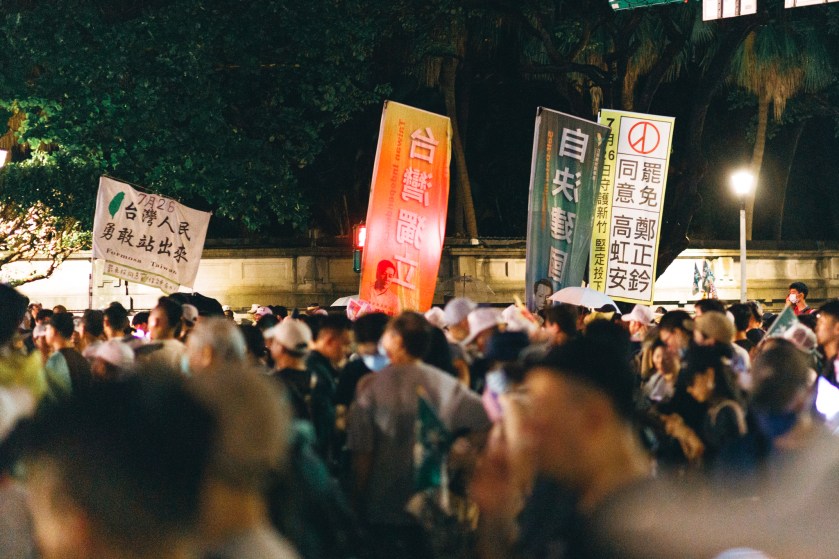
The recent recall election that took place on 26 July is arguably one of the greatest defeats the ruling Democratic Progressive Party (DPP) has suffered in recent years. With a total of 24 legislators from the leading opposition party, Kuomintang (KMT), together with Hsinchu Mayor Kai Hung-an (previously from the Taiwan People’s Party, TPP), facing potential revocation, all of them eventually succeeded in maintaining their seats. What are the political implications of the recall elections for important stakeholders in the political arena and Taiwan as a whole? This is the main question I intend to debate on in this short piece. I argue that the main winner of the recall election is the Taiwanese society, whilst actors that neither gained nor lost are the two leading opposition parties (i.e. KMT and TPP). As for the DPP and Taiwan’s current President Lai Ching-te, they are undoubtedly the main losers in this election.
KMT and the TPP: Temporal Success
With regard to the two leading opposition parties, the complete failure to recall the 24 KMT legislators in the July election provides some breathing room for the KMT as well as the TPP. For the TPP, the impact of the recall election was bound to be indirect, given that all 8 of their legislators secured their seats via the party-list proportional representation voting. The only concern for the TPP is if the results were to alternate, the TPP might lose its role as the critical minority in the Legislative Yuan. Yet, even if that had occurred, that would have required the DPP to win at least six seats in the by-election. Current TPP chairman Huang Kuo-chang has gained a substantial advantage from the July election, given that it has allowed him to consolidate his authority and power within the party. Given the opportunistic nature of TPP’s party members in its formation, we can expect to see Huang, along with others, to have more clout to advocate for their political agenda under the fag of being ‘true guardians of Taiwan’s democracy and freedom.’
Yet, the ongoing prosecution of former party chairman Ko Wen-je’s real estate corruption scandal will continue to be a hindrance for Huang and the TPP to regain yesterday’s glory, whilst the upcoming recall election this month may still threaten their critical minority role in parliament.
For the KMT, the unsuccessful attempt to recall their 24 legislators is welcomed and a long-awaited victory, especially for KMT party chairman Eric Chu. Mr Chu, with little to no charisma and political judgment, has been losing ground within the KMT and his supporters. For instance, this April, Chu made the repulsive decision to side with fellow party member Sung Chien-liang, who wore a Nazi symbol armband and made a Nazi salute during a public appearance. Additionally, the ongoing controversy concerning the KMT’s petition forgery (i.e. forging signatures of deceased people) for recalling DPP legislators is still under investigation in a number of areas (e.g. Chaiyi, Keelung and Taipei), whilst the Tainan Prosecutor’s office has already pressed charges against 11 individuals from the KMT.
In addition, Chu has also allowed TPP chairman Huang Kuo-chang to take the front seat in countering the ruling DPP whilst securing more seats in the parliament. For instance, when President Lai offered an olive branch to both the KMT and the TPP by inviting both parties’ chairmen to attend the national security briefing in June, it was the latter that first rejected and openly appealed for Mr Chu to second his decision. With Chu still serving as KMT chairman until this October, we can expect him to swiftly deplete any substantial clout he has gained from the July victory.
The Devastating backlash for the DPP and President Lai
On the other hand, the actors that suffer the most impact are the DPP and President Lai. There are three aspects to this discussion. To begin with, obviously, if the DPP did recall more than 6 KMT legislators, they would have secured a majority in the parliament. In turn, this would have enabled them to control both the executive and legislative branches. Yet the flip side is that failure to do so puts DPP in a power-deficient position for issue-framing. For instance, shortly prior to the recall election, the DPP had framed the campaign as the Taiwanese society’s way to rebuke KMT lawmakers due to their either China-friendly political positions or close and frequent interactions with the Chinese Communist Party (i.e. Fu Kun-chi). Thus, losing the recall election sends the undesirable signal internationally, especially to the US government. In the domestic political scene, the defeat indicates that the DPP not only lost the agenda-setting power in parliament, but also allowed the KMT to label the DPP as ‘problem maker,’ which is creating hatred and conflicts within Taiwan.
The second aspect is that the defeat has created a grudge between the DPP and the civic group in favour of recalling KMT legislators. When the election results were announced on the evening of 26 July, one of the movement’s opinion leaders, Mr Tsao Hsins-cheng (founder of United Microelectronics Corporation, UMC), openly stated to civil groups that ‘we should let the DPP take the steering wheel [in the August 23rd recall election]’. The statement sparked concerns that the DPP might have merely vocally supported the campaign rather than devoted their total efforts. For instance, the turnout of the recall election for KMT legislator Yeh Yuan-chih from New Taipei City showed that a total of 63,357 ballots were cast to revoke Yeh. Yet, on viewing the turnout merely of the 2024 general election, the then incumbent DPP legislator Dr Lo Chih-Cheng secured 75,841 votes, despite losing to Yeh’s 78,134 ballots. Hence, these statistics add to the suspicion that the DPP did not effectively mobilise their supporters for the recall election.
Finally, the recall election has put President Lai in an unfavourable position. For one, the failure of the July election has led to his commitment to fully support the recall election in August. Yet, unlike KMT legislators facing recall votes in July who were mostly first-comers (e.g. Yeh Yuan-chih, Tsu Chiao-hsin, Niu Hsu-ting), the August election is mostly incumbent and senior legislators (e.g. Chiang Chi-chen, Lo Ming-tsai). The odds of any success in revoking all 7 KMT legislators seem insurmountable. Another aspect is that the recently announced 20% tariff levied on Taiwan starting 7 August can be expected to further deteriorate Lai’s popularity. In fact, statistics show that Lai’s approval rate has plummeted from 44.7% to 34.6%, whereas the disapproval rate reached a new high of 56.6% from 46.8% compared to the preceding month. On this basis, discourse concerning Lai’s next step, for instance, resigning his DPP chairmanship and also whether other candidates would be more pertinent to represent the DDP in the upcoming 2028 presidency campaign has begun to emerge.
Consolidating Democracy in Taiwan
As for the Taiwanese society, there are two aspects that I argue the country has most to gain. The first aspect is the symbolic meaning and message conveyed in the great recall election. For Taiwan, these recall campaigns can be viewed as important milestones for the consolidation of Taiwan’s democracy. Moreover, one can argue that the election has further entrenched such values in the country’s political, social, and cultural fabric.
Taiwan, along with South Korea, was a newly democratised polity labelled as Third Wave Democracies by the late Harvard Professor Samuel P. Huntington in the early 1990s. Although rapid and sustained economic growth was argued to be the major factor that launched the transition from authoritarian political systems, when the transition is completed, the critical question becomes the sustainability of these regimes. As noted by scholars (e.g. Larry Diamond, Stephan Haggard and Robert Kaufman), a common issue newly transitioned countries often encounter is incidents that ‘reverse democratisation’. Thus, how to sustain and defend against these reverse developments is paramount in successful democratisation.
The most important factor we must underscore in the great recall campaign is that it was launched by self-motivated individuals from different areas of Taiwan with no direct political affiliation to the DPP. Campaign participants, for example, Ms. Liu, one of the volunteers from the campaign to recall KMT lawmaker Tsu Chiao-hsin (Taipei), who frequently acted as the speaker/representative of the group, not only had been a KMT supporter in previous elections, but also has business operations in China. In addition, the recall campaign also included a number of supporters who are retired senior military personnel, who have long been KMT party members and anti-DPP individuals. Hence, it is problematic to view the great recall election as a dyadic confrontation between the DPP and KMT. Instead, it is a response of Taiwan’s civil society to the various fiascos occurring in the Legislative Yuan over the past year.
In addition, the turnout of the election indicates voters from these constituencies have actively expressed their opinions in the recall election. In fact, all of the 24 constituencies surpassed the compulsory 25% voting threshold of each constituency, stipulated by the Public Official Election and Recall Act. To put this in perspective, the first electoral district of New Taipei City represented by KMT’s Hung Mong-kai has a total of 40,5060 voters. This indicates that it requires 10,1265 ballots (25%) to be cast for the election results to gain legitimacy. Statistics show that a total of 21,6400 ballots were cast for Hung’s recall vote, accounting for almost 54% of the total ballots available. Whether one agrees to recall the legislator or vice versa, the substantial factor is that voters have used democratic means to solve their disagreements. Hence, one can consider the election a great success for Taiwan insofar as the election has generated positive feedback that strengthens the institutions of democracy, which subsequently allows the consolidation of democracy per se.
Conclusion
The outcome of the recall election has impacted different actors in Taiwan in varying ways. For the KMT and the TPP, their victory have given both party chairmen some advantage to gain clout within their respective parties as well as vis-à-vis the ruling DPP. Yet, existing investigations for forgery (i.e. KMT) and political bribery (i.e. TPP) on both parties can be expected to hinder their further success. On the other hand, Lai and the DPP are those who suffer most from the failure to recall, and the outlook for the August recall election seems grim. Finally, though civic groups were not able to successfully recall their respective legislators, these attempts have further consolidated Taiwan’s democracy. Thus, in my humble opinion, regardless of the results, the greatest winner is the Taiwan society as they continue to foster their value in freedom and democracy.
Chieh-chi Hsieh received his PhD from the Department of Politics and International Studies, University of Warwick (UK). He also holds an MSc degree in International Political Economy from the Department of International Relations, London School of Economics and Political Science. You can follow him on Twitter @DrHsiehCC.
This article was published as part of a special issue on ‘Recall elections: Practice or problem for Taiwan’s democracy?‘.
 Taiwan Insight