
Written by Nils Peterson.
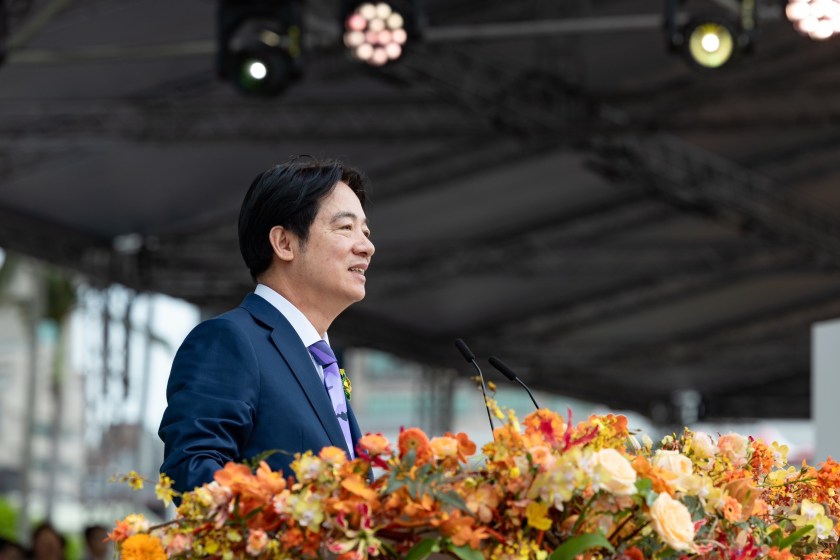
Image credit: 05.20 總統出席「就職慶祝大會」並發表就職演說 by 總統府/ Flickr, license: CC BY 2.0.
Republic of China (ROC) President Lai Ching-te began his four-year term on 20 May 2024. Lai’s Democratic Progressive Party (DPP) controls only 51 of the 113 seats in the Legislative Yuan (LY), with 60 of the remaining 62 divided in a 52 and 8 split between the Kuomintang (KMT) and Taiwan People’s Party (TPP), respectively. The KMT and TPP have formed a coalition to control the LY. This marks the first time since then-DPP leader Chen Shui-bian occupied the presidency (2000-2008) that the ROC has had different parties controlling the legislative and executive branches. Bitter political fights between the KMT and DPP-aligned coalitions, in addition to political corruption scandals, characterised Chen’s terms in office, as noted by Yun-han Chu, Larry Diamond, and Kharis Templeman in the introduction to their 2016 book Taiwan’s Democracy Challenged: The Chen Shui-bian Years. Shelly Rigger went so far as to label Chen’s first year in office an annus horribilis as his attempt to cancel the production of a nuclear power plant in Taiwan ran into a months-long stalemate with the KMT-aligned legislature. Chen initiated negotiations with the KMT-led bloc to get over this stalemate, and the two sides agreed to build the power plant while restricting the production of future nuclear power plant developments. The ROC president could not overpower the legislature and needed its cooperation to craft and implement policy.The trying experience of the Chen years leads to the following contemporary question: how could a KMT-aligned LY affect the Lai administration’s capability to achieve its cross-strait relations policy objectives over the next three years?
This paper argues that a divided government poses two potential hurdles for the Lai administration in achieving its cross-strait relations policy: 1) the risk of domestic political gridlock that leads to an image of an incapable Lai administration, and 2) the risk of fights over defence appropriation funding.
In his inaugural address, Lai stated that his cross-strait relations policy objectives are to maintain the Four Commitments of the preceding DPP Tsai Ing-wen administration (2016-2024) and to achieve his Four Pillars of Peace plan. Then-President Tsai stated in her 10 October 2021 National Day Address that the Four Commitments are (1) to uphold a democratic ROC, (2) to ensure that the ROC and People’s Republic of China (PRC) are not subordinate to one another, (3) to resist “annexation or encroachment upon our sovereignty,” and (4) to ensure that the people of Taiwan determine the future of the ROC. Lai’s Four Pillars of Peace plan entails “strengthened national defence; improved economic security; stable and principled cross-strait leadership; and values-based diplomacy.”
The first hurdle Lai faces in implementing these two policies is domestic political gridlock. The KMT and TPP passed a law in May 2024 allowing the legislature to call anyone, including the president, before it to testify, with financial and jail penalties for non-adherence. The ROC Constitutional Court declared the overwhelming majority of clauses in the law unconstitutional in October 2024. The confrontation between the DPP and KMT-TPP bloc, which started via the passage of the aforementioned law in the first month of the Lai administration, indicates that the KMT and TPP intend to use their legislative majority to constrain Lai’s ability to achieve his domestic and foreign policy agendas. The KMT view that Lai is pursuing a “two nations” policy and “obliterating any ambiguity in cross-strait relations” as well as the TPP accusation that the DPP is abusing its power via ongoing corruption investigations into TPP party founder Ko Wen-je, both buttress the view that Lai will struggle to pass legislation in the LY over the next three years.
It will be difficult for Lai to achieve his goal of improving economic security without strong legislative support. A key necessity for improving ROC economic security is to limit ROC capital flows to the PRC and divert this investment to South and Southeast Asia via what amounts to a continuation of the Tsai administration’s New Southbound Policy. Crafting tax incentives and regulatory frameworks to encourage the Taiwanese business community to avoid investing in China, where it has deep economic ties, will necessitate legislation and compromise with the KMT-TPP legislative bloc.
Lai will also face difficulties projecting “stable and principled cross-strait leadership” without controlling the legislature. Lai’s capacity to officially form the ROC’s cross-strait policy will also be challenged by a KMT-controlled LY. KMT party representatives, such as Vice Chairman Andrew Hsia, have repeatedly met with Chinese Communist Party (CCP) counterparts in the PRC since Lai won the presidential election on 20 January. The KMT sees this as a way to manage cross-strait tension by giving assurances to the PRC while simultaneously not appeasing the CCP’s demands. The KMT has criticised Lai for failing to take this approach to cross-strait relations since he assumed office in May. The CCP gains from these party-to-party discussions by legitimating the KMT as a cross-strait negotiating partner and framing the DPP as intransigently driving hostilities in the strait. These visits undermine the authority of Lai’s cross-strait policy by revealing a lack of unity within the ROC government’s approach to cross-strait relations.
The second hurdle that Lai faces in his goal of strengthening national defence is the defence appropriations funding. KMT member Ma Wen-chun serves as the co-chair of the Foreign and National Defence Committee of the LY. She also proposed over 135 cuts to the defence budget in 2023 and is under criminal investigation over accusations that she leaked information concerning Taiwan’s submarine production program to South Korea. She represents a potential obstacle for Lai if he chooses to propose a future increase in military spending to respond to escalating naval and aerial threats by the People’s Liberation Army (PLA) over the past four years. Her centrality in defence legislation will also give Taiwan’s foreign supporters cause to pause and consider what information and capabilities to share with the ROC. The US$3.05 billion hold on defence spending, as part of the KMT-TPP budget freezes and cuts passed in the first months of 2025, is also an ongoing immediate concern for strengthening the ROC’s national defence.
A divided government presents the Lai administration with two potential key challenges, domestic political gridlock and defence appropriations, to its stated policy goals of carrying out the Four Commitments and Four Pillars of Peace. These challenges are not insurmountable for Lai but overcoming them will require some degree of compromise between the KMT and DPP on key national issues, such as the defence budget. The failure of DPP-aligned electoral recall campaigns to remove a single KMT legislator on 26 July 2025 reinforces the need for compromise between a DPP-controlled executive and a KMT-controlled legislative branch. The next three years will test whether the ROC political system can deliver effective foreign policy amidst a divided government and deteriorating security situation brought about by an increasingly coercive PLA.
Nils Peterson is a Marshall Scholar studying for an MA in Taiwan Studies at the School of Oriental and African Studies. He holds a BA in History and Chinese from the University of Wisconsin-Madison. He previously led the China Team at the Institute for the Study of War as a War Studies Fellow.
This article was published as part of a special issue on ‘SOAS Taiwan Studies Summer School 2025‘.
 Taiwan Insight