
Written by Peter (Hung-Yao) Chu.
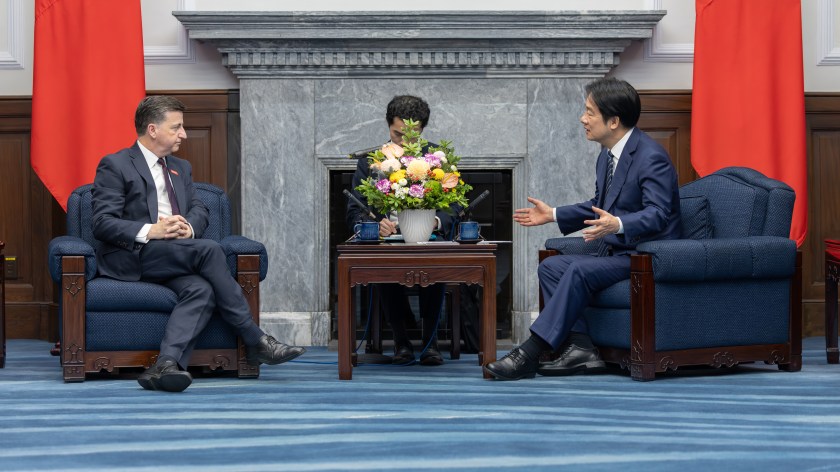
Image credit: 06.30 總統接見「英國商業暨貿易部副大臣艾禮遜」by 總統府/ Flickr, license: CC BY 4.0.
Introduction
The article explores the development of UK-Taiwan relations since the Tsai Ing-Wen administration until the current William Lai administration. The strategic importance of Taiwan in global supply chains and rising tension between the US and China have led the UK to reassess and adjust its strategy and policy toward Taiwan. Over the past nine years, the UK has shifted from less engagement with Taiwan to more inclusive diplomatic and economic cooperation with Taiwan, even though the UK has maintained a consistent legal position on the One China Policy – since 1972, the UK government recognised the People’s Republic of China (PRC) as the sole government of China. An analysis of the evolving UK-Taiwan relations in terms of economic and security interests indicates significant interests for the UK to strengthen relations with Taiwan.
Taiwan’s strategic importance to the UK
The UK government has maintained a consistent position on the status of Taiwan since 1972, which views the issue between China and Taiwan as China’s internal affairs and recognises the government of the People’s Republic of China as the sole legal government of China. The UK and the People’s Republic of China signed a communique, which ‘acknowledged the position of the Chinese Government that Taiwan is a province of the People’s Republic of China’.
However, since President Tsai Ing-Wen took office in 2016, she changed the strategy to deal with cross-Strait relations and engaging with the world compared to her predecessor President Ma Ying-Jeou, who focused more on cross-Strait relations. Tsai adopted a different strategy to shift from the focus on Taiwan’s relations with China to actively engage with like-minded partners in the West, such as Europe, to “internationalise the Taiwan issue”. In addition, the UK also recognises Taiwan’s importance as a potential economic partner after Brexit, looking for potential partners in the Indo-Pacific region. The Indo-Pacific region accounts for more than 65 percent of global GDP and rising tension between Taiwan and China has destabilised the Taiwan Strait, prompting the UK to rethink its longstanding position on Taiwan. For instance, in 2025, the UK Prime Minister Keir Starmer and French President Emmanuel Macron reaffirmed their commitment to Indo-Pacific and peace and stability in the Taiwan Strait during the UK-France Joint Leaders’ Declaration.
UK’s Post-Brexit Interests in the Indo-Pacific and UK-Taiwan Relations
The UK has been looking for trading partners and potential opportunities in the Indo-Pacific since Brexit in 2016, which has led to further economic cooperation with Taiwan. The UK’s economy was seriously impacted after Brexit, with restricted access to the EU free trade market; therefore, the UK turns its head to the Indo-Pacific region and looks for potential trading partners to boost the UK economy, and this also leads to a change in its policy toward Taiwan.
In 2020, the UK signed a free trade agreement with Japan – Japan-UK Comprehensive Economic Partnership Agreement (CEPA) – the UK’s first major trade deal after Brexit, marking a historic moment for opening the gate for the UK to engage with the Indo-Pacific region. In 2021, the UK government issued the Indo-Pacific Tilt, emphasising increased defence, trade, and foreign policy engagement in the Indo-Pacific region. In 2023, the UK became the 12th member of the Comprehensive Progressive Agreement for Trans-Pacific Partnership (CPTPP) and the first European country to join the CPTPP. The officials hope to boost Britain’s struggling economy by as much as $2.5 billion.
Furthermore, given that Taiwan ranks first in market share for major ICT products, producing 60 percent of the world’s overall semiconductors and over 90 percent of the most advanced ones, it is thus indispensable for the UK to develop further economic relations with Taiwan. The UK realises Taiwan should be an important partner in terms of AI, digital trade, cybersecurity and renewable energy for UK companies.
Thus, Taiwan’s Minister of Digital Affairs, Audrey Tang, visited the UK to promote UK-Taiwan digital resilience cooperation. During her visit, Minister Tang met up with Lord Faulkner of Worcester, the UK’s Trade Envoy to Taiwan, Deputy Speaker of the House of Lords, and the former co-chair of the British-Taiwanese All-Party Parliamentary Group (APPG). The purpose of the visit was to exchange views on democracy development and UK-Taiwan technological cooperation. Furthermore, in 2025, the UK and Taiwan signed the three-pillar agreements of the UK-Taiwan Enhanced Partnership (ETP), focusing on investment, digital trade, and energy and net-zero cooperation. Taiwanese President William Lai also met Douglas Alexander (Minister of State at the UK Department for Business and Trade) in person in Taipei to discuss further bilateral economic and trade cooperation. Bilateral trade between the UK and Taiwan reached £9.3 billion (US$12.76 billion) in 2024, making Taiwan the UK’s 33rd-largest trade partner, according to the British government. These three agreements aim to foster further bilateral and multilateral cooperation and enhance trade and investment relations.
In sum, the UK and Taiwan have worked closely on digital trade and renewable energy and actively engaged to strengthen the cooperation on AI and cybersecurity in recent years because the UK government realises that its trading partners in the Indo-Pacific are crucial for its economy after Brexit.
China’s Aggressive Actions and the UK Reaction to the Taiwan Strait
Secondly, as China’s growing power and aggressive foreign actions increase, especially after Chinese President Xi Jinping addressed unification with Taiwan as a core national interest linked to achieving China’s national rejuvenation by 2049, the UK government starts to change its perception of China as a reliable partners. Moreover, the 20th anniversary of the anti-secession law emphasises “non-peaceful means can be used if the possibilities of a peaceful reunification with Taiwan are exhausted”.
In addition, China’s normalising regular demonstration of military forces, conducting massive military drills, and conducting grey zone tactics across the Taiwan Strait and aggressive action in the South China Sea have alarmed the UK to change its longstanding position. For example, military drills after US Speaker Nancy Pelosi visited Taiwan, Joint Sword-2024A and Joint Sword-2024B, during Taiwanese President William Lai’s term. Beijing’s actions on cracking down on Hong Kong protests and passing of National Security have raised concerns about China’s credibility about what it has promised to the UK of maintaining Hong Kong’s free environment for 50 years. All these aggressive domestic and foreign actions have alarmed the international community and changed the UK’s perception of China.
Due to the change in the UK’s perception of China, the UK government changes its narratives regarding cross-Strait relations and Taiwan. In 2023, UK Foreign Secretary James Cleverly confirmed that “Britain’s longstanding position is that we want a peaceful settlement of the difference across the strait… it’s essential that no party take unilateral action to change the status quo”. In 2024, UK Foreign Secretary David Cameron stated that “the two sides of the Taiwan Strait will renew efforts to resolve differences peacefully through constructive dialogue, without the threat or use of force or coercion”. In 2025, the UK’s National Security Strategy 2025 emphasises the importance of maintaining peace and stability in the Taiwan Strait, opposing unilateral changes to the status quo, and fostering strong ties with Taiwan. In 2025, Australia’s Foreign Minister Penny Wong and Deputy Prime Minister and Defence Minister Richard Marles, together with UK Foreign Secretary David Lammy and Defence Secretary John Healey, recently held ministerial consultations. They then issued a joint statement emphasising that the Taiwan Strait peace and stability are of vital importance and supporting Taiwan’s meaningful participation in international organisations. The ministers committed to further deepening cooperation with Taiwan in the economy, trade, science, technology and culture.
These official statements suggest that the UK government changed the previous understanding about ‘internal matter’ to give great weight to maintain peace and stability across the Taiwan Strait and against the unilateral change of the status quo by China. Under this new guideline, the UK sends its carrier strike group with HMS Spey sailing through the Taiwan Strait, which shows the UK’s interests in the Indo-Pacific region and willingness to maintain peace and stability across the Taiwan Strait. Besides these statements that support peace and stability across the Taiwan Strait, Taiwan is also allowed to have real-time intelligence sharing with the Five Eyes alliance of the UK, the US, Canada, Australia and New Zealand. This information sharing allows Taiwan to have substantial security cooperation with the UK and other partners with regard to classic information that is vital to peace and security in the Indo-Pacific.
In sum, China’s aggressive domestic and foreign actions and its military action across the Taiwan Strait have made the UK change its longstanding position regarding Taiwan and its security focus in the Indo-Pacific, which gives the UK and Taiwan a chance to enhance their relations and broaden the UK’s involvement in security issues in the Indo-Pacific region.
Conclusion
In conclusion, Brexit and China’s increasing assertiveness play as two of the most important factors that lead the UK to reassess its approach toward the Indo-Pacific and Taiwan. While maintaining its One-China policy, the UK has embraced deeper economic, technological, and security ties with Taiwan to secure its interests in the Indo-Pacific in the post-Brexit era. Strengthened cooperation in digital trade, AI, renewable energy, and shared security concerns reflects a strategic shift toward a more engaged and resilient partnership. As Taiwan continues to play a pivotal role in global supply chains and regional stability, the UK has recognised the value of a closer relationship—showing a new era for UK-Taiwan relations.
Peter (Hung-Yao) Chu is a PhD candidate in international relations at the University of Edinburgh. His research focuses on US-China-Taiwan relations, EU-China relations, and Chinese foreign policy.
This article was published as part of a special issue on ‘SOAS Taiwan Studies Summer School 2025‘.
 Taiwan Insight