
Written by Manoj Kumar Panigrahi.
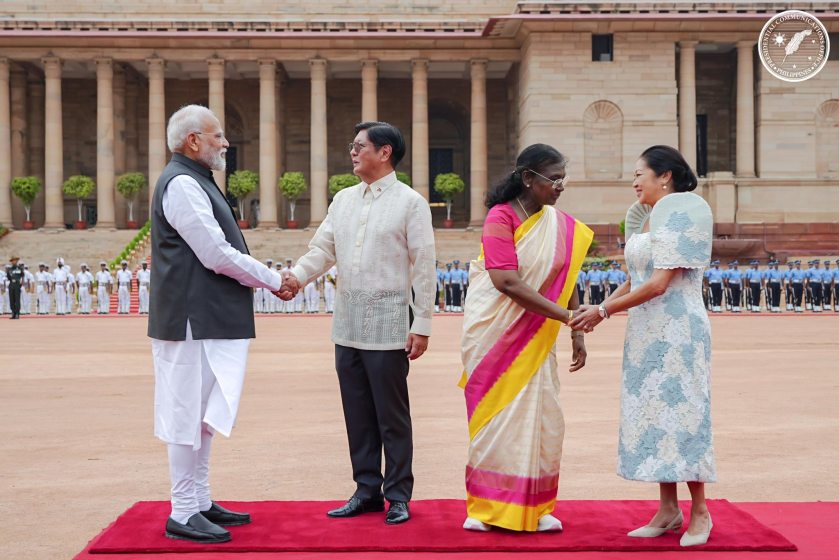
Image credit: President Marcos affirms strengthened Indo-Pacific partnership during State Visit to India by Presidential Communication Office, the Philippine government.
President Bongbong Marcos Jr.’s recent visit to India, from August 4 to 8, 2025, is seen as one of the “remarkably productive” visits. With over 13 bilateral agreements signed, the relationship between the two countries is being strengthened to a strategic level. The visit also resulted in a direct investment of USD 446 million and a potential of USD 5.7 billion in the future from Indian enterprises in the Philippines.
Although the visit can be seen as any other visit by President Marcos, his mention of Taiwan in one of his interviews sparked a reaction from the Chinese and Taiwanese governments. He stated that if there is a conflict out in Taiwan, the Philippines cannot stay out of it, and the country will enter the conflict to secure the lives of its people (primarily the Overseas Filipino Workers, OFWs) in Taiwan. This highlights the importance of Taiwan as a sensitive and important player in regional security. In response to President Marcos’ statement, the Chinese Ministry of Foreign Affairs spokesperson stated that “geographical location” and “large volume of Filipinos” in Taiwan should not be used as pretexts to interfere in the internal and sovereign affairs of other countries. The statement stands in contradiction to the earlier statement made by Huang Xilian, Chinese Ambassador to the Philippines, who, in 2023, warned the Philippines of the safety of 150,000 OFWs in Taiwan in case there is a war over the cross-strait. The ambassador’s remarks pertained to the then-Enhanced Defence Comprehensive Agreement (EDCA) between the Philippines and the United States, which specified “military bases” to be used by the United States on a rotational basis. He implied that by permitting this access, the Philippines could be perceived as siding with the US in a potential conflict with China—thereby putting the safety of Filipinos in Taiwan at risk. In response to President Marcos Jr.’s speech, Taiwan’s Ministry of Foreign Affairs issued a statement supporting the remarks, highlighting the importance of regional peace and stability.
On a similar note, the recently concluded visit of China’s Foreign Minister Wang Yi to India also brought Taiwan into the picture. A Chinese Foreign Ministry statement and the media house Xinhua mentioned that Indian External Affairs Minister Dr S. Jaishankar has “reaffirmed that Taiwan is a part of China.” The claims, however, seem unlikely because Jaishankar, in his opening remarks, did not mention anything about Taiwan. On the contrary, he spoke of “a fair, balanced and multi-polar world order, including a multi-polar Asia”. This reflects the dangers of disseminating fake news, particularly when citing a world leader on such a sensitive issue. Such a move can be seen as changing the narrative on Taiwan, targeting both the domestic audience and the larger Chinese-speaking population worldwide, with an inward approach in English to the non-Chinese-speaking population. According to the Press Trust of India’s latest report, the Indian External Affairs Ministry has denied that Jaishankar made any such statements. Such misinformative narrative building can create a perception war and can shape opinions in a free and open society.
Beyond the fake narrative push, leaders in Taiwan should not see the India-China resumption of talks as putting Taiwan in a corner. The talks were primarily held to address bilateral issues, including the border dispute between the two countries. Both India and China are neighbours and share an ancient history, as well as a long-standing tradition of trade. The resumption of the talks can be viewed from multiple perspectives. For India it led to securing rare earth minerals, import of machinery, resumption of direct flights to each other, increasing of number of Indian tourists’ pilgrimage to sacred locations which lies inside the Tibet region, and also to follow a rules-based order so that the voices of the developing countries can be heard in the international forums, and finally sharing the data of rivers which flows from China towards India, which is crucial for the Indian Northeast region.
Moreover, from a Chinese perspective, the resumption of talks leads to addressing the uncertainty that it has been facing due to US President Donald Trump’s tariff war. The tariffs will affect both India and China’s exports to the US, raising the cost of the goods produced in these countries more as compared to others. The rising cost of goods can also lead to job cuts, which will have a direct impact on the country’s GDP and growth. Additionally, with the push to end the Ukraine-Russia war by the US, it can be interpreted that China sees the resumption of talks with India as an early harvest policy to cooperate in international forums, and to have India on its side while addressing its concerns in multinational arenas, one such is the upcoming Shanghai Cooperation Organization in China and annual United Nations meeting in the United States.
In contrast, the relations between India and Taiwan have seen significant growth over the years. There has been a record growth in the bilateral trade to an expected 12 billion USD in 2025, which stood at 10.6 billion USD in 2024. There have been talks of a Free Trade Agreement (FTA) between India and Taiwan, but nothing significant has come out in public yet. Both could benefit from a more structured and deeper economic collaboration. There has also been a growth in the number of Indians visiting Taiwan. In 2024, 38,158 Indians visited Taiwan, and in 2025 January to June period, 22,687 Indians have already visited Taiwan, marking a substantial rise. Both sides are also collaborating in the development of the semiconductor manufacturing capacity in India. The mutual bonhomie also continued when the Indian Prime Minister Narendra Modi acknowledged President Lai Ching-te’s wishes on his re-election.
Additionally, Prime Minister Modi also expressed his condolences to the earthquake victims in Taiwan in 2024. This marked one of the first interactions between a sitting leader of India and Taiwan. Both India and Taiwan are important partners for each other. With the growing strategic importance of India and a huge market, New Delhi can provide an alternative for Taiwanese companies to invest. India can also be a crucial country for the companies as one of their major markets. The bilateral relations, although they see their own challenges due to a lack of diplomatic relations, have been collaborating in other sectors, propagating Track 1.5 partnerships.
There is no doubt that the internationalisation of Cross-Strait affairs has grown significantly now more than ever. Combined with China’s actions towards Taiwan and its immediate neighbours, the fake news narrative push has led the world to more curiosity about Cross-strait affairs. The statements made by President Marcos have not only pushed the “internationalisation” of the Taiwan Strait issues but also brought the attention of other like-minded countries that have stakes in the region. Furthermore, the categorical and timely rejection of the Chinese MOFA statements by India refutes any misinformation and misunderstanding between the growing ties between India and Taiwan. For both the Philippines and India, Taiwan is a necessary and crucial partners.
Manoj Kumar Panigrahi is an associate professor at O.P. Jindal Global University’s Jindal School of International Affairs in India. He teaches courses on Taiwanese society and politics and cross-strait affairs.
 Taiwan Insight