
Written by Meng Kit Tang.
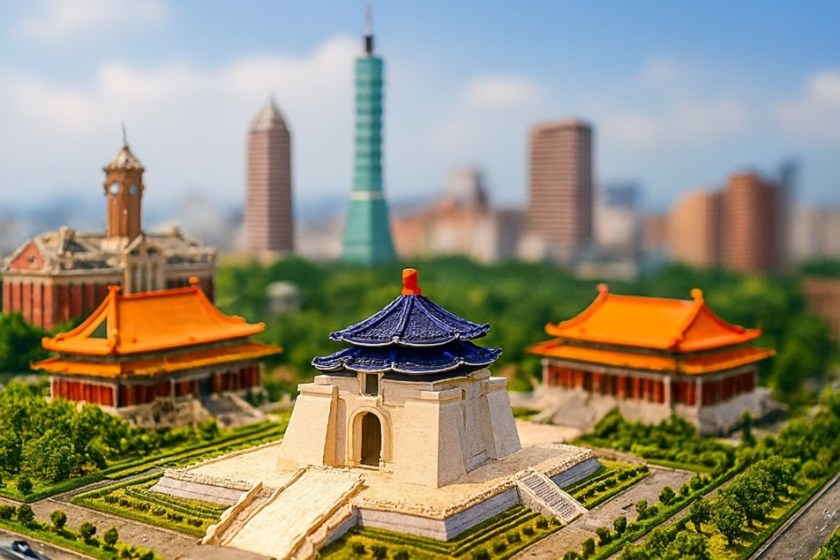
Image credit: created by the author.
For decades, the blue-and-white Chiang Kai-shek Memorial Hall, with its marble steps rising to a pagoda-like roof, hosted solemn changing-of-the-guard rituals that cast Chiang as an unblemished national saviour. Yet for many others, the building is not a shrine of pride but a tomb of pain, standing over the unhealed wounds of the White Terror.
In July 2024, Taiwan’s Ministry of Culture announced the withdrawal of honour guards from the hall’s interior, part of an effort to reduce “worshipping authoritarianism.” The decision ignited a fresh debate: should Taiwan preserve or dismantle the physical legacy of Chiang? The argument is not just about architecture and statues. It is about how a democracy remembers its past, and whether it can hold competing truths without tearing itself apart.
Memory as a Democratic Test
Every democracy confronts the problem of memory. How should societies handle monuments that reflect both nation-building and injustice? Germany preserved concentration camps as educational sites. South Africa transformed Robben Island into a museum guided by former prisoners. In the United States, Confederate monuments sparked bitter debates, with many ultimately relocated to museums for study rather than veneration.
For Taiwan, the stakes are high. Chiang Kai-shek embodies both survival and suffering. His government enacted land reforms that fuelled economic growth, yet also imposed martial law, silenced dissent, and enforced decades of repression. Deciding the fate of his memorial is, in effect, deciding how Taiwan views itself: as heir to the authoritarian order, as a victim of it, or as something more complex.
Memory is never abstract. It shapes national identity, public trust, and the lessons future generations inherit. Mismanaged, it deepens polarisation and cynicism. Managed wisely, it strengthens democratic resilience. The debate over the Chiang memorial is thus a litmus test of Taiwan’s democratic maturity.
The Moral Force and Limits of Removal
For victims of the White Terror, Chiang Kai-shek’s monuments are not neutral artefacts but symbols of trauma. Between 1947 and the late 1980s, more than 140,000 people were imprisoned and thousands executed under martial law. Political trials, surveillance, and censorship crushed their lives. For survivors and their families, seeing Chiang’s image cast in bronze across campuses and parks is a painful reminder of the repression they endured.
In April 2024, the Ministry of Culture reaffirmed plans to remove or relocate hundreds of Chiang statues, a decision welcomed by human-rights groups who argue that public spaces should not glorify oppressors. The National Human Rights Museum has echoed this call, emphasising that commemoration must place survivors at the centre. To some, especially descendants of the victims, the building is a living reminder of the hurt and wounds that do not heal, carrying an undeniable moral force. Ignoring them would hollow out Taiwan’s commitment to transitional justice.
Yet removal alone is no cure. Memory does not vanish with a toppled statue. Historian Karen L. Cox, writing on monument controversies in the United States, observes that such battles often harden into zero-sum conflicts, with each side convinced the other seeks cultural annihilation. Taiwan faces the same danger. Erasing Chiang risks turning him into a martyr of memory for supporters, while preserving him uncritically perpetuates injustice for victims.
The way forward lies in transformation, not obliteration. Chiang’s monuments should neither be objects of reverence nor consigned to silence. With honest contextualisation through plagues, exhibits, and survivor testimony, they can become instruments of civic learning. In this way, these can be reimagined as reminders of both achievement and abuse, scars and lessons, thereby strengthening democracy as it confronts its past fully.
Chiang’s Ambivalent Legacy
To understand why Chiang remains revered in some quarters, one must recall his constructive achievements.
One of his most significant achievements was the land-to-the-tiller reform of the 1950s, which dismantled landlord dominance, redistributed land to farmers, and stabilised rural society. Supported by U.S. aid, it became a model of equitable development studied internationally. Education also flourished under his administration. Compulsory schooling expanded, literacy rates rose, and a skilled workforce emerged, laying the foundation for Taiwan’s high-tech economy and future democratic development.
Chiang’s industrial policies, including export-oriented industrialisation, infrastructure projects, and state-owned enterprises, helped launch the “Taiwan Miracle,” transforming the island into one of the “Four Asian Tigers.” National defence was another key domain. Facing the threat of invasion from the mainland, Chiang maintained a strong military posture that ensured Taiwan’s survival, sovereignty, and social stability.
These accomplishments, however, existed within an authoritarian framework that curtailed civil liberties and inflicted suffering during the White Terror. Recognising both achievements and abuses is essential: Chiang remains both the architect of Taiwan’s survival and prosperity and a symbol of oppression. Preserving this duality allows society to confront history honestly, learning from both success and tragedy.
Voices from Taiwan
Taiwanese society remains divided over Chiang’s legacy, with views shaped by history, politics, and generation.
Assistant director of international affairs Hsu Yu-chien of the KMT argued: “We believe it’s very important for the current government to contemplate more on the various groups of people’s historic memory.” For many older citizens, Chiang represents survival in exile, stability during the Cold War, and the foundations of prosperity.
Younger Taiwanese see him differently. At a rally in Taipei, student leader Huang Min-chen said: “This is about what democracy looks like. We don’t want to erase history. We want to teach it.” For her generation, raised after martial law, the memorial is less a monument of pride than a symbol of authoritarianism incompatible with democracy.
Civil society voices add further nuance. The Transitional Justice Commission stresses that authoritarian symbols retraumatise victims unless they are contextualised, noting how effigies of Chiang are often damaged during annual commemorations to highlight his responsibility in massacres. Historians such as Wu Rwei-ren call for “a culture of honest remembrance,” acknowledging that while Chiang implemented a reign of terror, he also safeguarded Taiwan during the Cold War. Meanwhile, Indigenous activists highlight how Mandarin-only policies marginalised native languages and traditions, with figures like Ljegay Qeludu stating: “Our constitution says we are China, but that’s the history that the KMT brought over.”
The divide is clear: to many elders, Chiang was a shield; to many youths, he was a jailer. Both truths coexist, underscoring why his legacy must be faced with balance rather than erasure.
Lessons from Abroad
Taiwan is not alone in wrestling with the burden of contested memory. Other societies have faced similar dilemmas and offer useful models for transforming monuments from sites of division into instruments of civic education.
Germany chose exposure over erasure. Former concentration camps like Dachau and Buchenwald were preserved to force confrontation with the atrocities committed. Survivors’ testimonies, photographs, and documents became the heart of these sites, ensuring that denial was impossible. The German example shows that preserving difficult symbols, when paired with rigorous documentation, can strengthen collective memory and inoculate society against historical amnesia. For Taiwan, the message is clear: Chiang’s memorial can remain standing, but only if it openly displays evidence of repression alongside his achievements.
South Africa built reconciliation through inclusion. Robben Island, once the prison of Nelson Mandela and countless anti-apartheid activists, is now a UNESCO World Heritage site where former prisoners serve as guides. Visitors hear history from those who endured it. The site embodies both oppression and resilience, teaching that reconciliation requires centring the voices of victims. Taiwan could adopt a similar approach by making survivors of the White Terror integral to the curation and storytelling of the Chiang memorial.
The United States illustrates the risks of partial measures. Confederate monuments, once prominent on courthouse lawns, became flashpoints of cultural conflict. Many were eventually removed or relocated to museums, where they could be studied rather than celebrated. While this shift marked progress, it also showed that relocation alone does not resolve deep divisions. For Taiwan, the lesson is that simply moving statues into storage or parks may defuse immediate tensions but cannot replace the hard work of contextual education and dialogue.
Together, these cases underscore a common principle: societies cannot escape their past. Instead of demolishing it, they must confront it and turn it into a civic classroom. For Taiwan, the pertinent question is how Chiang should be remembered, and how these memories serve to educate more than divide.
The Geopolitical Stakes
Taiwan’s struggle over Chiang’s legacy is not just domestic. Beijing portrays him as part of a “shared Chinese history,” to bolster its unification narrative, even as it criticises today’s Kuomintang for wavering on cross-Strait alignment. For China, controlling memory is a tool of power; for Taiwan, how it remembers will shape how the world sees its democracy.
Demolishing the memorial outright could hand Beijing a propaganda line that Taiwan is erasing Chinese history. Leaving it untouched risks preserving a shrine to authoritarianism. Preserving it with honesty offers a stronger alternative: turning the site into an educational space that openly confronts dictatorship while affirming democratic values.
This contrast matters globally. China censors Tiananmen; Taiwan would show that a confident democracy can face its past without fear. In Liberty Square, Taiwan has the chance to transform contested memory into soft power, proving that democracy is not about hiding flaws but about confronting them.
Conclusion: Reverence and Reckoning
Taiwan is no longer Chiang’s island; it is a pluralistic democracy of 23 million voices. Some remember him as the saviour of the Republic, others as the oppressor of their parents. Both truths coexist.
Historian Karen Cox warns that tearing down memory risks losing civic lessons, while preserving it without context risks collective amnesia. The solution lies between reverence and reckoning. Taiwan should not demolish the Chiang Kai-shek Memorial Hall but turn it into a civic classroom, teaching that democracy is forged through struggle, contradiction, and reflection.
In doing so, Taiwan would not only confront its past honestly but also offer the world a model of how a democracy remembers.
Meng Kit Tang is a Singaporean freelance analyst and commentator who works as an aerospace engineer. He graduated from the S. Rajaratnam School of International Studies (RSIS), NTU, Singapore in 2025. He is also a regular contributor to Taiwan Insight.
 Taiwan Insight