
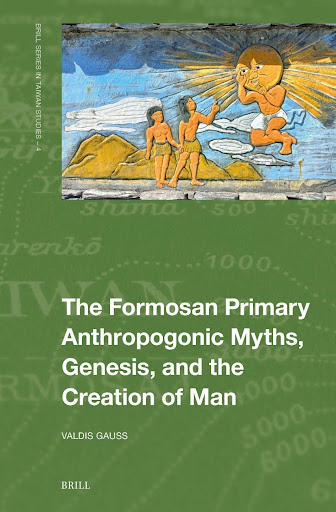
Written by Valdis Gauss
Image credit: Brill Series in Taiwan Studies
Despite its relatively small size, the island of Taiwan consistently makes headlines around the world for a plethora of reasons. While politics, economics, and the occasional earthquake or typhoon usually take centre stage in such news stories, Taiwan is also a place bursting with vitality, variety, and a unique kind of intrigue.
As the springboard for Austronesian languages and cultures, a subject that was notably heralded on the international stage by Robert Blust and Peter Bellwood, who promulgated the Out of Taiwan hypothesis, Taiwan’s cultural uniqueness is preserved, in part, by its aboriginal inhabitants and their ancient oral traditions. For the uninitiated, Taiwan is home to 16 officially recognised tribes, each with its distinct non-Sinitic language and cultural traditions, as well as a handful of unrecognised so-called pingpu or plains tribes.
The ancestors of these distinct groups, whose modern combined population is approximately 600,000, were the original inhabitants of the island. Taiwan’s tribes remained uncontacted until the 17th century, when the Dutch East India Company established Fort Zeelandia and the Spanish built Fort San Domingo in their efforts to develop global trade routes. It was at this juncture that Taiwan began to emerge from the prehistoric era, which is memorialised in oral traditions, and entered—or, according to some deluge texts which preserve the motif of the loss of orthography, rediscovered—the age of the written word.
The ancestors of Taiwan’s tribes left behind moderate archaeological evidence of their civilisations in the form of megalithic sites, pottery, jewellery, and other artefacts across the island. Moreover, the archaeological sites in Taitung are believed to hold the earliest evidence of Austronesian material culture ever discovered.
The National Museum of Prehistory in Taitung, on the eastern side of the island, and its sister branch, the Tainan Branch, on the western side, contain extensive and in-depth collections concerning Taiwan’s ancient past. Moreover, many of the exhibits featured in these museums are focused on Taiwan’s first residents. The museum’s Austronesian Hall, for example, is the venue for the permanent exhibition Austronesian Worlds, Worldly Austronesias, and includes exhibits related to material culture and migrations, among others.
The recently published Formosan Primary Anthropogonic Myths, Genesis, and the Creation of Man is part anthology, part analysis, and part commentary on the origin myths of Taiwan’s Austronesian tribes. “Over 250 origin texts, sourced from dozens of linguistic, anthropological, historical, and mythological corpora, as well as other publications, have been collated and analysed, rendering the present literary survey far more comprehensive than any prior study on this subject”. After setting the stage by situating the reader within the myth-time of these sacred accounts, the Amis, Atayal, Bunun, Favorlang, Hoanya, Kanakanavu, Kavalan, Ketagalan, Liulang, Makatao, Paiwan, Pazeh, Kaxabu, Puyuma, Rukai, Saisiyat, Sakizaya, Seediq, Siraya, Trobiawan, Truku, Tsou, and Yami (also known as Tao) of Orchid Island origin texts are chronicled.
The author’s analysis notes and examines the salient motifs that can be attributed to each origin type. Notable creation motifs include singing and speaking, the birth of the ancestors as offspring of the gods, and the creation of man as products of transformation, among others. Spontaneous genesis from stones, trees, faeces, bamboo, smoke, lilies, and chthonic abodes is also noted. Moreover, the prevalence of the drift origin theme, which, contrary to the Out of Taiwan hypothesis, is founded on the premise that the ancestors of Taiwan’s tribes drifted to the island from locations overseas, is also anthologised and explored as it is represented in the oral histories of at least 15 tribes.
Noteworthy commonalities between Formosan texts and ancient texts from across the Earth are established. For example, parallels between Kanakanavu and Sumerian creation texts preserved in the Enuma Elish are noted. Similarities between Bunun sources and verses in the biblical book of Genesis are also highlighted. Elements of the Tsou myth of Hamo, who grew men from seeds that he planted in the Earth, are also compared with the Zoroastrian genesis text that is archived in the Zend Avesta. Commentary is also offered with regard to the cosmic vessels in the Formosan creation myths and the possibility that these noisy vessels, which ferried the ancestors from the sky to the island of Taiwan, offer echoes of what modern people refer to as Unidentified Flying Objects (UFOs) in common parlance.
Additional key findings of this book include the nature of the instructions left to the ancestors by their creators, the gods’ rationales and motives for creating mankind, and the roles of the theogonic and cosmogonic mythologems as they intertwine with the primary anthropogonic myths.
The analysis provided in The Formosan Primary Anthropogonic Myths, Genesis, and the Creation of Man addresses questions such as “What specific differences are there between the origin myths of Taiwan’s aboriginal tribes?” and “Where did the ancestors of the Austronesian populations on Taiwan come from?” as these questions are answered through the mythic texts of the tribes at issue.
To compile such a vast catalogue of topic-specific texts, countless hours were spent in libraries around Taitung. In addition to spending numerous hours scouring online archives, large libraries such as those at National Taitung University, the National Museum of Prehistory, and Taitung City Public Library offered access to a tremendous wealth of related books. The Nationwide Document Delivery Service, better known as NDDS, also proved crucial in the quest to identify and compile texts from all of Taiwan’s tribes. Despite the efficacy of these incredible resources, trips to small tribal libraries also proved extremely fruitful.
During research for The Formosan Primary Anthropogonic Myths, Genesis and the Creation of Man, the author quickly realised that the focus on the earliest origins of man was a cause for consternation. In the process of identifying and anthologising relevant texts, it became clear that materials identified by other authors as “origin myths” often concern non-primary origins. Many such texts concern latecomers or people who appeared after the first people had already come into existence. These accounts, which typically chronicle the Golden Age, the survivors of the Deluge, migrations into the early modern era, and numerous other post-diluvian origins, are part of the non-primary origins of man corpus, which are sprinkled throughout the oral histories of the Formosan myth-time. These non-primary anthropogonic origin texts may be the subject of a future monograph. However, the subject of the current work is restricted to primary origin texts that specifically describe Taiwan’s earliest human ancestors.
The Formosan Primary Anthropogonic Myths, Genesis and the Creation of Man, is the most comprehensive monograph ever published on mankind’s origins as they are chronicled in Taiwan’s aboriginal myths. This authoritative source is bound to intrigue those who are curious about the ancient origins of Austronesian culture and the first inhabitants of the island of Taiwan.
Valdis Gauss 高加州 is an Assistant Professor at National Taitung University. His other notable works include The Formosan Great Flood Myths: An Analysis of the Oral Traditions of Ancient Taiwan (2022), Origins of the Formosan Ethnonyms (2023), and The Formosan ‘Shooting the Sun’ Myths: Aboriginal Oral Histories in Taiwan (forthcoming).
 Taiwan Insight