
Written by Ching-yuan (Joy) Hung and Mu-Chen (Jenny) Liu.
Image credit: authors.
At the time we decided to apply for the National Taiwan University (NTU) Overseas Internship Program in 2023, we were both second-year graduate students in the Department of Horticulture and Landscape Architecture at NTU. Both of us graduated from the same department’s undergraduate school; therefore, although focusing on different crops, we often support each other during our research. Joy recalls being in the greenhouse, frustrated by experiments that wouldn’t cooperate, when she first noticed the internship announcement. That is the time she felt it might be a chance to break out of her research routine. As a second-year Master’s student at NTU, a time typically dedicated to intensive experiments and writing a thesis, it was a big decision to spend three months overseas on a project not directly related to one’s Master’s thesis. However, for a horticulture student, Kew is a dream place to visit, let alone secure a placement. However, as this is also a once-in-a-lifetime opportunity for us, if we don’t seize the opportunity, we might never have the chance to go to Kew.
Jenny shares a similar story. During that semester, she finished the progress review of her thesis and conducted several experiments to improve the integrity of her research. At the end of that semester, Jenny was deep in her impostor syndrome, which made her feel that she had accomplished nothing in her Master’s study, and not to mention that she was late in comparison with the others of the same age. Jenny thought she did not fit in doing research, nor did she have enough working experience. Therefore, when receiving the advertisement for this internship program from the department’s office, Jenny immediately decided to give it a try. Though participating in this program would postpone her graduation schedule, Jenny wanted to seize the opportunity to do something other than research. Encouraged by friends and parents, she finally found the courage to discuss with her advisor and applied to this internship program.
We were both stuck at the point that willing to change but not knowing how, and the opportunity to Kew is just a good fit for us.
Our Work in the Programme
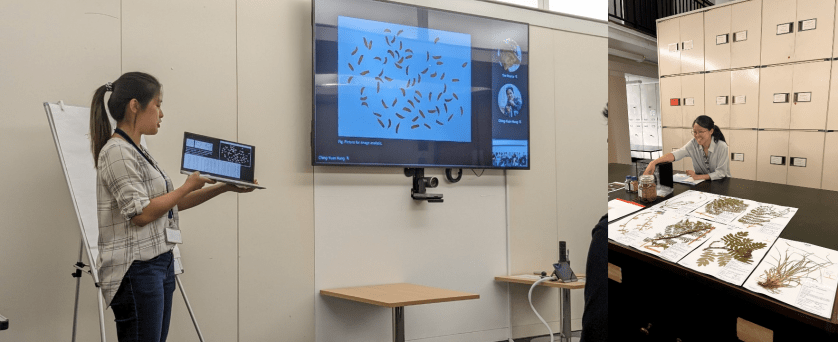
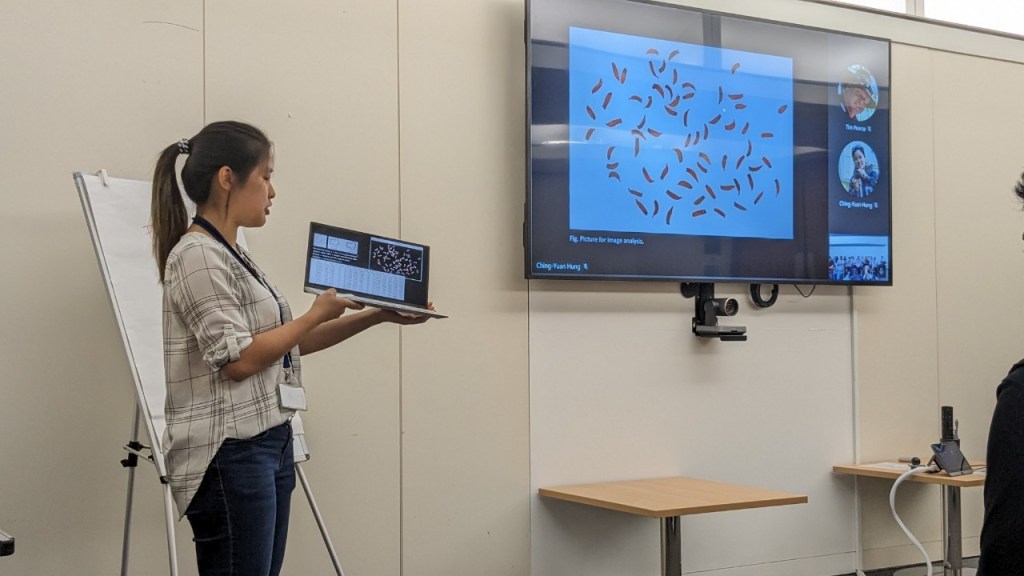
The main goal of Joy’s project was to capture the high-resolution seed image of Kakanchoe wild species, and then apply the image process to get a glimpse of the seed morphology variation across the genus. She used a focus stacking microscope to take pictures of tiny kalanchoe seeds whose average sizes ranged from 0.08 mm2 to 16.19 mm2, with most of them smaller than 2 mm2. She then utilised the ImageJ and R program to investigate the morphology difference across the genre. The details could be found in the Samara Issue 7, September 2023, the e-newsletter for the MSBP partnership.
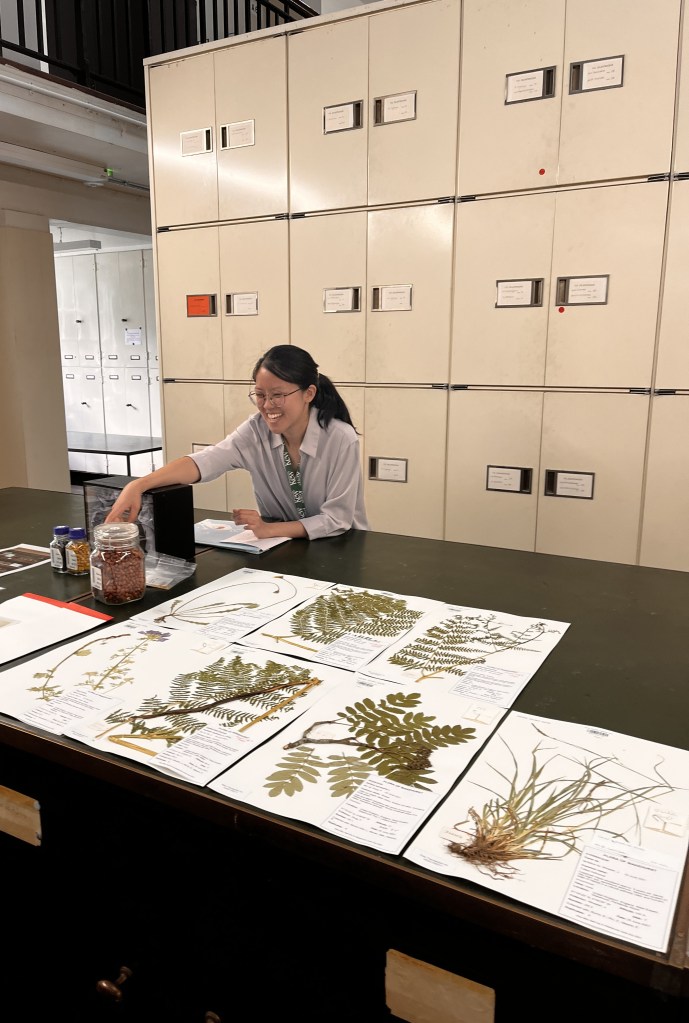
Jenny’s project was to create a toolkit for the herbarium at Kew, aiming for the scientists and curators who work there to use when leading tours. This project was led by the Science Education Team, which was actually not laboratory-based research. The Kew Herbarium is a world-renowned herbarium, with over 7 million plant specimens collected inside. They often received visitors from different organisations and lacked the collective documents for preparing the tours. Therefore, her goal is to make a toolkit that includes guidelines and materials, in the hope that this toolkit will become a support for staff giving tours and could further become training material for volunteer guides in the future. To complete this toolkit, Jenny conducted over ten meetings with people who work in various parts of the herbarium, including scientists, curators and managers of different special collections. In the meantime, she participated in three tours led by different people to observe the current tours in the herbarium. Additionally, to gain touring skills from others, she participated in over 13 tours, including two tours of the Kew Gardens and other tours in the different museums and institutes in London. All of these experiences merge into her own tour. At the end of the internship, Jenny held a workshop that not only introduced the toolkit but also discussed ways to strengthen the content.
Influence of the Program
Joy shared that the insights gained from her work experiences, interactions with diverse institutions and individuals planted a seed of inspiration within her. “Who knows what kind of remarkable growth this seed might eventually yield?” She said at the time when she finished the placement at Kew. Sitting in the office as a new PhD student at the University of Queensland, she mentioned the experience at Kew definitely influenced her a lot in chasing her dream to study abroad. The first impact directly linked to her time in the UK was her first job at the World Vegetable Centre. Although she wasn’t directly working in the seed bank part, the experience at the Millennium Seed Bank gave her a deeper understanding of how important a seed bank is. What made her more impressed was how much input is needed just to maintain a seed bank. Joy learned to be brave enough to just ask whoever she encountered in the aisle, to be willing to ask questions, and to be flexible in adjusting the schedule. For instance, she faced a critical problem at that time: the key tools she was using were broken, and there wasn’t enough time to fix them during her stay. Despite all challenges, she still tried to investigate the project using different methods and aspects, learning that “when nothing goes right, go left.” The time at Kew extended her understanding of plant research, as there were various chances to talk with scientists from different fields, but now all were devoted to plants. Not only did the experience broaden her horizons, but it also gave her the courage to discover different parts of the plant world that led her to her current career: being a PhD student to further explore the plant world while also utilising the advantages of computer technology.
In the meantime, Jenny also expressed that the internship influenced her decision to do a PhD. Through various meetings, she met a wide range of people working in different aspects of the garden, including scientists, curators, and coordinators. They showed her that there are diverse ways to contribute to any specialised area, and various career paths to work with that specific knowledge. In addition to the means of contribution in the area, this experience also led her to a deeper insight into conservation and climate change. It showed how botanists are dedicated to protecting the environment and coping with climate change. Therefore, after graduating from her master’s degree, Jenny became a part-time research assistant in the Agriculture Policy Research Center, Agricultural Technology Research Institute. In this team, they communicate with the government, horticulturists, and farmers to understand the needs in production and spread knowledge about climate change adaptation of agriculture in Taiwan. In this work, the experience of how Kew engages the public and communicates scientific knowledge enhanced her ability. Kew’s awareness of the environment and climate change prompted Jenny to think about the interdisciplinary collaboration between horticulture and plant science, that is, bridging the application science with fundamental science, and led to her decision to pursue further research by applying for a PhD.
Our time at Kew opened a window to the world outside and a door to self-reflection within, and changed the path of both of us. Recalling the official website of NTU Overseas Internship Program, “Set your sail to learn from the world” is indicated on the front page. The placement in Kew led us to the world, and we are now continuing our journey on our own method. In the documentary “Invisible Nation,” former president Tsai Ing-wen said, “Every Taiwanese should venture out into the world, reaching every corner, so that Taiwan can be seen and known globally.” With the hope of bringing Taiwan to the world and bringing the world to Taiwan, we both agree that our experience can benefit those who hesitate to step out but long to explore more of the world.
Ching-yuan (Joy) Hung (洪靖媛) is currently a PhD student at the University of Queensland, Australia. Holding BSc and MSc degrees from the Department of Horticulture and Landscape Architecture, National Taiwan University, she is now dedicating herself to plant breeding with the support of the ARC training centre in predictive breeding, hoping to apply the theory to tackle real-world problems. She can be reached at chingyuan.hung@uq.edu.au or on LinkedIn.
Mu-Chen (Jenny) Liu (柳沐真) is an MIBTP DTP PhD student based at the University of Birmingham, researching photosynthesis physiology and modelling. She graduated from the Department of Horticulture and Landscape Architecture at National Taiwan University with an MSc and a BSc in Agriculture. As someone chasing the sunlight from Taipei to Birmingham and transitioning from horticulture to plant science, she hopes to become a bridge between disciplines and across places. She can be reached at mxl1243@student.bham.ac.uk or on LinkedIn.
This article was published as part of a special issue on ‘Seeds of Exchange: Stories from the Kew-NTU Collaboration‘.
If you are interested in working at Kew, the Global Pathfinders initiative recently launched a program including six 6-month fully paid opportunities at Kew. More information can be found on page 6 of the website under codes G-8-34 to G-8-39: https://twpathfinder.org/overview1830.
 Taiwan Insight