
Written by Tasaw Hsin-Chun Lu
Image credit: Provided by the author.
When the military coup struck Myanmar on 1 February 2021, a peculiar kind of musicking took shape in the fluorescent-lit dormitories and cramped apartments of Zhonghe, New Taipei City, where most of Taiwan’s Sino-Myanmar people live. Night after night, hundreds of Gen Z ears and eyes—some belonging to twenty- and thirty-somethings who had never set foot in Myanmar, many others who had left as toddlers or teenagers—stuck to their phone screens. Through Facebook Live, they heard the same sounds that people inside Myanmar were experiencing: the metallic clanging of pots and pans at 8 p.m., the sudden crack of gunfire cutting through a protest song, and a mother’s wail as she identified her child’s body. Distance did not mute these sounds. Facebook amplified them, looped them, subtitled them, and turned solitary listening into a collective act of defiance.
The coup abruptly ended a decade of tentative democratisation. As the military detained elected leaders and responded to mass civil disobedience with lethal violence, Facebook—used by over half of Myanmar’s population, predominantly 18–35-year-olds—became the primary infrastructure for protest coordination and emotional sustenance. Unlike earlier revolutions, including 1988’s 8888 Uprising and the 2007 Saffron Revolution, in which cassette tapes circulated protest anthems, the 2021 Spring Revolution relied on instantaneous digital sharing, remixing, and co-listening.
The Facebook soundscape that emerged in Taiwan’s Sino-Myanmar community after the coup was a revolutionary soundscape. Never merely background, this cyber soundscape became a site of action that shaped perception, memory, and political possibility. Protest songs such as ‘Kabar Ma Kyay Bu’ (‘The World Will Not End’, originally from 1988), ‘A Yay Kyi Pyi’ (‘The Time Has Come’), and the newly composed ‘A Lo Ma Shi’ (‘No Dictatorship’) were often uploaded trilingually in Myanmar, Chinese, and English. Every time someone hit “share” on a video of ‘Kabar Ma Kyay Bu’ sung beneath tear-gas clouds or watched a live stream of pots being beaten in Mandalay, they were resisting the military junta’s atrocities. These protest songs and videos were endlessly re-uploaded, subtitled, remixed with gunfire or crying, and overlaid with images of fallen protesters.
As a counterpublic, the movement persisted even as the military shut down the internet, blew up mobile towers, and murdered journalists; it could not stop the sound from travelling. VPNs, mirrored videos, and diaspora servers kept the audio alive, and every replay in Taiwan was a quiet act of acoustic disobedience. Each share and comment intensified the emotional charge, creating what may be termed a “we-mode” revolutionary soundscape—a shared affective atmosphere that transcended physical presence.
The songs themselves were old and new at once. ‘Kabar Ma Kyay Bu’, born in the 1988 uprising, had once circulated on smuggled cassettes that could get you arrested for mere possession. In 2021, Taiwan became a nightly earworm. Young people who had grown up in Myanmar singing Mandopop in KTVs suddenly found themselves learning this song’s Myanmar lyrics by heart. The melody is slow, almost a lullaby, but when hundreds of Facebook users watched the same clip at the same moment—some in Taiwan, some hiding in Yangon safe houses—their breathing synchronised, their heart rates aligned, and their rage accumulated. This was not passive consumption. It was co-listening as communion, as a weapon, as proof of resistance.
Hip-hop also emerged as a particularly potent medium within this digital soundscape. Myanmar hip-hop, which first gained underground traction in the 1990s and 2000s despite severe censorship, has long carried revolutionary connotations. Pioneering groups like Acid evaded military censors through coded slang, English phrases, and rapid-fire delivery, rendering subversive messages “inaudible” to authorities. After 2021, hip-hop’s critical edge found new expression among Sino-Myanmar youth.
Duan Peiquan (Y.G.Z.), a rapper who moves between Taiwan and Myanmar, released his 2021 single ‘Bu Pa’ (‘Not Afraid’) on Facebook just weeks after the coup. Recorded in the Yunnanese-Chinese dialect with Mandarin and English expletives, the track launches a blistering attack on the junta, on China’s complicity in repression (with pointed references to oil-pipeline interests), on trigger-happy soldiers, and on the silence of traditional Sino-Myanmar associations whose inaction contributed to the killing of 19-year-old Sino-Myanmar protester Angel (Deng Jiaxi) on 3 March 2021. Ending with a quotation of ‘Kabar Ma Kyay Bu’ in Myanmar, Duan explicitly claims Myanmar as the collective homeland of revolutionary martyrs. Free from commercial or pre-2021 censorship pressures, ‘Bu Pa’ represents unapologetic political rap that fuses borderland Yunnanese-Chinese vernacular with global hip-hop defiance.
For these young people, the digital soundscape served multiple functions. First, it enabled participation from afar, especially for those who anxiously pieced together fragmented reports of violence in Yangon, Mandalay, and ethnic border regions they considered their hometowns. Second, it facilitated the construction of a cross-generational yet distinctly youthful Sino-Myanmar public. While older Myanmar generations, shaped by the traumatic anti-Chinese riots of 1967 and subsequent decades of state-sponsored xenophobia, largely remained silent or even accommodated the junta, Gen Z activists explicitly distanced themselves from such quietism. Through relentless sharing, remixing, and commenting on protest songs, they forged a hyphenated Sino-Myanmar subjectivity played out simultaneously at local, translocal, and resolutely Myanmar-rooted levels.
This musicking challenges conventional understandings of public spheres in authoritarian contexts. Whereas Habermas’s bourgeois public sphere presupposed rational-critical debate, and Fraser’s subaltern counterpublics emphasised marginalised groups’ parallel discursive arenas, the 2021 Myanmar case reveals a more fluid configuration. When the military paralysed traditional media through strikes and repression, Facebook temporarily became the de facto mainstream public sphere. The junta, unable to dominate this space, resorted to what has been termed “anti-public” tactics: internet blackouts, base-station destruction, and disinformation. Yet music, particularly remixed protest songs and hip-hop, proved remarkably resilient to censorship. Algorithmic affordances such as autoplay and easy sharing, as well as the cultural legitimacy of “mere” songs, allowed revolutionary sound to circulate even during shutdowns via VPNs, encrypted apps, and diaspora networks, particularly in Taiwan.
Ultimately, Sino-Myanmar Gen Z’s Facebook co-listening practices produced a new acoustic politics of belonging. By appropriating and remixing historical protest anthems, creating trilingual hip-hop, and relentlessly tagging, commenting, and live-streaming, they transformed private grief into public fury and diasporic ambivalence into rooted solidarity. In the process, they decentred traditional Chinatown festivals as sites of cultural reproduction, replacing them with a deterritorialised yet intensely localised digital soundscape. This generation no longer sees itself as rootless sojourners awaiting recognition from a distant “motherland.” Through the revolutionary power of shared listening, they have sonically claimed Myanmar as home, while simultaneously participating in the inter-Asian “Milk Tea Alliance” of democratic youth. In an era when authoritarian regimes increasingly weaponise silence, these young Sino-Myanmar have shown that co-listening can itself become a form of acoustic resistance.
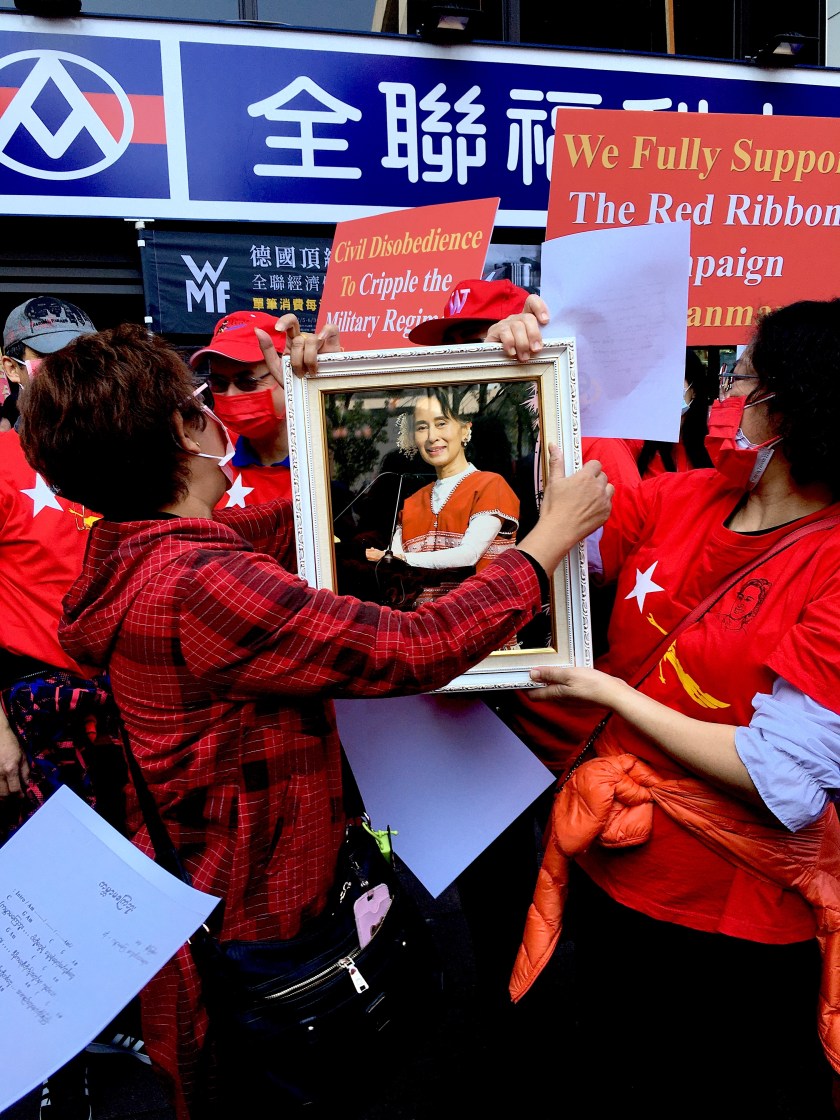
On 6 February, 21 March and again on 2 May 2021, this virtual soundscape spilt into the physical streets of Taipei. At Liberty Square, several hundred Sino-Myanmar youth—many wearing the red-and-peacock-flag colours of the NLD—sang the same songs they had been co-listening to for weeks. The sound was raw and untrained, but it carried the accumulated weight of countless solitary nights of listening in Taiwan. When they struck pots and pans in perfect rhythm with the videos they had watched from Mandalay, the acoustic link was complete: the soundscape that began as pixels and compression on Facebook had become flesh, breath, and metal in downtown Taipei.
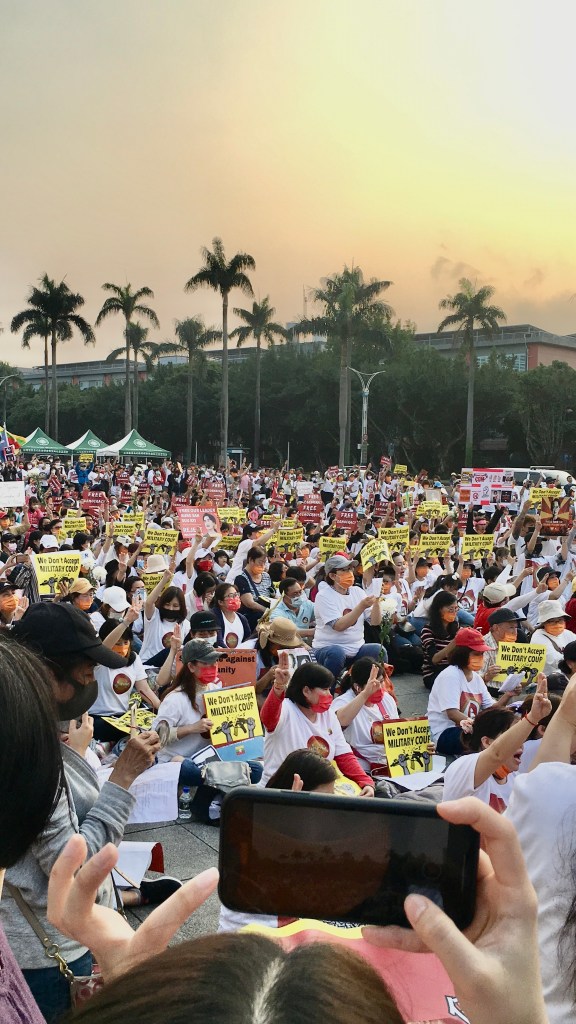
Image credit: Provided by the author.
In the end, the revolutionary power of this Facebook soundscape lay not in volume but in persistence. Long after the initial shock of the coup faded, long after international attention moved elsewhere, the songs kept circulating. Every February since 2021, on the coup’s anniversary, some Sino-Myanmar youth gather for candlelight vigils. They no longer need lyric sheets. They know ‘Kabar Ma Kyay Bu’ by heart in Myanmar. And when they sing it together under Taipei’s neon sky, they are doing more than remembering. They are continuing to listen—defiantly, lovingly, unapologetically—across borders, across generations, across the silence the junta tried to impose.
In an authoritarian world that polices silence, co-listening has become one of the last forms of acoustic sovereignty. For Taiwan’s Sino-Myanmar Gen Z, pressing play is no longer merely private. It is the quiet, firm, immortal refusal to forget.
Tasaw Hsinchun Lu is Associate Professor and Director of the Graduate Institute of Musicology at National Taiwan University (NTU). A specialist in ethnomusicology with a geocultural focus on Myanmar and its diasporas, her research centres on borderland musics, diasporic performance practices, and digital revolutionary soundscapes. She is the author of “Unfaded Splendor: Representation and Modernity of the Burmese Classical Music Tradition” (2012) and “Festivalscapes: From Evolution and Cultural Renewal of Sino-Burmese Multi-sited Music & Dance” (NTU–Harvard Yenching Book Series, 2025) and has published widely on Sino-Myanmar music and dance, Myanmar classical music and soundscapes in several journals.
This article was published as part of a special issue on “Sonic Worlds, Acoustic Politics and Hearing in Taiwan”.
 Taiwan Insight