
Written by Chieh-Ting Yeh.
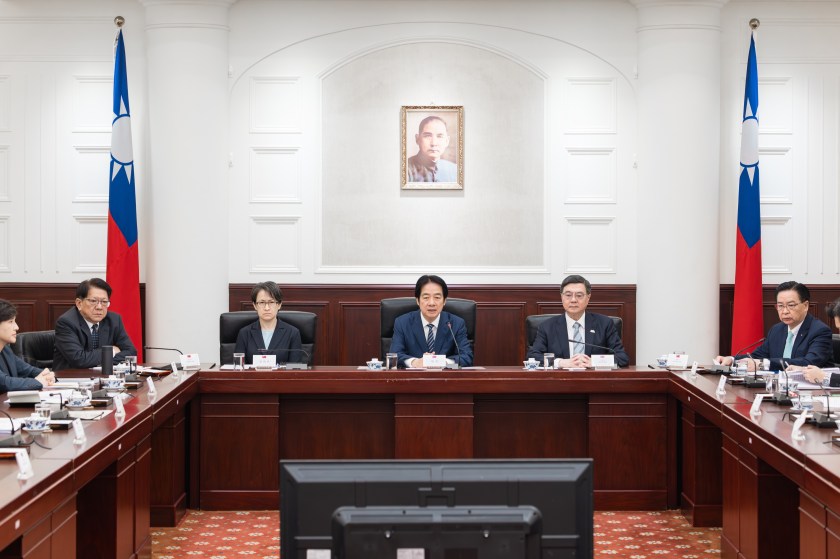
Image credit: 11.26 總統召開「守護民主台灣國安行動方案」國安高層會議 by 總統府/ Flickr, license: CC BY 4.0.
As 2025 draws to a close and 2026 begins, it is time to take stock of the past year and ponder the upcoming year. The US-Taiwan relationship has gone through an eventful year; this is the natural result of both the US-Taiwan relationship maturing past the initial euphoria of reaffirmed friendship and the instability of the global order under a much more unpredictable US administration.
Looking at US-Taiwan relations more closely, the two main areas of security and economy have both undergone major developments.
First and foremost, defence continues to dominate as the most important issue in the public discourse and is still the focus of most policymakers. Both the US and Taiwan have ramped up the sale and purchase of arms, respectively. The US approved its largest single arms sale package to Taiwan just a few days before the end of the year, including HIMARS surface-to-surface rocket systems, howitzers, Javelin anti-tank missiles, and Anduril’s loitering munition drones, totalling US$11 billion. Earlier this year, President Lai Ching-te announced a special defence budget worth up to $40 billion that supplements the regular defence budget for 2026 of close to $30 billion, in an effort to raise Taiwan’s defence spending closer to 5% of GDP.
While these developments are all welcomed by foreign relations and national security policy experts as well as the defence industry, two main questions now need to be answered: how wisely will the additional funding be spent, and how will Lai convince the Legislative Yuan, and more broadly the voters, that these budget increases and purchasing decisions are necessary costs for the country, especially in light of other competing priorities.
In 2026, the debate over defence spending is expected to continue to heat up within Taiwan. There will be more spirited discussions over questions such as whether the funding should go to conventional but costly weapons platforms such as replacing Taiwan’s aging aircrafts and submarines, or to newer but untested technologies such as drones and autonomous munitions; how much of the funding should be used to purchase existing items that could be deployed immediately, or to more research and development of capabilities and supply chains. There will be more questions about what policy priorities could be considered “national security” more broadly, such as energy security, communications security, and even freedom or limitations on speech.
Second, but perhaps just as important, is the issue of trade, with technology at the centre stage. In 2025, the Trump Administration had effectively reshaped the global assumption of free trade and set off a wave of economic nationalist policies around the world. Within this context, Taiwan has found itself in an awkward bind with the US. On the one hand, President Trump has accused Taiwan of “stealing” America’s semiconductor manufacturing sector and began the trade negotiations with Taiwan with a 40% “Liberation” tariff in April that has settled on an average rate of 15.2% for the time being. On the other hand, Taiwan has shown time and time again the willingness to invest in America, including additional semiconductor manufacturing capacities by Taiwan Semiconductor Manufacturing Company (TSMC) in Arizona. Most awkward is the fact that Taiwan and the US have not reached a trade agreement in 2025, unlike neighbouring Japan and South Korea.
The trade negotiations will continue to be the most-watched issue on the US-Taiwan economic relationship. Given the pressures of the tariffs and Taiwan’s eagerness to work with the US, there should be meaningful progress on the negotiations, if not a conclusion to them. However, this will depend on which version of Taiwan’s narrative Washington adopts: the war-prone chokepoint of key global technology, or the generous and capable partner for American priorities.
Looking further ahead, one crucial question that remains is whether the US and Taiwan are able to cooperate in recalibrating their value chain relationship. As the US is dreaming about re-industrialisation, so should Taiwan continue to move towards creative, research, branding and design, where higher value is derived from intellectual property rather than exploitation of physical and human resources, especially as Taiwan’s demographics point to shrinking workforces. US companies expanding R&D efforts in Taiwan are one element in this trend. More specifically, the US and Taiwan could be set to work more closely together in defence and dual-use technologies.
All of these developments in the US-Taiwan relationship, however important on their own, are governed by overarching narratives about the larger picture. The narrative refers not only to what issues are being talked about, but also to how they are being talked about. How does Washington view Taipei, and vice versa? What do the people of both nations think of each other?
The narrative around US-Taiwan relations is stuck in a strange, twilight zone kind of place—the two sides are anxiously preparing for a contingency so catastrophic that it is the only lens through which everything is seen.
Surely, deterrence remains the most important topic—for the moment. But the problem is that the mentality of deterrence is fundamentally a reactive one. A fight-or-flight, high-adrenaline state of mind can only be maintained for so long before the public at large becomes tired of it. The obsession with reacting to a war scenario will eventually crowd out all other thinking and discussion about the future of US-Taiwan relations.
Sadly, reactive visions do not inspire hope or action. We need a more robust, imaginative, positive, optimistic, uplifting, inspiring, forward-looking, and hopeful US-Taiwan relations narrative.
It would be about how the US and Taiwan will reconfigure their traditional design/IP/consumer brands and ODM/OEM trade model. The two economies could help each other build resilience and economic justice by Taiwan supporting advanced, speciality and national security manufacturing where it makes sense in the US, and the US investing more capital in innovation and cultural products from Taiwan. Like how the US and Taiwan built the post-Cold War supply chain model of separating design and manufacturing into distinct competencies and industries, the two could again engineer the trade regime for this century based not just on comparative advantage, but shared prosperity and common values.
It would be about how the two are equal partners, not just in the short game of shoring up Taiwan’s defence, but about the long game of dealing with and ultimately transforming China as a superpower. If deterrence through military capacity is a reactive salve for the symptom that is China’s aggression, it will remain so unless the root cause, China’s identity of insecurity and vengeance for perceived historical slights, is cured. Because Taiwan is as close to an alternative model of modern social contract as China will get, and is the people who inherently understand China’s psyche better than anyone else in the world, Taiwan’s perspective is an indispensable reference for China if it were to eventually transition away from
It would be about reasserting and bolstering the inherent universality of freedom and democratic values together. American strength and leadership are most robust when they are derived from faith in its founding principles of unalienable rights and government by the people. It has inspired nations around the world, including Taiwan. Taiwan’s democracy and respect for human rights are the result of multiple waves of modernisation, from the 1920s to the 1990s. In a world experiencing a recession of those values, including in the US and Taiwan themselves, the US-Taiwan relationship can only be stronger and more lasting if it were not based solely on mutual interest, but on common beliefs.
How 2026 turns out will depend a lot on how these narratives shape the specific developments. The next phase of US-Taiwan relations will not be decided by declarations or arms packages alone, but rather, it will be shaped by whether both sides can sustain a shared narrative, one that is honest enough for democratic societies, yet disciplined enough for strategic competition. The real danger is not invasion alone, but a future where Taiwan and the US stop imagining anything beyond survival.
Chieh-Ting Yeh is a venture investor in Silicon Valley and a director of U.S. Taiwan Watch, an international think tank focusing on US-Taiwan relations. In addition, he is a co-founder and the editor of Ketagalan Media and an advisor for the Global Taiwan Institute and National Taiwan Normal University’s International Taiwan Studies Center.
This article was published as part of a special issue on ‘Review Taiwan 2025: Challenges, Continuities, and Change.’
 Taiwan Insight
The article was posted 7 January but it seems to be written before the seizing of Venezuelan president, thus the article has limited value
LikeLike