
Written by Max Dixon.
Image credit: 蔡英文 Tsai Ing-wen/ Facebook.
The year 2025 has seen the most significant uplift in engagement between the United Kingdom and Taiwan in the history of the bilateral relationship. Taiwan has been an increasingly salient topic in British foreign policy debates in recent years, yet 2025 saw Taiwan emerge as one of the quintessential foreign policy issues in London. The year saw high-profile former Taiwanese and British leaders visiting London and Taipei, Taiwan explicitly considered in a British national security strategy white paper for the first time, the British-Taiwanese trade partnership expanded, and numerous Royal Navy vessels transited the Taiwan Strait. The degree of development in the relationship was, in essence, confirmed by a sharp rebuttal from the Chinese Ambassador to London in the Daily Telegraph, underscoring the significance of the enhancement of relations between Taipei and London throughout 2025.
‘Constant Efforts to Include Taiwan Globally’
Despite prioritising, occasionally overzealously, the revitalisation of a Sino-British relationship that had festered under previous Conservative governments in pursuit of economic growth, the current Labour government has seemingly rejected a binary approach between Sino-British and Taiwanese-British relations, instead undertaking a dual-track framework to China and Taiwan. This approach has seen Britain make consistent efforts to embolden relations with both China and Taiwan, whilst consistently taking opportunities to raise concerns about Taiwan’s security and stability across the Taiwan Strait in international arenas.
Britain’s outgoing representative in Taipei, de facto ambassador John Dennis, made this policy explicit in an interview with Nikkei Asia’s Thompson Chau in February 2025, stating that the UK was making a ‘constant effort’ to include Taiwan globally. Dennis called for further British-Taiwanese agreements on collaboration in investment, renewable energies and trade, a call his successor Ruth Bradley-Jones took up upon her arrival in April, agreeing on three additional pillars in Britain’s Enhanced Trade Partnership with Taiwan, on investment, digital trade, renewable energy and net zero, on the 30th of June 2025.
Moreover, in May, the British Office Taipei released a joint statement with the de facto embassies of Australia, France, Germany, Japan and other European countries reasserting their call for Taiwan’s ‘meaningful engagement’ in the World Health Organisation and World Health Assembly. Further British statements called for Taiwan’s international involvement, including in the G7 Foreign Ministers’ joint statements in March and November, and in July at a joint Australian-British summit in July which called for Taiwan’s engagement in international organisations where ‘the international community benefits from the expertise of the people of Taiwan’.
Furthermore, Taiwan was evoked by Prime Minister Keir Starmer at bilateral leaders meetings in 2025, with Starmer releasing joint statements with Prime Minister of New Zealand Christopher Luxon in April, and French President Emmanuel Macron in July, which raised the importance of Taiwan and peace and stability in the Taiwan Strait. Likewise, in a key foreign policy speech on December 2nd, the Prime Minister spoke of the ‘strategic challenge’ and importance of stability across the ‘Taiwan Strait’, reinforcing the extent to which cross-Strait relations and Taiwan are increasingly portrayed as central to Britain’s foreign policy focus.
‘A particular risk of escalation’
This growing focus on Taiwan in Britain was further cemented by the National Security Strategy paper released in June, which provided the most extensive engagement with Taiwan in a British government policy paper since Taiwan’s democratisation. Only the second Government policy paper to make explicit reference to Taiwan, after the Integrated Review Refresh in 2023, the 2025 review recognised the ‘particular risk of escalation around Taiwan’, tying stability in the region to Britain’s economic future by framing Taiwan’s importance in terms of its role in ‘global trade and supply chains’ and committing the UK to build upon ‘our strong unofficial relationship with Taiwan … underpinned by shared democratic values’. In securitising stability in the Taiwan Strait by binding Taiwan’s existential security to Britain’s economic security, whilst also making explicit the natural ties between Britain and Taiwan as two democracies, the 2025 policy paper can be seen as the most explicit support extended to Taiwan by any UK government this century.
That commitment would be realised in two ways over the summer of 2025, firstly, Royal Navy vessel HMS Spey transited the Taiwan Strait on the 19th of June, followed by the Royal Navy frigate HMS Richmond, which, alongside US naval destroyer USS Higgins, transited the Strait on the 13th of September. Such transits, defined by the Royal Navy as ‘Freedom of Navigation’ (FoN) sailings, are significant for they serve to outline Britain’s clear rejection of attempts by Beijing to redefine the Strait as China’s ‘internal waters’. Crucially, the Royal Navy matched in three months over the summer of 2025 the same amount of FoN sailings in the Taiwan Strait undertaken in the entire period between 2009 and 2024, underscoring Britain’s growing material commitment to the region and to Taiwan.
The importance of Britain’s material support for Taiwan was further emphasised by Defence Minister John Healey’s response to a question posed by The Telegraph on how Britain might respond to a Chinese escalation towards Taiwan. Speaking in Darwin, Healey stated that ‘If we have to fight, as we have done in the past … [Australia and Britain] will fight together,’ going on to say Britain and Australia were ‘ready to fight, [as] we deter better together.’ Naturally, Healey would row back slightly, claiming to be talking in ‘general terms’, but when placed in the context of the Security Strategy paper released by his department only a month prior and his specific reference to deterrence, and deterring Chinese aggression, Healey’s response shows how increasingly central Taiwan is to Britain’s defence and security considerations.
‘In Defence of freedom and democracy’
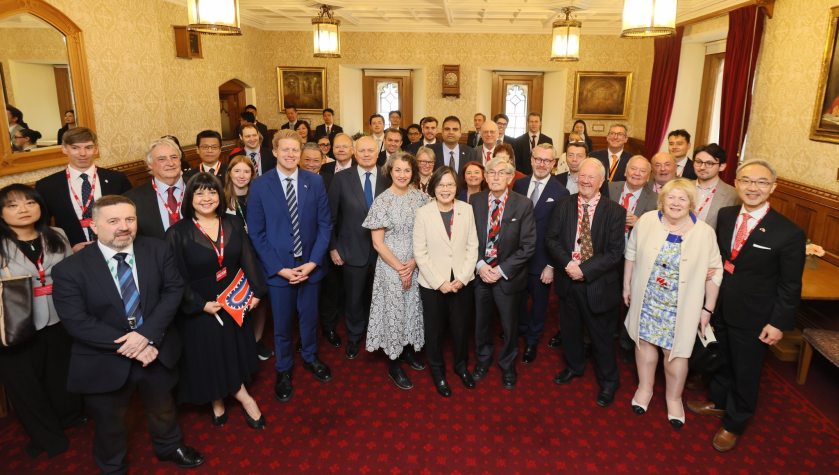
2025 also saw visits by high-profile Taiwanese and British politicians to London and Taipei. In May 2025, Tsai Ing-wen became the most high-profile former Taiwanese President to visit Parliament since Lee Teng-hui’s 2000 visit. On a visit that included a meeting with House of Commons Speaker Sir Lindsay Hoyle and almost fifty parliamentarians, Tsai spoke of ‘the need for Taiwan and the UK to work together in defence of freedom and democracy’, underscoring the elective affinities between Britain and Taiwan as liberal democracies. Moreover, two British parliamentary delegations would visit Taiwan in 2025. Firstly, the Taiwan All-Party Parliamentary Group led by Labour MP Sarah Champion visited Taipei in February 2025, meeting with President Lai, followed by a delegation of Labour MPs that travelled to meet with senior Taiwanese politicians, including Vice President Hsiao Bi-khim, in May 2025. Finally, in August, former British Prime Minister Boris Johnson visited Taipei, calling upon Britain and other European nations to strengthen ties with Taiwan, celebrating Britain’s natural affinity with Taiwan as ‘two island democracies’. Whilst Johnson indeed carries a controversial legacy both in Britain and beyond, it was significant to see a British Prime Minister whose legacy rests on foreign policy and his success in rallying European support for Ukraine in the early months of Russia’s invasion, making explicit his support for Taiwan. Such visits exemplify the extent to which Taiwan is seen increasingly by politicians in Britain as part of the ‘main’ in foreign policy calculations.
Conclusions
Perhaps the most potent measure in judging how far British-Taiwanese relations have grown lies in the degree of outrage it elicits from the Chinese embassy in London. Following the signing of the Enhanced Trade Partnership in 2023, China complained that the UK was using trade ‘as an excuse’ to enhance Taiwan ties. In 2025 in a Daily Telegraph guest article Chinese ambassador Zheng Zeguang chastised Britain’s engagement with Taiwan whilst stating that China would do ‘whatever it takes’ to block ‘external interference’, whilst also attempting to redefine Britain’s One China policy and position on Taiwan’s status as being defined by the UNGA Resolution 2758, an interpretation openly rejected by Parliament in November 2024. Crucially, China’s sharp rebuttals underscore a growing unease in Beijing that Taiwan is coming to be seen in Britain as increasingly vital to the maintenance of both global prosperity and security.
Whilst justifiable security concerns remain about the Government’s attempts to negotiate the process of rejuvenating its relationship with China, a stronger relationship with China has not come at the expense of Britain’s relations with Taiwan. On the contrary, as exemplified by the considerable progress made in 2025, the Government has not only maintained attempts by previous governments to enhance UK-Taiwan relations but has also overseen a considerable development in the bilateral relationship. Indeed, Britain’s engagement with Taiwan has seen a blending and entwining of technological and trading co-operation with a distinct recognition of the inherent security concerns faced by Taiwan and the importance of protecting ‘shared democratic values and human freedoms’, as stated by British ambassador to Taiwan Ruth Bradley-Jones. This intricate approach of balancing Sino-British and Taiwanese-British relations will, without doubt, come under closer scrutiny from Beijing, but it is to the credit of the work of all those working on the UK-Taiwan relationship, in London and Taipei, that it has continued to go from strength to strength in recent years, becoming ever more vibrant.
Max Dixon is a PhD candidate at the University of Portsmouth studying a thesis entitled The other China or an Emerging Taiwan? Democratic Taiwan and British foreign policy, 1996-2021, under the supervision of Dr Isabelle Cockel. His research is funded by the South Coast Doctoral Training Partnership and the Economic and Social Research Council.
This article was published as part of a special issue on ‘Review Taiwan 2025: Challenges, Continuities, and Change.’
 Taiwan Insight