
Written by Shen Ming Shih
Image credit: BigMedia https://www.bigmedia.com.tw/article/1767311418359
1. Introduction
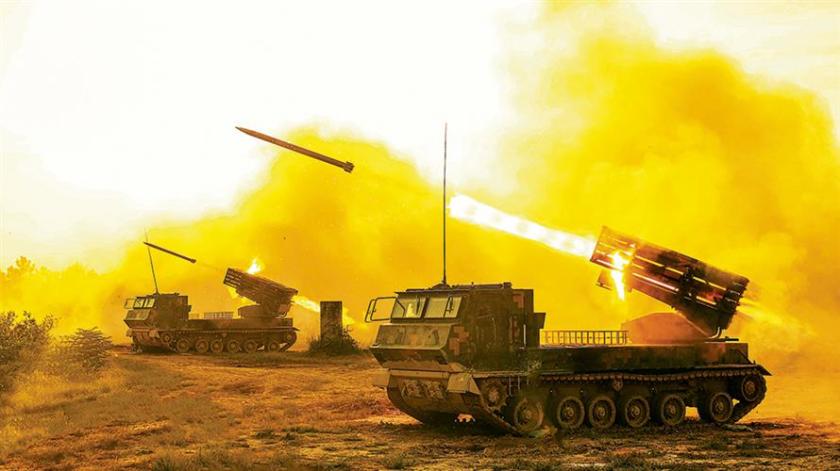
Using the pretext of US arms sales to Taiwan, China launched the “2025 Justice Mission” (正義使命) exercise against Taiwan at the end of 2025, conducting drills in the Taiwan Strait that included blockade, joint firepower strikes, and anti-access/area-denial (A2/AD) operations. Although the intensity of the exercise did not exceed the scale of the exercise following Nancy Pelosi’s visit as US House Speaker to Taiwan in 2022, the number of aircraft deployed in a single day reached a record high, and amphibious landing ships were dispatched for the first time. The exercise area extended 12 nautical miles near Taiwan’s homeland. A long-range Rocket Brigade conducted live-fire exercises extending 24 nautical miles—all unprecedented in previous exercises. While most exercises are designed for future combat operations, Chinese exercises typically serve multiple purposes with implications that differ.
2. Objectives
2.1 Practising tactics against Taiwan and anti-access/area denial (A2/AD) against the US and Japan
Each of the Chinese Communist Party (CCP)’s military exercises against Taiwan primarily rehearses the scenarios and tactics for future operations against Taiwan. In 2024, Joint Sword A and B, joint combat readiness patrols and joint fire strikes were practised separately, using computer animation, but no live-fire exercises were conducted. This exercise also rehearses tactics for blockading Taiwan and denying access to the US and Japan, but insufficient forces were deployed to the relevant positions. In other words, the number of ships blockading Taiwan is inadequate, and the amphibious landing ship, sailing southeast for the first time, is incapable of countering American nuclear-powered submarines or aircraft carrier battle groups.
2.2 Targeting the US for Arms Sales to Taiwan
In December 2025, US President Trump sold $11.1 billion worth of weapons systems to Taiwan, including High Mobility Artillery Rocket System (HIMARS) rockets and the latest self-propelled artillery, at the highest price ever. In the past, the CCP has always protested US arms sales through verbal condemnation and sanctions against American arms companies. Still, this time, the US is strengthening its anti-landing weapon systems for Taiwan, clearly signalling its support and assistance. A spokesperson for the Chinese Foreign Ministry stated that this exercise was intended to oppose US arms sales to Taiwan. If America continues arms sales to Taiwan, the CCP may continue to launch military exercises against Taiwan in the future. However, using exercises to halt US arms sales is not a viable approach, given the low likelihood of success.
2.3 Pressuring Japan to Retract Its Stance on the Taiwan Contingency
Since Japanese Prime Minister Sanae Takaichi announced a stance of “Taiwan Contingency”, the CCP has employed diplomatic, tourism, and food sanctions to seek to alter her stance. However, PM Takaichi has not shown any signs of changing her mind. This exercise also aims to deter US-Japan intervention and dispatch coast guard vessels into the waters around the Diaoyu Islands, thereby clearly demonstrating a multi-pronged approach to pressure. If this fails to achieve its objectives, the CCP must find alternative methods.
2.4 Creating the Image that the Military Remains Strong Despite Senior Generals’ Corruption
Since the Third Plenary Session of the 20th CCP Central Committee in 2024, the CCP has been continuously purging senior generals of Xi’s faction. Currently, only six generals remain in official positions. The commanders and political commissars of all military services or theatre commands have been officially announced as having resigned or as being under investigation. To prevent adversaries from perceiving the PLA as internally divided and weakened, and taking aggressive or provocative actions, the CCP must demonstrate its military strength. This exercise also aims to showcase the joint operational capabilities of the Eastern Theatre Command.
3. Implications
3.1 The CCP’s Already Staying in the Passive Position:
The CCP’s military exercises might be described as an old dog unable to produce new tricks. Still, given the same terrain and troop structure, the CCP’s strategy toward Taiwan has no room for innovation. Regarding countering US and Japanese intervention in the Taiwan Strait, it can be seen that the CCP is constantly innovating, whether by increasing the number of nuclear warheads or developing long-range torpedoes, drones, or ballistic missiles. However, the effectiveness of these countermeasures against US weapon systems, particularly strategic bombers, remains questionable. The CCP’s H-20 bomber has been slow to be incorporated into service, indicating persistent bottlenecks in China’s military technology. Through observation of the exercise and collection of electronic parameters, the US already has countermeasures and tactics against the CCP’s A2/AD actions. This put China in a passive position. The US’s actions—paralysing Venezuela’s air defence system in two and a half hours and arresting Maduro—also made China aware of its own vulnerabilities.
3.2 Reasons for Not Launching Missiles:
Logically, the CCP could have launched missiles during this exercise to highlight its capabilities. However, the reason for ultimately choosing to conduct only missile launches is that, with current satellite and other surveillance technologies, the form, launch location, and actual results of any PLA missile launch can be immediately known to the US military. In 2022, the CCP launched 15 missiles, but only 11 or 9 remained in the target area, demonstrating that the CCP’s missile firing still has shortcomings. There are problems with the missile bodies, materials, personnel training, and logistics. If the missiles were launched over Taiwan, there would be a risk of accidental strikes on Taiwan. Since US President Trump will meet with Xi Jinping in April 2026, any accidental clashes would affect the US-China Easing trend and bilateral relations. To reduce risks, the CCP may forgo missile firing; however, simply deploying and manoeuvring exercises cannot demonstrate actual combat capability, and the deterrent effect is limited.
3.3 Taiwan’s cognitive warfare is better than China’s
The CCP released drone footage of the landmark Taipei 101 during the exercise, but Taiwanese experts and scholars quickly debunked it as a composite or AI-generated image. Similarly, photos circulating online of J-20 stealth fighters in Pingtung County were confirmed to have originated in Guangdong, China. This highlights the People’s Liberation Army (PLA)’s clumsy attempts at cognitive warfare against Taiwan, which Taiwanese officials and civilians quickly deciphered and immediately diminished the propaganda’s effectiveness. Conversely, the 10 photos released by Taiwan showing F-16 sniper pods illuminating Chinese aircraft from a long distance demonstrate that Taiwanese fighters unknowingly locked onto PLA aircraft. Especially considering Taiwan’s possession of medium- and long-range air-to-air missiles, these aircraft may have been detected, locked onto, and shot down after leaving the mainland. The release of these photos not only showcases Taiwan’s military capabilities but also counters the PLA’s cognitive warfare, creating fear in PLA Air Force pilots’ minds and forcing them to remain constantly vigilant against aerial threats.
3.4 The Intent of the Exercise Area Approaching the Territorial Sea Baseline:
In this exercise, the CCP moved the exercise area closer to Taiwan’s territorial waters, nearly encroaching on the territorial sea baseline. The demarcated exercise area reveals the CCP’s attempt to undermine the symbolism of Taiwan’s sovereignty over its territorial waters, asserting that Taiwan is part of China. However, such a scenario is meaningful only if the Chinese ships and aircraft actually enter the territorial waters. When Chinese ships enter the 24-nautical-mile zone, they are repelled by Taiwanese Navy and Coast Guard vessels, thereby demonstrating that the Taiwanese government is defending its rightful territorial waters in accordance with its sovereignty. In other words, if the Chinese vessels haven’t even entered the territorial waters, they cannot demonstrate Taiwan’s ownership. Taiwan’s avoidance of conflict through refusal and confrontation prevents the CCP’s legal warfare regarding its territorial sovereignty from succeeding.
4. Implications
This isn’t the first time the CCP has conducted exercises against Taiwan. However, if each exercise follows a similar pattern, even if it starts as the new normal, it will eventually become the old normal, diminishing its deterrent effect. More importantly, as Taiwan’s geostrategic value increases, the more exercises the CCP conducts against Taiwan, the more internationalised the Taiwan Strait issue becomes. The international community is highly concerned about the pattern and intentions of China’s military exercises, as well as how Taiwan will respond. Exercises conducted by the CCP under the guise of military action can lead the international community to believe that the CCP is a troublemaker in the Taiwan Strait conflict, thereby sympathising with Taiwan’s situation.
For Taiwan, although this exercise was announced at the last moment, troop movements before the Chinese exercise indicated a possible large-scale exercise, and Taiwan had already prepared for contingencies. Because of the similarity in the CCP’s exercise patterns, Taiwan has developed a standard operating procedure for responding to such situations. The various missiles and vessels currently in service with the ROC Armed Forces and Coast Guard can react immediately. Moreover, the Coast Guard and the Navy conduct highly coordinated joint operations, demonstrating great skill in handling such situations. China’s weaknesses become more evident the more exercises it conducts. Once Taiwan and neighbouring countries understand their weaknesses, they can prepare for defence as early as possible.
Dr Ming Shih Shen, Research Fellow, Institute for National Defense Security Research (INDSR), Taiwan. He earned his PhD in Political Science at the National Defense University in Taiwan. He is also an Adjunct Associate Professor at Tamkang University and a Visiting Professor of Rashtriya Raksha University (National Security University) in Gujarat, India.
 Taiwan Insight