
Written by Meng Kit Tang.
Image credit: 蕭美琴 Bi-khim Hsiao/ Facebook.
Introduction
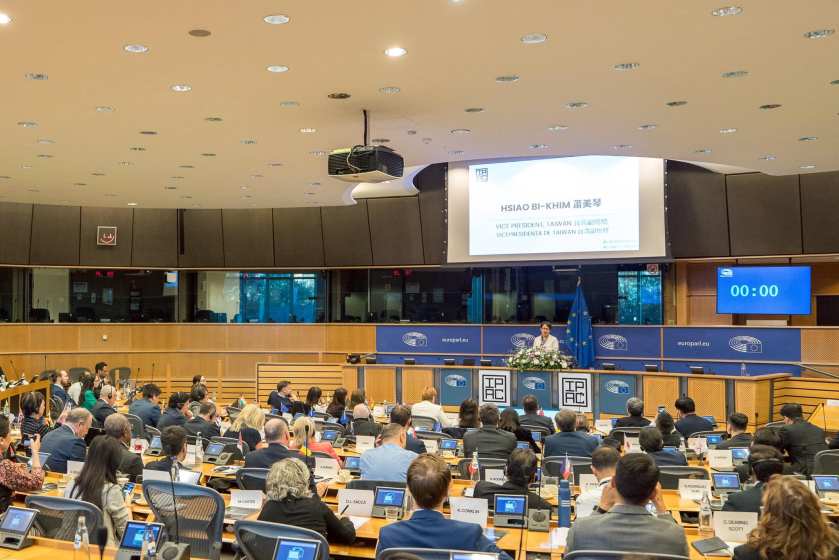
In 2025, Taiwan’s foreign policy under President Lai Ching-te was defined by a maturing shift: persistent symbolic outreach gave way to unprecedented substantive gains in security and economic partnerships, even as Beijing’s coercion escalated. Vice President Hsiao Bi-khim’s appearance at the Inter-Parliamentary Alliance on China (IPAC) summit in Brussels on November 7 drew instant enthusiasm among Democratic Progressive Party supporters.
Commentators rushed to call it a historic moment. Some even likened her speech in a rented conference room to Madame Chiang Kai-shek’s addresses to the United States Congress in 1943. The analogy collapsed as soon as it met history, yet the excitement revealed something true about Taiwan earlier in the year. Symbolic scenes still carry emotional weight at a time of unrelenting pressure from Beijing and uncertainty abroad.
The contrast with events in New York was striking. Only weeks earlier, Foreign Minister Lin Chia-lung hosted a dinner at Le Bernardin to showcase strong ties with Washington. Senior American officials did not attend. Taipei’s attempt to explain the empty seats as scheduling conflicts convinced few.
These episodes captured an early-2025 dilemma, but the year ended dramatically differently: a record $11.1 billion U.S. arms package in December, massive Chinese “Justice Mission 2025” blockade drills, deepened EU tech ties, and major TSMC investments abroad. Taiwan must shift from celebrating symbolic victories to securing institutional gains that strengthen its resilience.
The Brussels Event: What It Was and What It Was Not
Hsiao met about fifty-five lawmakers from twenty-four countries in a rented room inside the European Parliament complex. It was not a formal parliamentary session or a committee hearing. It carried no institutional authority. IPAC, the host, is a respected advocacy network founded in 2020, but it does not control EU budgets or negotiate agreements.
Security was tight. Belgian police escorted the delegation, and the trip had no public schedule. Some staff jokingly called it a “007 mission.” The phrase exaggerated the situation but reflected real concern. Beijing had pressured several European governments to block or downgrade the visit, so secrecy helped prevent interference.
Within days, Beijing-linked media and influencers launched a disinformation campaign. They claimed Taiwan had paid eight billion euros to rent the entire Parliament. The lie spread quickly across TikTok, YouTube, and diaspora messaging apps. Taiwan’s Criminal Investigation Bureau moved fast and indicted two individuals on November 12 for fabricating and amplifying the rumour. IPAC also issued a public clarification.
The controversy revealed how easily symbolic diplomacy can be weaponised against Taiwan. It underscored the fragility of Taiwan’s information space, where narratives often move faster than verification. Edited clips of the Brussels meeting circulated as proof of a grand breakthrough, inflating expectations that quickly deflated amid Beijing’s disinformation and protests – a familiar cycle of overhype and backlash. But in 2025, such incidents were overshadowed by concrete deliverables elsewhere.
Why the Historical Comparison Failed
The comparison to Madame Chiang Kai-shek’s 1943 speeches was neither accurate nor helpful. Madame Chiang spoke before a formal joint session of the United States Congress at a moment when Republican China was an American wartime ally receiving billions in Lend-Lease aid. The political stakes were enormous.
IPAC, by contrast, has no authority to negotiate agreements or allocate resources. Treating an advocacy network’s meeting as the equivalent of an address to a national legislature inflates Taiwan’s achievements and misunderstands how Europe’s political system works. This kind of misrepresentation does not strengthen Taiwan’s diplomacy. It creates openings that Beijing can exploit and that European officials quietly register.
Accurate framing does not diminish Taiwan’s success. Parliamentary advocacy matters because lawmakers often sense shifts in public sentiment and elite debate before executives adjust policy. Their support can build pressure that slowly shapes decisions inside ministries and commissions. But goodwill cannot replace the hard work of securing trade pacts, investment protections, and supply-chain cooperation. Taiwan needs clarity more than heroic narratives.
The New York Contrast and Washington’s Signals
The September dinner at Le Bernardin aimed to reassure Taiwan of continued United States support despite tensions over defence spending and delayed arms deliveries. Yet the absence of senior Trump administration officials conveyed a blunt message. Taiwanese media tried to soften the optics, but officials in Taipei understood the warning. Symbolic gestures cannot paper over structural frustrations.
After the United States election, the conversation shifted dramatically under the second Trump administration, from early-year frustrations, such as tariff threats and absent officials at symbolic events, to transactional gains via Taiwan’s semiconductor leverage. Negotiations yielded major semiconductor cooperation, including a $100 billion TSMC commitment for five new U.S. fabs announced in March, worker-training programmes, and tariff adjustments.
Most consequentially, December’s $11.1 billion arms package included HIMARS, ATACMS missiles, howitzers, drones, and anti-tank systems. The episode confirmed that Washington, under Trump’s transactional approach, responds most reliably to concrete leverage delivering clear U.S. benefits: Taiwan’s semiconductor dominance proved its strongest bargaining chip, unlocking these approvals amid Beijing’s escalations. Yet it must be wielded and paired with Taiwan’s own defence increases, rather than as a substitute for a comprehensive strategy.
Europe: Enthusiasm in Parliaments, Caution in Institutions
Europe’s policy environment runs on two tracks. Parliaments across the continent have passed resolutions supporting Taiwan since 2021. Lawmakers travel to Taipei and speak out against authoritarian coercion. These gestures matter, but they rarely translate into executive action.
Trade and investment policy sits with the European Commission, while major member states such as Germany, France, and Spain hold decisive influence. Their governments remain cautious. Automotive, aerospace, and luxury sectors still rely on access to China. The political cost of provoking Beijing stays high.
Even so, quiet progress continues. The third EU–Taiwan Trade and Investment Dialogue in December 2024 launched working groups on semiconductors, critical raw materials, and digital governance. These mechanisms attract little attention but gradually shape policy. TSMC’s ten-billion-euro European Silicon Shield project has become Taiwan’s most persuasive case. The Dresden plant remains on schedule for 2027, and the Munich AI research centre opens in 2025. Early discussions with Italy and Czechia add momentum. Supply chain anxiety often moves European governments more than moral appeals.
In this landscape, IPAC works as an amplifier rather than an engine. It raises awareness and keeps pressure alive. Real breakthroughs will come when parliamentary advocacy aligns with industrial interests and Commission priorities.
Beijing’s Expanding Toolkit
Beijing’s reaction to the IPAC meeting marked a new level of pressure. On November 14, credible reports indicated that Chinese authorities were preparing Interpol red notices for specific Taiwanese figures, including DPP lawmaker Puma Shen, amid Taiwan’s diplomatic activities in Europe.
These notices would not lead automatically to arrests in democratic states, but they would generate diplomatic friction and complicate travel, especially in countries with strong economic links to China. Interpol later indicated it would not approve such notices due to their political nature.
At the same time, the People’s Liberation Army intensified its grey zone activity. On November 29, 12 aircraft crossed the Taiwan Strait median line in a single day, out of 27 detected in total, turning near-daily incursions into routine tests of Taiwan’s air defences. Political coercion and military signalling now move in closer alignment, as evidenced by the PLA’s “Justice Mission 2025” drills in late December simulating a full blockade of key ports, live-fire strikes, and deterrence of external intervention.
Such notices and drills aimed to disrupt Taiwan’s diplomats and discourage hosting by smaller states. Symbolic diplomacy carries real risks when Beijing is prepared to punish even modest displays of visibility.
Domestic Echoes and the Cost of Hype
Taiwan’s political environment magnifies both diplomatic highs and lows. The DPP presents every overseas engagement as evidence of growing international space, reinforcing President Lai’s foreign-policy approval. Images of Taiwan welcomed abroad create a sense of momentum.
Exaggerated claims, however, set expectations that the government cannot meet. When every meeting is hailed as a breakthrough, the public may underestimate the structural work required to strengthen defence, energy resilience, and long-term deterrence. Disappointments then feel sharper than they should.
The opposition often dismisses parliamentary engagement as mere provocation, overlooking the value of legislative networks in Europe and North America. A balanced view recognises that symbolic diplomacy matters but cannot replace institutional achievement. Think tanks and partisan media sometimes reinforce the hype cycle, and analysts who highlight constraints risk being labelled pessimistic, discouraging honest debate and weakening public preparedness.
Opposition-controlled legislature checked early budgets, but late-year security boosts reflected narrowing partisan gaps.
A Maturity Agenda for 2026 to 2030
Taiwan can maintain symbolic diplomacy while strengthening long-term security, but this requires clear priorities. It should consolidate progress with the European Commission by institutionalising working groups and establishing an EU–Taiwan Trade and Technology Council, with parliamentary outreach supporting rather than overshadowing these efforts.
With the United States, Taiwan must secure concrete deliverables. Implementing the record arms package and TSMC frameworks offers rare opportunities, and Taipei should resolve remaining backlogs while advancing asymmetric capabilities. Taiwan also needs transparent communication about risks, including economic coercion and blockade scenarios, to build societal resilience.
A cross-party foreign policy council could protect core interests from partisan swings, ensuring energy, defence, and conscription policies remain consistent. Finally, a credible path to higher defence spending of the regular budget rising to 3.32% GDP in 2026, with supplementary packages, aligns with the scale of the threat and Taiwan’s diplomatic messaging.
Conclusion
Taiwan cannot abandon symbolic diplomacy. Visibility matters, and silence would invite more pressure from Beijing. Yet visibility alone is insufficient. 2025 showed how quickly symbolic achievements can be overstated and turned into liabilities, but also how real opportunities can emerge and endure.
Taiwan’s challenge is to turn goodwill into agreements and applause into action. Symbolic diplomacy should open doors, not replace strategy. By strengthening institutions, deepening partnerships, and preparing citizens for a long contest of endurance, Taiwan can make its international space durable. In 2025, it took decisive steps toward resilient reality over performative hope.
Meng Kit Tang is a Singaporean freelance analyst and commentator who works as an aerospace engineer. He graduated from the S. Rajaratnam School of International Studies (RSIS), NTU, Singapore in 2025. He is also a regular contributor to Taiwan Insight.
This article was published as part of a special issue on ‘Review Taiwan 2025: Challenges, Continuities, and Change.’
 Taiwan Insight