
Written by Yo-Ling Chen
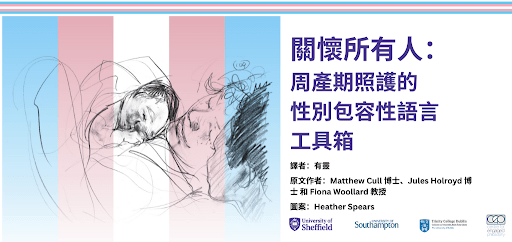
Image credit: Provided by author. Queer Margins translation of Matthew Cull, Jules Holroyd, and Fiona Woollard’s “Caring for everyone: A toolkit for gender inclusive language in perinatal care” booklet, a product of The University of Sheffield’s Centre for Engaged Philosophy’s “Inclusive Language and Practice in Perinatal and Postnatal Care” project.
Recent years have seen a broad and tangible push towards amending Taiwan’s Assisted Reproduction Act (ARA), which currently limits access to assisted reproductive technologies to infertile heterosexual spouses. In late 2023, prior to the 2024 elections, eight versions of ARA amendments were proposed by Democratic Progressive Party (DPP), Kuomintang (KMT), and Taiwan People’s Party (TPP) legislators; immediately after taking office in January of 2024, the incumbent President Lai Ching-te also declared ARA amendments to be a major priority moving forward. Over the past two years, 20 versions of ARA amendments have been proposed, with the largest difference between versions being that five amendment drafts proposed by KMT and TPP legislators included measures for legalising surrogacy in Taiwan. DPP legislators, as well as gender advocacy groups, have pushed for postponing the issue of surrogacy and focusing on expanding assisted reproduction access to single women and lesbian couples. Ultimately, the Executive Yuan approved the Ministry of Health and Welfare’s (MOHW) draft amendments, which do not include sections addressing surrogacy, on December 11 of last year; this version is currently under clause-by-clause review in the Legislative Yuan. While discussions around assisted reproduction have tended to overlook the reproductive rights and situation of transgender people, new developments offer a small glimmer of hope that the reproductive imagination of Taiwanese society is starting to expand.
In the current MOHW draft being reviewed in the Legislative Yuan, assisted reproduction access is explicitly expanded to “unmarried woman” and “lesbian spouses,” which respectively denote unmarried people whose legal gender is ‘female’ (and thus presumably has the capacity to gestate) and two parties whose legal genders are both ‘female’ and who have married under the Act for Implementation of J.Y. Interpretation No. 748 (《司法院釋字第七四八號解釋施行法》). The use of legal gender as the defining terminology for expanding access to assisted reproduction results in the exclusion of certain groups within the transgender community. For instance, a transgender man who maintains the capacity to gestate but has changed his legal gender to ‘male’ would be excluded, as would any gay spouses (whose legal genders are both ‘male’) for whom one or both parties maintain gestational capacity. Indeed, while transgender activists submitted a formal recommendation to the MOHW in July 2024, warning that their ARA amendment draft results in certain forms of transgender exclusion during an earlier phase of their drafting, the MOHW gave no response to these recommendations and did not address this glaring issue.
As early as 2021, various LGBTQIA+ groups have sought to draw attention to the reproductive rights of transgender people and expand the public’s understanding of fertility. For instance, as part of their Transgender Film Festival in November of 2021, the Taiwan Alliance to Promote Partnership Rights (TAPCPR) screened Jeanie Finlay’s 2019 documentary, Seahorse, which tells the story of Freddy McConnell’s experience accessing assisted reproductive technologies in the UK and giving birth to his first child as a transgender man. In May 2024, TAPCPR also hosted a forum on ARA amendment efforts that sought to “go beyond the gender binary and heteronormative family-making presumption.” The consensus of this forum was that ARA amendments should be completed as soon as possible without implementing surrogacy laws, and also that these amendments should ensure the reproductive rights of transgender people.

Image credit: Provided by author. Taiwan 2024 A Deal With the Universe Documentary Tour poster.
In partnership with TAPCPR and Taiwan LGBTQ Family Rights Advocacy, Queer Margins (酷兒翻越), an online publication specialising in producing translations and original content on gender and intimacy diversity, organised an island-wide documentary tour in 2024 screening Jason Barker’s 2018 film, A Deal With the Universe, of his experience navigating assisted reproduction with his wife. Over the years, Queer Margins has also published a variety of articles and translations drawing attention to the diversity and challenges of transgender family formation, transgender fertility and gestation, reproductive behaviours such as chestfeeding, and the necessity for transgender-inclusive perinatal care.
On January 7, the Legislative Yuan issued an evaluation report of the ARA amendment draft to the MOHW, which explicitly brought attention to the MOHW’s failure to address transgender reproductive rights. The report questioned the use of legal gender as a primary access requirement for assisted reproduction access and drew attention to the fact that “a portion of people with gestation and birthing capacity may be excluded from the scope of access established by these amendments” (p.4). Furthermore, the report explicitly mentions that the reproductive rights of transgender people are threatened under the existing amendment parameters drawn around legal gender, and calls on the government to establish appropriate measures to deal with this issue (p.5). In the appendix of the Legislative Yuan’s report, Professor Yi-Chien Chen (陳宜倩) of Shih Hsin University’s Institute of Gender Studies similarly expressed concerns about using ‘female’ as a legal gender category to define the scope of expansion of access to assisted reproduction and explicitly named transgender men who maintain gestation capacity as one of the groups who may be excluded under the current amendments (pp. 97-98). Furthermore, in a recent article by a Legislative Yuan assistant, critical attention was brought to how the MOHW’s ARA amendment draft currently excludes heterosexual spousalships where the husband is transgender, gay homosexual spousalships where at least one husband is transgender, lesbian homosexual spousalships involving one cis woman and one trans woman, and unmarried transgender men who maintain gestational capacity.
Within the medical literature, the past decade has seen a boom in transgender fertility-related research. In general, research on transgender fertility preservation indicates low fertility preservation rates, even if the desire to biologically reproduce is reportedly high, especially amongst transmasculine individuals, who are assigned female at birth and identify as either male or masculine. Some research indicates that transgender women are able to regain enough spermatogenesis capacity after cessation of long-term estrogen therapy to undergo assisted reproduction. However, a higher proportion of sperm abnormalities are found in such cohorts. Successful induced lactation amongst transgender women has also been documented, with expressed milk having an adequate nutrient profile when compared to milk expressed by cisgender women who give birth. Some transgender men have also been able to successfully chestfeed, even after certain forms of top surgery where the nipple stalks are not severed in the process of breast reduction and chest masculinisation. Comparative research between cisgender female and transgender male pregnancies shows no statistical difference in assisted reproductive technology outcomes, even when testosterone therapy has already been initiated.
Within the arenas of gender studies and transgender advocacy, qualitative interview research on the pregnancy experiences of transgender male and transmasculine nonbinary individuals is increasingly abundant. Initiatives such as the Trans Pregnancy Project, Trans Fertility Co. and the Centre for Engaged Philosophy’s Inclusive Language and Practice in Perinatal and Postnatal Care Project have been sharing vital information on transgender fertility, reproduction, and related healthcare and research with a variety of audiences. Research also indicates that even in Argentina, the first country in the world to pass its gender self-identification law in 2012, transgender men still face many challenges when navigating their reproductive health needs. Some researchers have described the collective effects of the barriers facing transgender reproduction as a form of “passive eugenics,” a term that draws attention to societal mechanisms that discourage certain populations from reproducing through indirect means without explicitly stating eugenic intent.
In Taiwan, transgender people are still required by an unconstitutional executive order to undergo sexual organ removal surgery in order to change their legal gender. Even if transgender people in Taiwan engaged in fertility preservation prior to surgery or other forms of medical intervention, the ARA and pending amendments still exclude some of these individuals from making use of their frozen gametes through assisted reproduction. Furthermore, Taiwan’s medical system remains largely ignorant of the most recent research on transgender fertility and reproductive health. Also, it lacks clinical experience with such patients, given how few cases there are of transgender people in Taiwan engaging in some form of (assisted) biological reproduction. When it comes to transgender reproduction, Taiwan’s policy has taken a posture of passive eugenics, which refers to the de facto effect of discouraging certain populations from reproducing even when relevant policies do not explicitly state this outcome as a goal.
Nevertheless, the Legislative Yuan’s incisive critiques of the MOHW’s ARA amendment draft offer a brief shimmer of hope that Taiwan may be able to move beyond cisnormative understandings of fertility and passive eugenic policies towards transgender people. In Taiwan, as in other places, the pernicious hegemony of cisfertility—the assumption that discussions and policies dealing with fertility and population have as their primary subject the cisgender person and/or couple, which simultaneously constructs transgender fertility as either unimaginable or as a de facto impossibility vis-à-vis passive eugenics—may slowly be cracking. It remains to be seen whether this major step forward in ARA amendment discussions will become a milestone for transgender reproductive justice in Taiwan, or if it will be a short-lived flash in the pan of cisfertility.
Yo-Ling Chen (they/them/他) is a trans nonbinary Taiwanese American writer, translator, activist, and independent scholar based in Taipei. They are a contributing editor at New Bloom Magazine and a founding editor and translator at 酷兒翻越 Queer Margins. Yo-Ling’s academic research and teaching focus on the intersections of transgender studies, asexuality studies, and Taiwan studies. They are the lead PI for the Transpacific Taiwan Transgender Studies Research Collective (3TS), which analyses and develops strategic responses to anti-gender mobilisations in Taiwan. This article was made possible by grant funding from the Transgender Educational Network: Theory in Action for Creativity, Liberation, Empowerment, and Service (TEN:TACLES) Initiative for 3TS.
 Taiwan Insight