
Written by Yu-Ying Hu
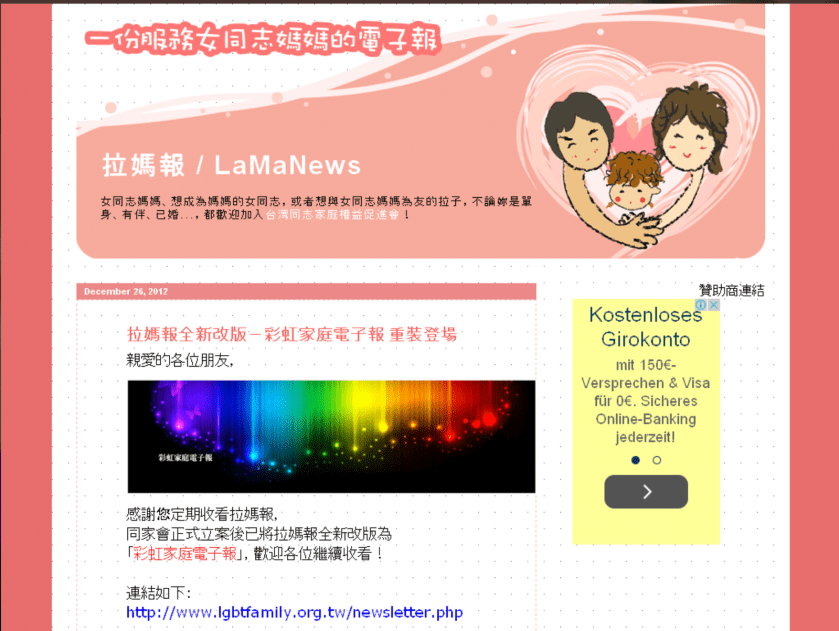
Image credit: Screenshot from the Taiwan Cultural Memory Bank source website. The image shows “LaMa News,” an electronic newsletter that originated as a collaborative publication between lesbian women in Hsinchu and the nationwide LGBTQ movement organisation “Lesbian Motherhood,” founded in 2005. In 2012, as the publishing body gradually transformed into “Taiwan LGBT Family Rights Advocacy”, the newsletter was officially relaunched and registered under the title “LGBT Family Newsletter”.
Introduction
In 2019, the Executive Yuan passed a draft bill on same-sex marriage equality with the title of “Act for Implementation of J.Y. Interpretation No. 748” (《司法院釋字第七四八號解釋施行法》) on May 17 and enacted it on May 24. Lesbian couples in Taiwan have thus gained unprecedented legal recognition in Asia. Yet this landmark reform has not translated into equal access to assisted reproductive technologies (ART). Taiwan’s Assisted Reproduction Act continues to restrict ART to heterosexual married couples diagnosed with infertility, effectively excluding lesbian couples who seek to conceive biological children. As a result, a growing number of Taiwanese lesbian women are compelled to pursue reproductive care abroad.
This article illustrates the lived medical practices of Taiwanese lesbian women who engage in cross-border ART. Rather than framing these practices through the consumerist lens of “reproductive tourism,” it conceptualises cross-border reproductive care as a precarious yet agentic process shaped by legal exclusion, intense desires for pregnancy, and unstable transnational medical networks. By foregrounding the dynamic entanglement of vulnerability and resistance, this article introduces the concept of transnational relay to analyse how lesbian reproductive subjects coordinate fragmented medical, legal, economic, and logistical actors across borders in their efforts to achieve pregnancy under negotiating conditions of structural precarity.
Lesbian Reproduction in Taiwan: Social, Legal, and Medical Constraints
Historically, lesbian motherhood in Taiwan was largely associated with women who had children within prior heterosexual marriages. Before the widespread availability of ART, the identities of “lesbian” and “mother” were widely understood as socially incompatible. Lesbian partners without biological ties to children were frequently denied recognition and legitimacy, reinforcing the dominance of heterosexual, blood-based kinship norms.
Beginning in the early 2000s, lesbian communities developed informal knowledge-sharing practices around self-insemination techniques and donor networks, forming grassroots support systems outside formal medical institutions. These practices were closely aligned with feminist health politics, which emphasised bodily autonomy and resistance to medical overintervention. Since the 2010s, however, overseas ART, particularly in vitro fertilisation (IVF), has become more common among Taiwanese lesbian couples. Clinics abroad offer higher reported success rates, access to legally regulated donor sperm, and technologies such as ROPA (reception of oocytes from a partner), which enable both partners to establish biological connections to their children. While these options expand reproductive possibilities, they also entail intensified medical intervention and heightened health risks.
The shift from low-tech, community-based insemination to highly medicalised transnational reproduction mirrors long-standing feminist debates: does reproductive technology enable women to emancipate themselves from heterosexual reproductive norms, or does it further subject their bodies to medical control? For lesbian women, this dilemma is intensified by legal exclusion, which renders cross-border reproduction not a matter of preference but, in many cases, a structural necessity.
Reproductive Exile: Vulnerability and Agency in Cross-Border ART
Cross-border reproductive care is often described as an expression of consumer choice under the rubric of reproductive tourism. Such narratives, however, obscure the structural inequalities that compel individuals to seek care abroad. For Taiwanese lesbian women, reproductive mobility is rarely elective; it is more understood as the outcome of legal exclusion at home. Scholars have therefore proposed the concept of reproductive exile to foreground the coercive dimensions of cross-border reproduction.
At the same time, portraying lesbian reproductive subjects solely as victims risks flattening their lived experiences and erasing their agency. Numerous participants in this study possessed substantial cultural, economic, and informational resources, which enabled them to navigate foreign medical systems with considerable competence. This dual condition, in which structural vulnerability coexists with strategic decision-making, echoes Judith Butler’s argument that vulnerability and resistance are not oppositional but mutually constitutive. Lesbian women’s reproductive bodies become exposed to heightened medical risks precisely through acts of resistance against heteronormative reproductive regimes. Their bodies thus emerge as sites where legal exclusion, medical authority, emotional aspiration, and logistical coordination converge and collide.
Risk Choreography, Logistical Action, and the Concept of Transnational Relay
Building on scientific and technological studies, this article conceptualises reproductive decision-making as a form of risk choreography—a process through which individuals assemble heterogeneous actors to manage shifting definitions of risk. For lesbian women pursuing ART abroad, risk extends well beyond clinical success rates to include job precarity, financial strain, legal ambiguity, and logistical disruptions.
Additionally, the article draws on the concept of logistical action, highlighting how reproductive subjects must actively coordinate fragmented systems. Lesbian women frequently act as project managers of their reproduction, synthesising information across clinics, sperm banks, airlines, immigration authorities, and domestic healthcare providers.
From these analytical threads emerges the transnational relay. Cross-border reproduction is considered a relay process in which incomplete tasks—medical procedures, hormonal monitoring, and gamete transport—are sequentially passed among actors across time and space. Reproductive success depends less on any single institution than on the continuity of fragmented connections across borders.
Crucially, instability within the relay network constitutes the primary source of risk. Disruptions such as conflicting medical protocols, delays in sperm or embryo shipping, visa complications, or sudden regulatory changes can derail entire reproductive trajectories. Lesbian women must therefore engage in continuous repair work to sustain reproductive momentum.
Two-Stage Medical Strategies and Reproductive Health Risks
To cope with work constraints and financial pressures, many participants adopted a two-stage medical strategy. One is that preliminary monitoring and hormonal treatments were conducted in Taiwan, while critical procedures such as egg retrieval or embryo transfer took place abroad. While this approach reduced time off work and travel expenses, it also introduced significant inconsistencies in medical care.
Divergent clinical protocols, communication gaps between physicians, and limited follow-up increased health risks. Some participants reported experiences of ovarian hyperstimulation syndrome, repeated implantation failure, and psychological distress generated by prolonged uncertainty. In extreme cases, logistical breakdowns resulted in pregnancy loss or enduring health consequences. These outcomes exemplify what this article terms reproductive health precarity—a condition in which individuals are unable to fully anticipate or control reproductive health due to structural instability. Unlike generalised medical risk, reproductive health precarity is produced at the intersection of legal exclusion, transnational fragmentation, and unequal access to continuous care.
Conclusion: Vulnerability and Resistance Revisited
Viewed through the lens of transnational relay, lesbian reproductive practices appear neither fully emancipatory nor entirely oppressive. Cross-border ART enables lesbian women to form families and challenge heteronormative reproductive systems, yet these acts of resistance simultaneously expose their bodies to disproportionate medical, emotional, and economic strain. This dialectic underscores Butler’s insight that resistance is both embodied and relational. Lesbian women’s reproductive agency is sustained through networks that are at once enabling and hazardous. Their success in achieving pregnancy often comes at the cost of heightened vulnerability.
By foregrounding reproductive health precarity, this article calls attention to the unequal costs borne by sexual minorities in their pursuit of family formation. Legal reform alone is insufficient to address these disparities, as cross-border ART has become structurally embedded in lesbian reproductive imaginaries and practices. Meaningful reproductive justice, therefore, requires not only expanded legal access but also sustained attention to health equity, continuity of care, and the lived realities of marginalised reproductive subjects.
Dr Yu-Ying Hu is a professor at the Graduate Institute of Gender Studies at Kaohsiung Medical University. Her research interests encompass LGBTQ+ identities and movements, transnational cultural politics, LGBTQ reproductive health, and the intersection of nationalism and gender politics. She is currently conducting research on the transnational reproductive practices of Taiwanese lesbian women and the intersection of LGBTQ identities with Taiwanese nationalism. This article is adapted from a journal article published in 2025 by the Journal of Women’s and Gender Studies. Please refer to the original publication for a full discussion of the topic.
This article was published as part of a special issue on Zeroing Fertility: Family-making and Future Parenthood.
 Taiwan Insight