
Written by Dr Josie-Marie Perkuhn and Assistant Professor Dr Amélie Keyser-Verreault.
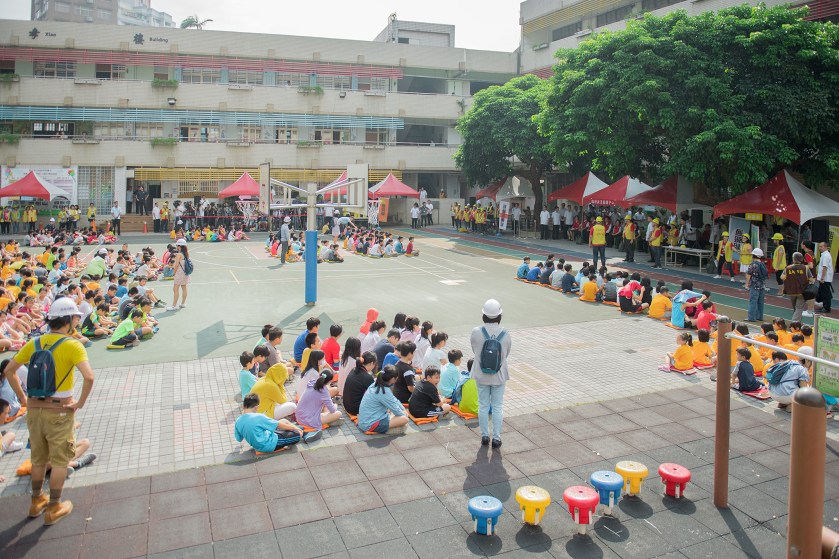
Image credit: Office of the President, Republic of China (Taiwan) | Government Website Open Information Announcement. / Wikimedia, license: CC BY 2.0.
Children are under increased surveillance – an issue of digitally connected societies
In the Taiwanese context of a persisting ultra-low fertility crisis, CCTV systems are increasingly being implemented in childcare and educational settings to enhance child safety and security. While there’s a general push for increased surveillance to protect children, particularly in kindergartens and day-care centres, there are also ongoing discussions about balancing safety with privacy concerns. Support and concerns can be voiced via the governmental-initiated petition platform Join (公共政策網路參與平臺), and we wanted to know if and how?
Digitalisation is a condition of the twenty-first century and has emerged as an omnipresent megatrend of our times. As such, it entered and shaped our daily life. Keeping children under close surveillance while taking care of them is one feature of the spread of digital applications in our societies. Establishing a government-run petition platform for democratic participation is another feature of a digitally connected society. The reception of digitality varies greatly; each subsection of personal life entails different merits of convenience or safety and perils of unsafeness or vulnerability. One of the expressed goals of TAP’s research agenda focused on synergies of interdisciplinary and cross-perspective collaboration to tackle specific topics of these intersections linked to megatrends of the twenty-first century. In this research agenda, Amélie Keyser-Verreault and Josie-Marie Perkuhn collaborated on the digital connected society. They analysed the petitions about children under surveillance, combined with the attitude of the general public.
Defining a research agenda for a cross-perspective approach on the intersection of digitality and children under surveillance
In our cross-perspective approach, we shed light on this intersection of digitality and analysed the submitted petitions to the Join platform and present results from a self-commissioned survey. The debate on data protection and governmental involvement in personal life has been an issue from the beginning: In 2017, petitions concerned, for instance, a personalised parenting service (個人化育兒服務) to support new parents and support organising the healthcare procedures. At that initial phase, neither the number of supporters nor comments achieved high numbers. Over the past years, the usage of the petition platform increased. That changed over time. Based on a self-conducted analysis comparing three four-month periods during 2022 to 2025, not only did the number of submitted proposals increased but also the success rate. More proposals reached the threshold of 5000 supporters and got transferred to the authorities, including the topics on monitoring children. For this paper, we selected one example that was issued in December 2022, which passed the threshold and attracted more than 50 comments either supporting or objecting, as an indicator of being a topic of important concern and ultimately an indicator of how widespread the support for monitoring children while in day-care centres is. To check for whether and how this topic on children under CCTV surveillance is received in the broad public, we included three questions on the topic of children under surveillance in a TAP-initiated Taiwan-wide survey on “For your safety: concerns, preparation and your opinion on Taiwan’s future in the 21st Century” that was conducted in collaboration with the NTU WEB Survey Service in August 2025. In the questionnaire, we covered four main topics on digital democracy, energy security and transition, cybersecurity, and international cooperation with the EU/Germany (For more information on the results from this survey, see also the Commonwealth Magazine article). 1,140 valid questionnaires were completed of distributed 1,200. From this sample, we selected two sets of results confirming the general public interest in this topic.
What do people petition for when it comes to children under surveillance?
On December 13, 2022, the registered user Leon petitioned for the installation of surveillance cameras to monitor children while being in kindergarten or day-care (立法幼兒園全面安裝監視器). Until the petition closing response stage on February 2, 2023, the petition reached 5828 supporters and received the required authority response on March 25, 2023. The content of this proposal concerns Article 13 of the Preschool Education Act (教保服務人員條例), which describes the regulations of misconduct and discharge of employees. Any educator under this regulation shall be determined for a period of between one and four years, during which that educator is not permitted to be appointed or employed as a preschool educator. Article 13 lists five circumstances, including violation of the Child and Youth Sexual Exploitation Prevention Act or the infliction of corporal punishment that caused physical or mental injuries. The proposal claims that this regulation fails to define improper discipline and child abuse and lacks clear regulations on how to obtain or preserve evidence of cases of child abuse (不但沒有訂出不當管教與虐童的定義,也沒有明確規定在兒虐事件中,如何取得及保全兒虐證據). Instead, the proposal recommends four points, including the installation of surveillance cameras in all kindergartens (1, 立法幼兒園全面加裝監視器), mandating that footage should be stored for 30 days and be uploaded to a cloud for storage (2, 應立法30天內的影像上傳至雲端保存) and the establishment of a reporting mechanism, so that it can serve for authorities and the police as evidence in investigations (3, 幼兒園之監視器應由主管機關及警察兩方均可以通報檢舉方式保留,並作為主管機關及調查委員會調查兒虐過程之證據). A fourth commendation demands similar penalties for the kindergartens if surveillance cameras are damaged or the material is destroyed or tampered with (4, 幼兒園若擅自丟棄及破壞監視器等相關設備,幼兒園之罰則應比照兒少體罰、霸凌等相關法令,幼兒園才沒有動機動監視器設備). In the following subsection, the submitter elaborates on the interest and impacts to support his claims.
Before closing, the petition received 74 supporting comments and 18 opposing ones. Several comments received further expressions, such as likes or dislikes. The comment #13 by Joanne, for instance, seconded the claim and demanded a real-time connected surveillance camera, which would allow the parents to watch the class immediately” (issued on December 2, 2022). Her comment received 95 likes and 15 dislikes. One opposing comment by Stella L (#3, issued on December 2, 2022) added the hope to reduce the teacher-student ratio, while maintaining the quality of teachers’ work, yet reduce their workload. This post received 18 likes, but no dislikes. The Ministry of Education responded in four stages and elaborated on how they would act on this petition. (For further information, see their responses in the subsection, Agency Response 機關回應). This proposal and the reached number of supporters demonstrate that this topic is not only debated among parents but also an issue within the netizens and petitioning community. From this limited insight, we perceive a positive attitude towards the usage of CCTV cameras to monitor children. But what is the general public’s attitude towards this matter?
Should children be under such intensive monitoring? – Outcome of Survey Results
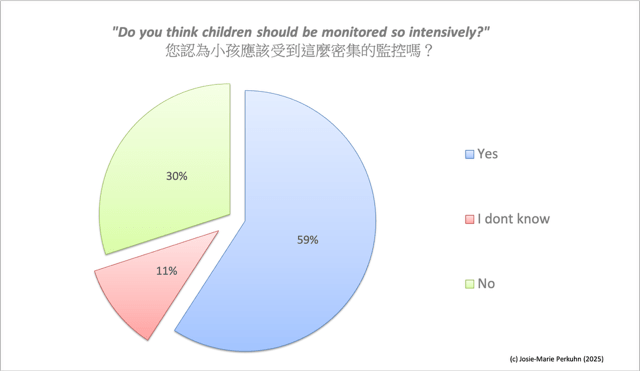
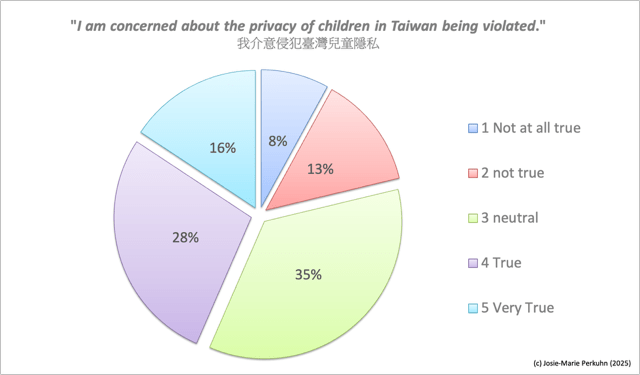
According to the survey results on the question “Do you think children should be monitored so intensively?” (您認為小孩應該受到這麼密集的監控嗎?) [Include Illustration 1, see below], almost 60 per cent of the respondents tend to a positive attitude and stated ‘yes’. Only one-third objected to the intensive monitoring, and eleven per cent had no opinion, as of “they don’t know”. In the following questions, we introduced the risk of privacy breaches and asked “to what extent do the following statements describe your thoughts” (關於隱私洩露風險,以下敘述在多大程度上符合您的想法?). The respondents were required to select from a 5-step scale, 1 indicating “not true at all” (完全不符合) and 5 “very true” (非常符合). On the statement “I am concerned about the privacy of children in Taiwan being violated” (我介意侵犯臺灣兒童隱私), the largest share, 35 per cent, selected the median scale, which indicates that they don’t have a particular opinion of support or objection on that matter. While only eight per cent strongly disagree with the statement and 13 per cent tend to disagree, 16 per cent agreed fully with this statement, and the remaining 28 per cent tend to agree. Over two-fifths of those surveyed agree, which indicates that the respondents are rather concerned with the Taiwanese children’s privacy when asked about possible privacy breaches. The set of these two questions indicates that the general public also has an overall positive attitude towards monitoring; however, being confronted with digital vulnerabilities of misconduct of surveillance, the results shift towards privacy concerns.
Conclusion: Surveillance technologies are a topic of democratic petitioning
Overall, we figure that innovative technology is rather seen as a means to improve life and convenience. Using digital devices to monitor underage or preschool children when in day-care centres benefits the safety demands of parents and is supported by the general attitude. However, further discussions also question vulnerabilities and safety breaches.
Advocates of children’s safety organise to submit petitions via the established online platform for public petitioning and successfully seek democratic support for their requests.
In sum, amidst a demographic crisis characterised by declining birth rates, people are having fewer children. Yet this also means each child receives heightened parental attention and significant investment. Technology and childcare are becoming increasingly inseparable. For instance, for safety reasons, more children possess mobile phones and smartwatches to maintain contact with parents and alleviate parental anxiety when separated. Consequently, this topic of how digitalisation and childcare intersect will significantly increase in importance in the foreseeable future, with associated ethical controversies growing ever more diverse. These include balancing technological convenience with personal safety, children’s autonomy and decision power, data security, growing dependence on digital devices, and the resulting need for digital detox. These will be key topics for us and scholars across various disciplines to address and debate.
Dr Amélie Keyser-Verreault is a researcher at the Institute of Ethnology of Academia Sinica. Her research focuses on body politics, gender, resistance and the family in East Asia in general and Taiwan in particular. She is currently conducting a social demography research project on the choice of young Taiwanese not to start a family. Her work has been published in journals such as the Journal of Gender Studies, Feminism and Psychology, The Gerontologist, Asian Anthropology and Chinese Sociological Review.
Dr Josie-Marie Perkuhn leads the joint postdoc research project Taiwan as a Pioneer at Trier University and is a non-resident fellow at the Institute for Security Policy at Kiel University (ISPK). She graduated in Political Science and Chinese Studies and received her PhD from Heidelberg University in 2018. Her current research focuses on responses to the challenges of the 21st Century, such as Digitalisation, Energy and Climate, and Global Health. Her research portfolio includes Security & Strategy, Peace Studies, and China’s role in international relations and the Arctic. Being a member of the East Asia Institute (OAI e.V.), she engaged in cultural heritage and people-to-people diplomacy. In 2023, she was nominated to the German-Taiwan Dialogue Platform (DTDP) initiated by the Ministry of Foreign Affairs.
This article was published as part of a special issue on ‘Taiwan as a Pioneer (TAP): Visions and Practices’.
 Taiwan Insight