
Written by Chee-Hann Wu
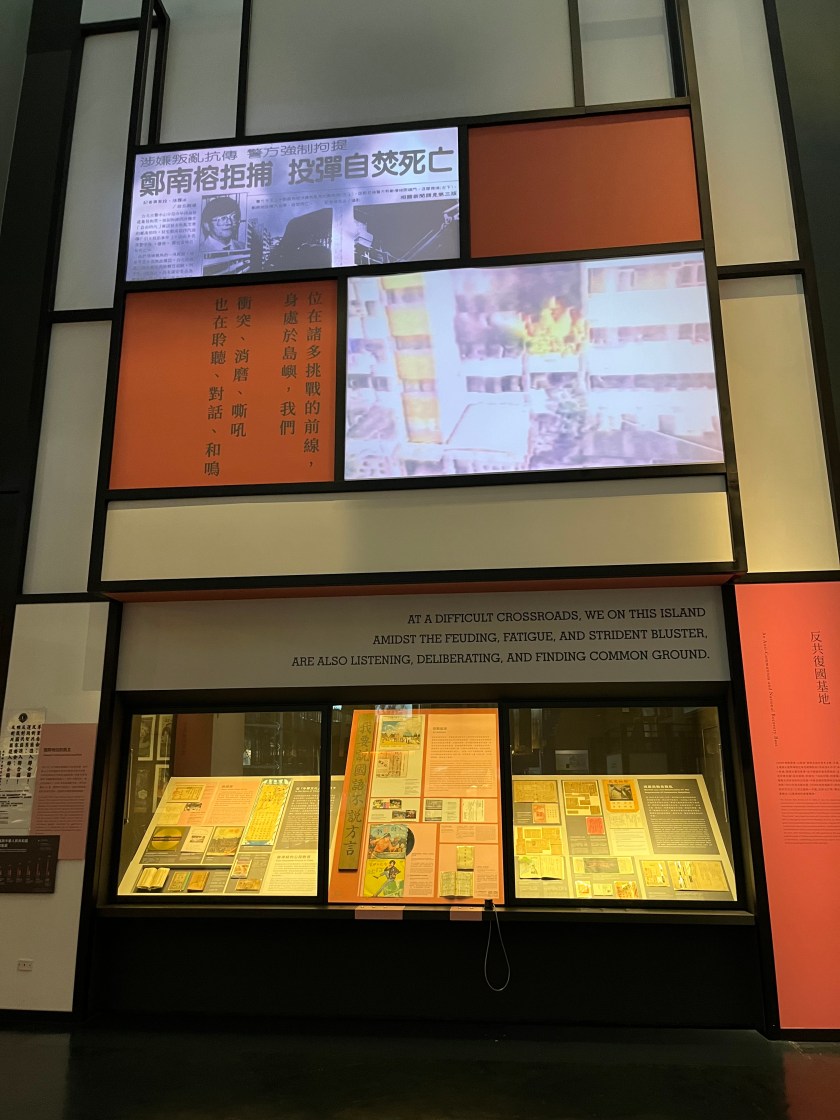
Image credit: Provided by author. National Museum of Taiwan History, Tainan, Taiwan.
This is the second part of my article exploring the ethics of storytelling amid the controversies surrounding The Century Bloodshed, as someone who teaches college students in drama and theatre. I shared the incident and discussed ethical duties as artists and storytellers with my students. The article reflects our genuine thoughts.
As the controversies surrounding the production of The Century Bloodshed deepen, some recurring questions have resurfaced: “If other films have done this, why can’t The Century Bloodshed?” Some advocates, in a particularly confounding move, elevate artistic freedom to an almost sacred status while overlooking questions of social responsibility and conflating ethical boundaries with censorship. They ask: “Isn’t art meant to stand on its own, separate from politics? Haven’t we always insisted that politics has no place interfering with artistic expression?”
While we all agree that artists’ creative freedom must be protected in a democratic society, protecting that freedom also means valuing ethical boundaries and recognising the responsibilities that accompany it. We live in an age inundated with a persistent influx of information, misinformation, and disinformation from countless outlets. In this environment, artists need to be well aware that spectators tend to consume whatever is fed to them. Therefore, artists bear responsibility for both the content they create and the narratives they construct. For a fictional film depicting an actual event, particularly an unsolved murder case under an authoritarian regime, this responsibility becomes even more significant. The creators carry a heavier ethical weight than they might for purely fictional works.
Accountability is what genuinely supports free creative interpretation and expression. True artistic responsibility involves more than simply treating one’s subject with respect; it requires understanding the fundamental difference between telling a story about someone and telling a story for someone. This distinction highlights the major flaw in evaluating The Century Bloodshed. The absence of prior permission or authorisation from the victims highlights the production company’s exploitation of the Lin family’s trauma in the name of creative freedom. The sheer existence of this film serves as a public reminder of the family’s excruciating pain. It reopens the old wound while simultaneously inflicting new ones.
A true-crime novelist once said in an interview that she knew her work would likely cause people pain. However, she then added an important caveat: “I never fooled myself into thinking that I was offering any kind of resolution to the victim’s family members or friends.” We should never presume that a fictionalised story or characters can resolve the trauma of real people. This principle explains why the statements made by actresses Candy Yang (楊小黎) and Lee Chien-na (李千娜) provoked such outrage.
Yang exclaimed that she felt “close to history” while maintaining “her own creative space”, and she further compared her partnership with actress Jian Manshu (簡嫚書) in investigating the Lin family murders to “Sherlock Holmes and John Watson solving a case together.” Lee similarly expressed that if people “only look this up online, they’ll always be stuck living in that moment of fear. But if it gets revisited or reinterpreted, it might allow people to re-examine what happened and see it as something less severe or less terrifying, offering a new understanding instead.” A rumour circulating also notes that the film suggests a final revelation of the true murderer, despite many official case documents remaining classified as state secrets.
“Not all stories are yours to tell.”
One of my students offered an insightful comment that captures the heart of this controversy, emphasising that even when we feel genuinely motivated and have a strong sense of mission to tell an untold story, even with the best intentions, sometimes we must simply recognise that “not all stories are ours to tell.” The question of culpability is complex. Despite being unsure of the full extent to which we should blame the actors, whether their choices stemmed from naivety, ignorance, or actual vice, there is undoubtedly a significant gap in their awareness. Kind-heartedly, I prefer to believe they were like my elementary-school self, who simply did not know. They had no clue this wasn’t their story to tell.
But what of the production company, the creative team, and the director? Did they know? Another major controversy of the film lies in the fact that the director, Hsu Kun-hua (徐琨華), is the grandson of Hsu Mei-lin (徐梅鄰), a spokesperson for the Taiwan Garrison Command at the time of the killings. While nothing is certain, it is widely believed that the Lin family’s murder was related to the Taiwan Garrison Command, as Lin was a political prisoner at that time. On this note, actor Johnny Kou’s (寇世勳) comment that the film contains no “political ideology” becomes deeply ironic. Resonating with my earlier argument, given the director’s background and the actors’ attempts to reframe the narrative and depoliticise the subject matter, many people reasonably suspect that the film intends to whitewash crimes committed by the state during the White Terror period.
A student raised a critical question about whether anyone would benefit from this film. Aside from the troubling possibility of state whitewashing, if a piece of art depicts someone’s trauma, it at least has to contribute meaningfully to their situation. For instance, students shared that some profits from true-crime novels or documentaries will be donated to organisations that support the victims, their families, or people in similar positions. This approach might not ease the pain of those who have suffered, but it can potentially raise awareness or prevent future tragedies.
Instead, we see cast members suing the production company while the director and producer avoid addressing the actual problems. Despite various public apologies, no one appears willing to take genuine accountability. Performative sadness or remorse cannot replace sincerity, respect and care for the people whose story is being told.
To conclude, being respectful means more than simply informing victims and their families about consent for the work; it means granting them genuine agency – the opportunity to decide for themselves and to voice their thoughts and feelings about the work. Victims are inherently deprived of power and agency in the face of their trauma. In the case of the White Terror, many victims were silenced or simply disappeared; it has been a very difficult task for transitional justice to try to retrieve what has been suppressed, hidden, erased or distorted.
Lin’s former colleague, family friend and the first witness to the murder, Tien Chiu-chin, has attended a plethora of interviews to bring attention to the case. In one such interview, she harshly questioned the film producers: “You don’t know how much courage it took for Lin and his wife to live. [. . .] Have you ever taken the time to listen to what we’ve truly experienced?” Giving voice to the victims is, at the very least, one of the very few things artists can do to honour their presence and restore their agency. Yet this essential truth remains clear: the story will always remain theirs, and to no one else.
Chee-Hann Wu is an assistant professor and faculty fellow in Theatre Studies at New York University. She is drawn to the performance of, by, and with nonhumans, including but not limited to objects, puppets, ecology, and technology. Chee-Hann has recently published two journal articles, exploring Taiwan’s White Terror memories through the video game Detention and children’s puppet theatre. Another contribution to an edited volume on the White Terror-themed VR short film, The Man Who Couldn’t Leave, is forthcoming. She is also a part of the crowd who have been taking “make-up classes” on Taiwan’s past history in recent years.
This article was published as part of a special issue on “Thirty-Nine Years after Martial Law: Fractured Truths, Silence, and Unconscious Forgetting“.
 Taiwan Insight