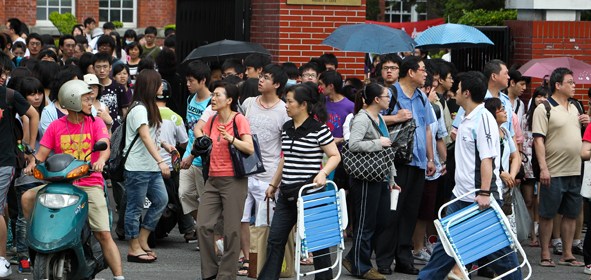
Moving Toward a More Inclusive Society: The Educational Policy of New Immigrant Children in Taiwan

Written by Dorothy I-ru Chen. Ethnocentrism is often found in a highly homogenous society like Taiwan. There have been stereotypes and bias against new immigrant children over the years. Studies conducted in the early days suggested that these children’s academic achievements were lagging. Moreover, these studies failed to recognise the problem may lie within schools which are not capable of meeting the needs of children from diverse cultural backgrounds.

Welfare State System Development in Taiwan: The Causal Determinants of the Past and the Future

Written by Christian Aspalter. Taiwan today has a relatively comprehensive welfare state system due to the work of Lee Teng-Hui and millions of Taiwanese. These citizens pushed the very same man to open and safeguard the process of democratisation back in the late 1980s, and to set up the first major system of the Taiwanese welfare state, the universal National Health Insurance, back in 1996. Lee listened to what people wanted, and that means all of the Taiwanese people, not just the elite, the ancient regime of the Kuomintang (KMT) or the business tycoons. Other leaders behaved quite differently.

Social Inequality, Score Ladders, and College Choice in Taiwan’s Expanded Higher Education

Written by Ruo-Fan Liu. If you travel to Taiwan in February or July, you will probably hear people talk about their children’s exam scores in MRT stations, coffee shops, and traditional markets. These days, high schoolers are busy applying for colleges, sustaining admissions from selective universities, and hoping that what happens at this stage in their life will set themselves apart from peers in the future. Since the Taiwanese Government expanded higher education and diversified admission channels for different kinds of students, this process has become more complex, and admission rules are continually changing.

New Curriculum, Same Problems? Can the New 2019 High-School Curriculum Help Tackle Inequality?

Written by Yi-hui Lee and Kai-chieh Yang. As a result of geographic and economic factors, educational recourses have long been distributed unevenly in Taiwan. This has long caused some disquiet. The effect of this recourse inequality worsens at every stage of the education system and severely hampers class mobility. The new “school-determined curriculum,” which is so central to the 2019 curricula reforms, will change many of the compulsory class requirements for high-schoolers in Taiwan. With inequality being such a clear issue, it is essential to ask: what affect will this have on the uneven recourse distribution across schools?

More Channels, More Inequality? the Debate around University Admissions Reforms

Written by Jen-Chen Chao. Up until the 1990s, all university applicants in Taiwan were allotted university places based solely on their test scores on a standardised exam. This was generally seen as leading to a high-pressure environment in which students had to prepare endlessly for a high-stake test. Recent attempts by the Government have tried to alleviate some of this pressure whilst also promote the learning and developments of students.

1 2 3