Hong Kong’s National Security Law 3 years on – Taiwan should build a defence

Written by Michael MO. Hong Kong’s pro-democracy struggle was a hot-button issue in 2020’s Taiwan presidential election campaign. Both President Tsai and former head of Executive Yuan Su Tseng-chang took the city as a case in their speeches to remind the Taiwanese to defend the island and not turn Taiwan into another Hong Kong. Three years on, specific policies to guard the country against the potential legal and political harassment from the extraterritorial application of the NSL remain non-existent. While the issues of Hong Kong may no longer be a concern in the presidential race, the need to build a robust defence to protect Taiwanese interests in Hong Kong should still be on the political agenda of the island.

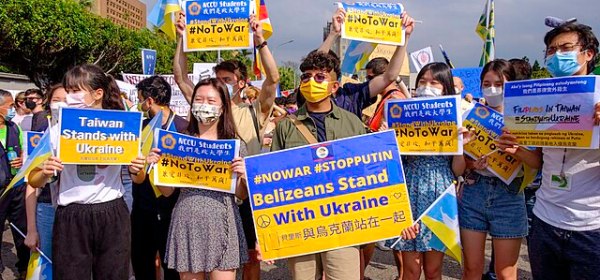
A lesson from the Russo-Ukrainian war for Taiwan: Connection

Written by Patricia Elnakhal, H.K. Wind and Fengze Strategy. Currently, the controllable intensity on the Taiwan Strait can potentially escalate. The growing frequency of analogous cases that several military aircraft from the mainland flying into the island’s air defence zone cause the intensity on this territory, while the situation is still under control because these actions are mainly for strategic purposes. More importantly, none of the powers is fully prepared for uncontrollable collisions, but the situation’s development indeed keeps invisibly escalating. As a lesson from the Ukraine war, Taiwan has to construct an unbroken and heavy rope connecting itself to the international community to prepare well earlier for various possibilities. The connection between Taiwan and the international community could be observed through two main aspects: the diplomatic interactions connecting to international politics and the economic development connecting to the international market.

Reflecting on the Laguna Woods Shooting Tragedy: One Year Later

Written by Wayne Huang. On May 15, 2022, a fatal shooting occurred at the Irvine Taiwanese Presbyterian Church in Laguna Woods, California. During a lunch reception, the gunman locked the doors and opened fire with approximately a hundred people present. The church has been recognised for its significant role in Taiwan’s democratisation and independence movements since the 1970s. It has led to the suspicion that this historical connection motivated the assailant to travel over a hundred miles from Las Vegas to target the church. The shooting resulted in six individuals being shot, including Dr John Cheng, who lost his life while attempting to disarm the gunman. 

Is Going Green Hurting Indigenous Communities? Reflection from Participating in the United Nations Permanent Forum on Indigenous Issues 

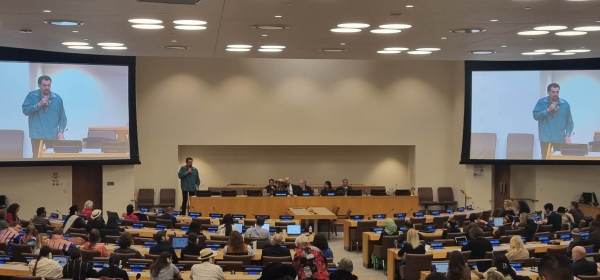
Written by Wasiq Silan. Is going green hurting Indigenous communities? Not necessarily. However, exclusionary conservation measures create a lose-lose outcome for non-Indigenous and Indigenous communities. Indeed, Indigenous peoples’ full and substantial participation is a prerequisite to achieving a sustainable future and halting the rapid loss of global biodiversity. This is true for the Indigenous communities in Taiwan, such as in the case of the solar panel controversy on the Katratripulr Pinuyumayan (Beinan in Mandarin Chinese) people’s traditional territory. Drawing from the experience of the Sámi, my recent participation in the United Nations Permanent Forum on Indigenous Issues (UNPFII) may shed light on this issue.

Progress or Not? An Assessment of the Significance of Liz Truss’ Taipei Visit

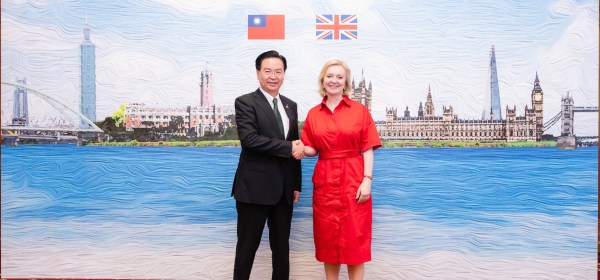
Written by Milo Hsieh and Wei Azim Hung. At a time when Downing Street seeks to recalibrate its relationship with Beijing, Liz Truss’ Taipei trip has raised eyebrows and controversy in London as well as provoked strong condemnation from Beijing. For Taiwan, the trip shows that yet another former official sees Taiwan as an important part of their agenda as world leaders increasingly make Taiwan a priority destination.

Liz Truss: Fighting for Taiwan or Personal Credibility?

Written by John Burn. It was already clear from her recent speech to conservative think tank The Heritage Foundation in Washington DC that Liz Truss – the UK’s shortest-serving Prime Minister of all time – is trying to develop her image beyond the country’s shores. Being responsible for one of the most disastrous economic policy outlines in the UK’s history in her mini-budget upon coming to office, she lost public confidence and the confidence of the Conservative Party in very short order, resulting in her dismissal after 44 days in office.

Going for Low-Hanging Fruit, Deliberate Strategy, or Path Dependency?: Liz Truss’ Visit to Taiwan

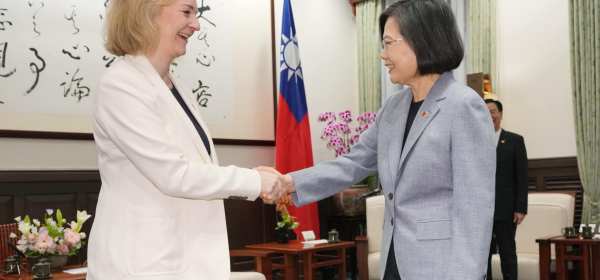
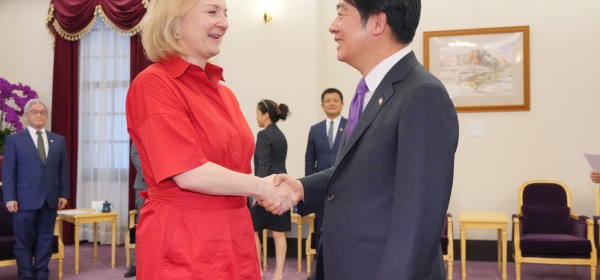
Written by Brian Hioe. Former UK prime minister Liz Truss arrived in Taiwan on May 16th for a five-day visit. Truss’ main purpose in visiting was to give a speech at the invitation of the Prospect Foundation, a think tank close to the Tsai administration. In addition, Truss met with President Tsai Ing-wen, Vice President William Lai, and other high-ranking officials.

Truss Visits Taiwan: Worth or Trouble?

Written by Huynh Tam Sang and Phan Van Tim. Liz Truss’s journey is in the limelight as the first ex-British prime minister to set foot in Taiwan nearly thirty years after Margaret Thatcher’s visits in the 1990s. Nonetheless, the worth of Truss’s five-day sojourn is a contentious issue. From one perspective, Truss’s visit is deemed immensely significant, exemplifying the UK’s unwavering backing for Taiwan amidst escalating Chinese pressure, given her enduring advocacy for a democratic Taiwan. But, conversely, others argue that her visit merely inflamed the already high-strung tensions between China and Taiwan.

An Instagram comeback tour or a sincere bid to strengthen democracy in East Asia? Liz Truss’s Taiwan visit exposes growing Conservative Party tensions over China, but either way, Taiwan still wins.

Written by Max Dixon. Liz Truss, MP for South West Norfolk and British Prime Minister for 44 days, visited Taiwan last week, between May 16th and May 20th, meeting with senior officials, including William Lai, the frontrunner to replace current President Tsai Ing-wen, and giving a keynote speech to the Prospect Foundation that called for a more stringent British approach to China. Ostensibly the visit of a former Prime Minister has been heralded as a coup for Taipei in emboldening the position of Taiwan in the global imagination amidst growing Chinese assertiveness; indeed, the Ministry of Foreign Affairs has welcomed Truss’ visit.

Leveraging Cultural Exports for Resilience: Insights from Taiwan and South Korea

Written by Tommy Hall and Margaret Siu. Global discussions about Taiwan often focus on an invasion scenario, and many observers wonder if Taiwan is adequately preparing for war. These discussions often dissect Taiwan’s hard power—military and economic factors that may dissuade Beijing. However, soft power is crucial in conflicts between imbalanced parties. Current discussion would benefit from diversifying outside hard power calculations and examining Taiwan’s soft power. Taiwan should apply lessons from South Korea’s model to bolster its ability to co-opt global support. Describing Taiwan’s soft power vision and comparing both nations’ top-down cultural promotion efforts is helpful.

How Does Recipients’ Corruption Taint the International Image of Taiwan’s Foreign Aid?

Written by Ernie Ko. Taiwan’s foreign aid, officially known as official development assistance (ODA), has rarely been mentioned as a good practice in the circle of international press and international aid agencies. On the contrary, corruption, inefficiency, non-transparency, and unaccountability are often associated with the recipient countries of Taiwan’s aid. So, the question is, does this negative stereotype unavoidable?

Europe’s Dream of Strategic Autonomy

Written by Gunter Schubert. Slowly, the dust settles after French President Emmanuel Macron’s remarkable performance during his state visit to China from April 5-7. However, it is a safe bet that his statements on the danger of the European Union (EU) being drawn into a war by the US because of Taiwan, a place of no interest to Europeans, will have long-lasting repercussions for the transatlantic relationship.

1 2 3 4 5 6 16