Taiwan and the Netherlands: What the East Asian Island Nation Can Learn from its Former Colonizer

Written by Charlie Smith. The King’s Field is a famous Japanese video game series created in the 1990s. But nearly 400 years ago, there was another King’s Field—the entire island nation of Taiwan. For 38 years in the 17th century, Taiwan was a colony of the Dutch Republic under the administration of the Dutch East India Company. And the Dutch king was the largest shareholder. 

“The Han people pioneers cleared the land, but the land they cleared was stolen from them, and they were forced to turn their labors toward tilling the so-called ‘king’s fields’,” wrote historian Su Beng in Taiwan’s 400 Year History. “Moreover, most of what they achieved was given over, in the form of rent or taxes, called ‘king’s field rent contributions,’ for the use and enjoyment of the Dutch.”


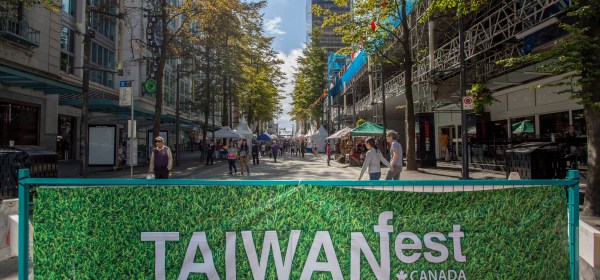
What is the significance of the dialogue with the Dutch community in Vancouver for 2023 TAIWANfest in Canada? 

Written by Charlie Smith. The Dutch Cultural Association of B.C. is trying to tell a more nuanced and complete story of the Netherlands, including the experiences of those who lived under Dutch colonial rule. Moreover, the association’s goal is to provide a richer understanding of how Dutch descendants should act as visitors on the unceded lands of Indigenous nations in Canada’s westernmost province. Oostindie believes that this has set his organization up well for a collaboration with this year’s TAIWANfest in Vancouver and Toronto. Oostinde discusses how Taiwan, the Netherlands and Canada can “have heartfelt discussions that bring these hidden histories forward. And we can learn about what it means for contemporary politics, how we work together, and how we consider democracies.” 

Beyond Chinese: The Evolution of Taiwanese-Canadian Identity in Canada

Written by Charlie Smith. At the height of the pandemic in 2020, a cultural producer generated considerable discussion within the Taiwanese diaspora in North America. It came when Charlie Wu wrote an article declaring: “I’m a Taiwanese Canadian, not a Chinese Canadian.” It was the managing director of the Asian-Canadian Special Events Association’s personal response to being constantly labelled as Chinese in his adopted country. In fact, Wu was even included in the list of the top 100 influential Chinese Canadians in British Columbia in a 2006 article in the Vancouver Sun. 

Time Travel Dialogue of Two Iconic Artists: Emily Carr (Canada) & Chen Cheng-Po (Taiwan)

Written by Charlie Smith. Emily Carr (1871-1945), who grew up on the West Coast of Canada, made her mark with vivid paintings of local scenery. She depicted changes in the landscape of British Columbia, touching upon industrialization. Carr was strongly influenced by Fauvism, which was advanced by Henri Matisse, André Derain, and other artists in France. Similarly, Taiwanese artist Chen Cheng-po (1895-1947) devoted much of his career to painting the natural landscape in bold, vivid colours. His oil paintings touched upon industrialization in Taiwan, and he, too, was influenced by Fauvism. 

Touring Indigenous music from Taiwan in Canada—the lessons of Kanatal

Written by Charlie Smith. Last September, when the band Kanatal walked onto the stage in front of the Vancouver Art Gallery, it marked a milestone. This was the culmination of the first Canadian tour by a group of Indigenous musicians from Taiwan. After performing in several Canadian cities, the four members—guitarist Masaw Ali, keyboard player Suana Emuy Cilangasay, singer Abus Tanapima, and drummer Vangacu Kalevuwan—were eager to impress a crowd that had gathered for the signature event of TAIWANfest Vancouver. 

A Dialogue between Taiwan and Canada

Written by Chee-Hann Wu. The world is filled with diverse cultures and histories, each with its unique narratives and connections. This special issue explores Taiwan and Canada’s fascinating cultural and historical ties. Despite their geographical distance, these two nations share surprising parallels that have shaped their identities and fostered mutual understanding. From immigration patterns to artistic influences, this special issue demonstrates how the cultural and historical connection between Taiwan and Canada is a testament to the power of shared experiences and the ability of diverse nations to forge meaningful bonds.   

Racing to Join the Club: A Canadian Perspective on the CPTPP

Written by Hugh Stephens. As Canada works to develop and roll out its new “Indo-Pacific Strategy,” its membership in the Comprehensive and Progressive Trans-Pacific Partnership (CPTPP) has become a cornerstone in the strategy’s thrust of diversification in Asia away from China. This is part of a perennial concern to find new markets to help offset Canada’s high degree of trade dependence on the United States. Closer economic relations with Taiwan will likely be one outcome of this strategy, although China will remain an important factor. 

A Comprehensive and Progressive Agreement for Trans-Pacific Partnership (CPTPP): A Game of Go? Or Three-dimensional Chess?

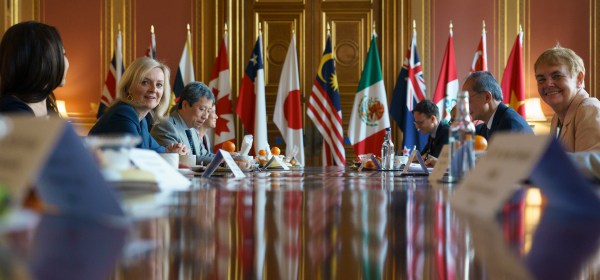
Written by Chun-Yi Lee and Michael Reilly. The CPTPP is an ambitious, wide-ranging free trade agreement (FTA) signed between Australia, Brunei Darussalam, Canada, Chile, Japan, Malaysia, Mexico, Peru, New Zealand, Singapore, and Vietnam in March 2018. The CPTPP was originally named as the Trans-Pacific Partnership and comprised twelve members. However, after the Trump administration withdrew the USA from it in 2017, the remaining eleven countries reorganised and renamed it. After leaving the EU, the UK applied to join in February 2021, followed by China and Taiwan in September. South Korea has been considering joining but has yet to do so. Countries seeking to join the bloc must negotiate tariffs and other market access conditions with each of the eleven original members.