
Written by Anthony H. F. Li.
Image credit: 嘉義縣政府.
A stable electricity supply is vital for national security, economic development as well as the everyday lives of citizens in Taiwan. Since the Democratic Progressive Party (DPP) pursued an ambitious policy to decarbonise the electricity sector with renewable energies and to phase out nuclear energy by 2025, the discussion on whether Taiwan is facing a shortage of electricity amidst the process of energy transition emerges on the social agenda from time to time.
Harnessing its presidency-parliamentary dominance since 2016, the DPP successfully made amendments to the Renewable Energy Development Act in 2019 and 2023, the Electricity Act in 2017, and the Climate Change Response Act (formerly known as Greenhouse Gas Reduction and Management Act) in 2023, to pave the legal foundations for the promotion of renewable energies with the mix of voluntary participation in and mandatory installation of renewable energies in the context of the liberalisation of the electricity sector. According to the statistics by the Energy Bureau, renewable energy development, especially solar energy, benefits enormously from the DPP’s policy to subsidise installation with the feed-in tariff. Renewable electricity generation significantly boosted from 4.06% in 2015 to 8.27% in 2022. In the same period, electricity generated from nuclear energy decreased from 14.13% to 8.24%. While the government celebrates the use of nuclear energy now lower than that of renewable energies for the first time, the achieved electricity generation is far short of the target of 20% of electricity generated from renewable energies by 2025 set by the Executive Yuan in 2019. The head of the Ministry of Economic Affairs, Wang Mei-hua, admitted in early 2022 that it is very unlikely that the government could achieve the original target, citing an underestimation of the electricity consumption growth.
Social costs of top-down solar energy development
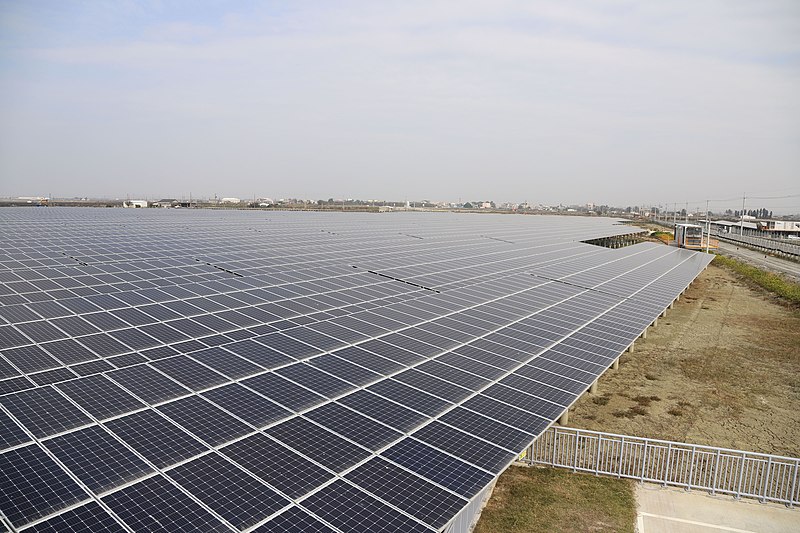
The aggressive target of renewable energy development with an emphasis on solar energy is principally facilitated by commercial solar energy companies, and it comes with a price as social controversies loom large over the massive grabbing of spaces for other valuable uses such as agriculture in Pingtung County and wetland conservation in Tainan City with the lucrative subsidy from the government. Without much knowledge about the social and environmental impacts of solar energy installation on the neighbourhoods, local residents have reasons to worry about the potential pollution from solar panels and the encroachment of the installation on their lived space, which usually leads to their confrontation with solar energy companies.
Moreover, power blackouts have occurred more frequently since 2016, with four unscheduled territory-wide blackouts in 2017, 2021, and 2022 respectively, accompanied by sporadic regional blackouts in the meantime. These incidents not just galvanised the general public into discontent amidst the heat, but they also embarrassed the government, which repeatedly said they were taking every measure to prevent it from happening after the first one in August 2017. In May 2021, when territory-wide blackouts happened twice within a week, President Tsai expressed her sorry with a sense of helplessness. However, even with such political attention from the top, large-scale blackouts occurred once again in March 2022. The then Chairperson of the state-owned Taiwan Power Company (TaiPower) explained that the massive amount of renewable energy which fed into the existing electricity grid complicated the system more than ever. The government investigated each power blackout with a technical report and implemented plans to minimise the chance of re-occurrence, such as the multi-billion programme to strengthen the resilience of electricity infrastructure in the coming ten years. Yet, no matter if it is attributed to the manual malpractices by individual operators, the insufficiency of stand-by generation capacity below the alarming level, or the outdated transmission system awaiting to be upgraded, citizens on the receiving end of electricity supply might easily interpret these power blackouts as a shortage of electricity as they could not get electricity when needed. As a result, the government’s energy policy becomes the target of criticism. While the government continues to stress that the electricity supply is sufficient for industrial and household consumption, Mark Liu, the Chairperson of TSMC with huge electricity demand, hinted at his shaken confidence in Taiwan’s electricity supply when he expressed an ambiguous comment in June 2023.
Mockery about electricity generation with love
The public grievances against the sporadic power blackouts culminate in the creative use of ridicule and memes online. It is not uncommon to see that netizens use the phrase “Generating Electricity with Love” (yong ai fa dian 用愛發電) to joke about power blackouts. The phrase originated from the protest of about one hundred environmental groups against the continued use of nuclear energy in 2015 after four years of the Fukushima Nuclear Accident. According to the spokesperson of the Homemaker United Foundation, which led the procession under this slogan, the phrase was meant to represent the love for future generations free of the negative consequences of nuclear energy. Yet, the phrase was later misinterpreted as an unrealistic ideal proposed by radical environmentalists and was taken as a ridicule detached from its original meaning. For example, on the social media Facebook, netizens shared memes about the power blackout in August 2017, teasing the fragility of the electricity system with the phrase.
On the online platform PTT, the phrase began to gain traction with the discussions to ridicule power blackouts since June 2022. On another online platform, Dcard, the phrase’s usage could date back to April 2015 and is more diverse in its used contexts. For example, in early 2023, some young netizens expressed frustration with the DPP with the phrase in a similar fashion. Others used the phrase as a metaphor to suggest the fruitless efforts they could make to improve the political situation. In one post on 21st March 2023 with over 80 comments, a writer lamented the poor quality of candidates from the KMT and the poor performances of the DPP in the past years, asking if all young people can do is “Generate Electricity with Love”. In non-political contexts, the phrase is used in a slightly more positive way, which refers to the passionate support for pop stars or a worthy cause, but it bears the connotation of idealism, which cannot be sustained for long.
In the mass media, its usage by the Nationalist Party (KMT) is usually associated with the accusation of the DPP’s lack of real efforts to ensure a stable electricity supply. For example, in March 2022, the leader of the KMT, Eric Chu, mocked the DPP with the phrase for failing the Taiwanese and Taiwan’s economy after the recent territory-wide blackout. Besides, there was also a surge in the Taiwanese’s search for “Generating Electricity with Love” soon after that particular power blackout (Figure 1), which suggests the popularisation of the term after the incident.

Figure 1: Relative search frequency of the term “Generating Electricity with Love” by Google users (Source: Google Trend)
Conclusion: The call for a more inclusive public engagement
Given the complexity of the electricity system, there are many uncertainties about the energy transition process in terms of the knowledge required to achieve decarbonisation. The set of values which underpins the policy guiding such a process is also subject to debate. The land grabbing and the power blackouts in Taiwan demonstrate that the energy transition is likely to be a process filled with trials and errors, which requires both input and political support from the public, not just with the technocratic know-it-all and the appeal to the pro-environment ideology of a political party. The political nature of the energy transition certainly makes it harder to reach a consensus, especially with the pro-nuclear advocacy in the politically loaded media context and the disinformation campaign by Mainland China against the DPP in Taiwan. For these reasons, it is important to engage the general citizens not in a tokenistic manner, leaving them only with the power to mock using the phrase “Generating Electricity with Love” as the “weapon of the weak”, but in a more inclusive way with rolling institutional channels to incorporate their interests into the policymaking, as the prerequisite for their greater acceptance of renewable energies and the associated social costs. Surveys conducted by the TAISE consistently suggest that the majority of the Taiwanese are supportive of renewable energy development, but their support is likely to be conditional upon the benefits they receive in relation to the social costs they need to bear. Overlooking the political need by the ruling party for a more inclusive and dynamic public engagement might be desirable in the short run for the sake of administrative efficiency, but this could hinder the progress of the energy transition in the long run with the fading public support, which will paradoxically make future energy transition more challenging.
Anthony H. F. Li is a PhD candidate in public administration at the University of Hong Kong, specialising in institutional analysis and Taiwan’s energy transitions.
This article was published as part of a special issue on European Association of Taiwan Studies.
 Taiwan Insight