
Written by Minfan Yu.
Image credit: untitlted by chia ying Yang/ Flickr, license: CC BY 2.0.
On May 28th, the DPP-affiliated presidential campaign candidate William Lai Ching-Te (賴清德) stirred controversy by responding to a question about whether the cross-strait tensions faced by Taiwan had resulted in a shortage of natural gas for electricity production. Despite being a staunch advocate for green energy and consistently promoting an anti-nuclear stance, Lai’s answer suggesting the potential reactivation of nuclear power plants in emergency situations appeared contradictory to the DPP’s anti-nuclear policy. Although both the Executive Yuan spokesman, Lin Tze-Luen (林子倫), and the DPP spokesman, Chang Chih-hao (張志豪), clarified that the DPP’s commitment to a ‘2025 nuclear-free homeland’ remained unchanged, public suspicion and criticism of Lai’s stance have extended to questioning the DPP’s nuclear policy position arises from the contradiction between its anti-nuclear manifesto and a pro-nuclear policy proposal. The evident dilemma stems from the ruling party’s obligation to guarantee a stable electricity supply. However, in the current circumstances, none of the other three types of power plants are deemed viable options to serve as backup solutions for addressing the short-term electricity shortage.
DPP’s first time as a ‘traitor’ but always with firm anti-nuclear declarations
The DPP has faced public scrutiny regarding its anti-nuclear stance on multiple occasions since 2001. As a political party that has forged a deep coalition with green groups since its inception in 1986, one of their common objectives was to challenge the prevailing political system and the ruling KMT during the authoritarian era. The DPP consistently advocated for pro-environment policies and prominently emphasised its anti-nuclear position, often framed as a ‘nuclear-free homeland,’ to maintain its alliance with green groups, which played a significant role in electoral campaigns. However, the DPP’s decision to announce the restart of the Lungmen Power Plant (N4) in 2001 was perceived as a betrayal by both green groups and those who had trusted its commitment to shutting down N4, a promise made just one hundred days prior. Taiwan’s civil society, particularly green groups, experienced profound disappointment with the DPP and engaged in a period of reflection. This disillusionment led to the belief that political parties’ commitments were unreliable. It became evident that the nuclear issue was merely a political tool, and political parties could not be counted on for unwavering support in the anti-nuclear cause. Consequently, the relationship between the DPP and green groups shifted from a comprehensive alliance founded on trust to the latter taking on the role of supervisors tasked with monitoring the DPP’s adherence to its anti-nuclear pledges.
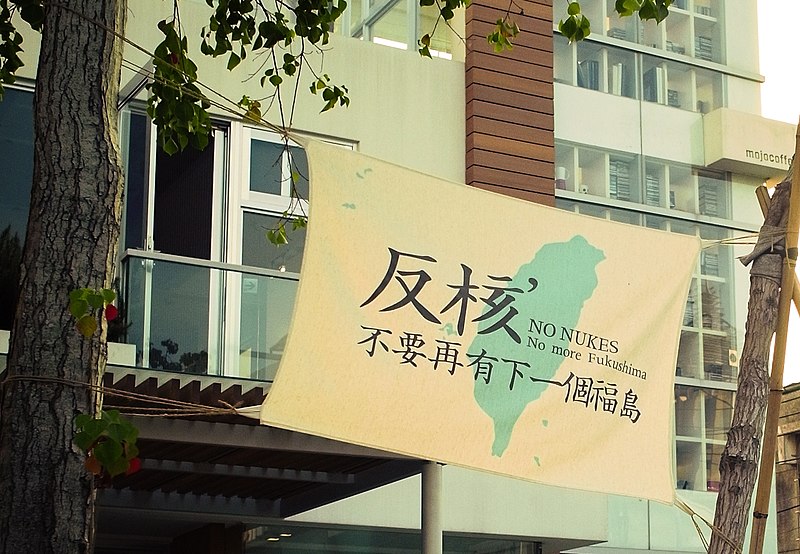
The change in the attitude of green groups towards the DPP has not affected the DPP’s publicity of its anti-nuclear intentions. Even during the period when work on the N4 resumed, and its budget continually increased from 2001 to 2008, the DPP consistently championed the “nuclear-free homeland” proposal in 2003, despite its eventual rejection by the Legislative Yuan controlled by the KMT-PFP coalition. The DPP’s anti-nuclear campaign reached its zenith when the Fukushima Nuclear Disaster occurred in March 2011. This Disaster led to significant social repercussions and a surge in anti-nuclear sentiment among the public. The DPP’s renewed commitment to its anti-nuclear position was underscored by Tsai’s presidential campaign manifesto in 2011, which included a clear political platform aiming to achieve a “nuclear-free homeland” by the year 2025.
Wavering position after 2016, reflected by the proposed policies
Different from its sincerity on the ‘2025 nuclear-free homeland’ statement, the DPP’s inconsistent stance on nuclear policy continued to draw scrutiny from green groups even after 2011, intensifying after 2016 when the third political party turnover occurred, and the DPP returned to power as the ruling party. Two contentious cases revolved around existing nuclear power plants. The first dispute emerged merely six months after the political party turnover when the then-Premier Lin Chuan (林全) discussed the possibility of restarting Jishan Nuclear Power Plant (N1) in response to concerns about electricity shortages despite N1 having been shut down for over 17 months for safety reasons. Following Lin’s announcement, although he suspended the proposal for N1’s restart within just two days, the DPP faced not only the expected strong criticism from green groups but also dissatisfaction expressed by some DPP candidates. They were concerned that the proposal contradicted the party’s commitment to the ‘2025 nuclear-free homeland’ initiative.
The N1 dispute in 2016 quickly subsided because no further progress occurred after Lin pledged that any decision regarding the future of N1 would be contingent upon social consensus. However, two years later, a decision to restart Unit 2 (a nuclear generator unit) at Kuosheng Nuclear Power Plant (N2) was proposed by the Executive Yuan and subsequently approved by the DPP-dominated Legislative Yuan without encountering any opposition from DPP members after the N2 has a prolonged period of inactivity exceeding 20 months. Ironically, Lai, who had served as the Premier in 2018, was concurrently responsible for the N2 restart proposal. This decision triggered even fiercer criticism from environmental groups compared to the 2016 dispute. They accused Lai of endangering public safety due to unit 2 having a safety hazard since it experienced an explosion even after undergoing an overhaul. Furthermore, they criticised the DPP for its perceived lack of readiness to transition to alternative energy sources and fulfil its ‘2025 nuclear-free homeland’ proposal. These criticisms were accompanied by a nuclear abolition march on the seventh anniversary of the Fukushima nuclear disaster.
The paradoxical reality and potential pushing factors
The dilemma for the DPP is its long-standing slogan, ‘nuclear-free homeland,’ which stands as one of the fundamental pillars of the DPP’s political agenda and seems to hold an unwavering position in the nuclear policy but contradicted its behaviour on repeatedly introducing several pro-nuclear proposals after 2016. The DPP’s insistence on the anti-nuclear stance is attributed not only to the close and enduring relationship between the DPP and green groups, dating back to the ‘Tangwai movement’ period but also to the anti-nuclear manifesto consistently serving as a political opportunity for the DPP to distinguish itself from the pro-nuclear KMT and secure votes. This distinction becomes particularly vital when prevailing public sentiment is marked by scepticism regarding nuclear energy.
Both proposals to restart nuclear generators emerged against the backdrop of deteriorating circumstances, a trend that had been developing since 2016. Following the third political party turnover in 2016, the DPP regained power, thereby assuming the responsibility for formulating energy-related policies. This responsibility becomes particularly significant in matters concerning electricity sources, given that public satisfaction with issues related to livelihood profoundly influences the outcomes of subsequent elections. Five years later, the shadow cast by the Fukushima Nuclear Disaster gradually receded, replaced by concerns arising from incidents such as blackouts and the looming potential for widespread electricity shortages. Taipower registered an unusually low operation reserve percentage, typically only seen during hot summer months but increasingly prevalent even in winter. This decrease in daily operation reserve percentage and the more frequent electricity restriction alerts (限電警戒) indicated a rising demand for electricity and the higher possibility of electricity shortage year by year. As the imperative of addressing electricity shortages progressively takes precedence over public concerns regarding nuclear power plant safety, the DPP’s commitment to staunchly uphold the ‘2025 nuclear-free homeland’ pledge is inevitably weakening. This shift is primarily motivated by the common consensus that election results are the paramount determinant of the long-term sustainability and growth of a political party rather than a single nuclear-related issue.
In a market characterised by an insufficient and unstable supply of renewable energy, although the objective of promoting green energy has consistently been articulated through officially channel, with the aim of achieving a 20% green energy share by the year 2025, there appear to be limited options to mitigate the power shortage issue. These options primarily involve bolstering the operations of fossil fuel power stations or gas-fired power plants, which collectively constitute the current major sources of electricity supply in Taiwan. However, both of these directions come with their own set of drawbacks, which could have implications for the DPP’s electoral standing. The first option, which entails increasing the output of fossil fuel power stations, is problematic due to the inevitable concerns it raises about heightened air pollution. Such concerns are unfavourable for the electorate as they directly impact public livelihoods. On the other hand, controversies persist around the use of gas-fired power plants, particularly regarding their impact on marine ecosystems, which has prompted protests from certain environmental groups.
Consequently, nuclear power emerges as the seemingly solitary viable alternative to circumvent the aforementioned challenges. The DPP’s ultimate priority is to ensure a stable electricity supply to maintain public satisfaction and secure favourable performance in upcoming elections. To rationalise these policies, the DPP has attempted to argue that they do not inherently contradict the commitment to achieving a ‘2025 nuclear-free homeland’ because all nuclear power plants will be phased out before 2025. Nevertheless, these pro-nuclear actions inherently conflict with the DPP’s avowedly consistent anti-nuclear stance. This paradox looms over the DPP like the Sword of Damocles, resulting not only in a complex energy policy impasse but also drawing criticism from the opposite KMT and civil society.
Minfan Yu is a graduate student pursuing an MA in Taiwan Studies at SOAS, University of London. She holds a bachelor’s degree in Sociology and International Relations from the University of Leeds. Her current research interests primarily revolve around the energy transition in Taiwan.
 Taiwan Insight
I just read the abstract. It seems to me that if the problem is to activate the nuclear energy in the emergency condition, there is no contradiction at all. Principle is one thing, emergency is another.
LikeLike