
Written by Zoe Parrott.
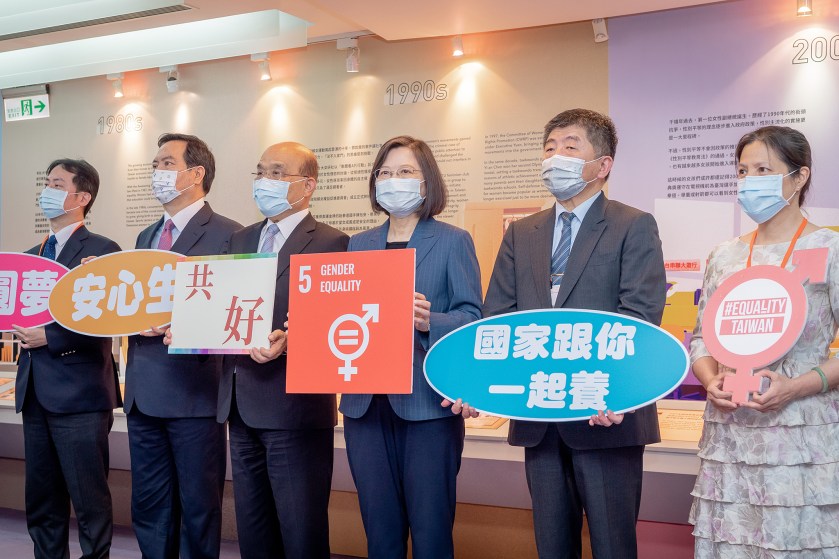
Image credit: 05.07 總統參訪「台灣國家婦女館」 by 總統府/ Flickr, license: CC BY 2.0.
There is no doubt that, as three examples of major developed East Asian countries, Japan, South Korea, and Hong Kong are able to boast of countless laudable achievements. Furthermore, compared to other countries, all of these nations have impressive Human Development Indexes, ranking higher than the United States. However, there is one aspect of each of these nations that often flies under the radar – the infamous gender inequity these nations are characterised by. For concrete examples, look no further than DJSoda, who was sexually assaulted during her show in Osaka, Johnny Kitagawa, who, for decades, dangled “the price of stardom” as an explanation for his sexual abuse, and the four undergraduates who were sexually harassed and/or raped by their older 28-year-old peer at the Education University of Hong Kong.
However, there seems to be one outlier among its peers – Taiwan, otherwise known as the Republic of China.
How did Taiwan perform?
A 2021 report published by the Taiwanese Department of Gender Equality placed Taiwan 6th globally and 1st in Asia using the 2019 Gender Inequality Index. Despite the fact that for political reasons, these statistics are not posted by the UN nor World Population Review, which are the general experts for such matters, there is likely truth behind these self-reported figures. After the 2022 local elections, female political participation in Taiwan hit a ground-breaking high of 56.3%, and as of 2019, 36.8% of small and medium enterprises in Taiwan are female led. Taiwanese feminism is slowly revolutionising how the nation looks and treats women. And this revolution isn’t just domestic. Globally, Taiwanese women are becoming more and more recognised. Tai Tsu-Ying, Chou Tzu-yu, Tsai Ing-wen, and many others are examples of this.
Do these statistics really draw a line between Taiwan’s and other Eastern Asian nations’ treatment of women? A 2023 report on Forbes Advisor reported that “Korea has the largest gender pay gap in the world at 31.5%.” After the 2020 Hong Kong legislative elections, women in the nation made up less than 17% of the entire political landscape. In 2022, there were 4,708 reported forcible indecencies and 1,655 reported forcible sexual intercourse recorded in Japan, and these figures have been on an upward trend since 2020. Most shockingly, “Over 95 per cent of incidents of sexual violence in Japan are not reported to the police,” meaning these low recorded numbers are likely just a shadow of the real problem. Plain and simple, Taiwan seems to distinguish itself from the underrepresentation, the scandals, and the dismaying statistics.
How did Taiwan achieve gender equality?
In the early 1990s, Taiwan’s feminist history was centralised around two main advocacy groups – Awakening Publishing House and the Homemakers United Foundation (HUF). Historically, Awakening utilised a nonpartisan top-down approach by targeting politicians that would eventually promote individualist feminism, a type of feminism that emphasises autonomy and equality under the law. HUF utilised a bottom-up approach that mobilised Taiwanese housewives and mothers to make political purchasing choices, all the while promoting relational feminism, which emphasises recognising and accepting more traditional feminine traits and activities in conjunction with social equality.
Focused on legislation, Awakening introduced and lobbied for many women-rights laws. Awakening introduced the Gender Equality in Employment Bill, which was promulgated in 2002, and also co-wrote the Gender Equity Education Act, which was ratified in 2004. Among other actions, this act introduced gender studies to all Taiwanese universities. Meanwhile, focused on grassroots organisations and communities, HUF worked on many smaller achievements, such as hosting an environmental mother’s camp in 1989, establishing the Consumer Quality Committee in 1991, launching a fundraising campaign for the health of homemakers in 2010, etc. Many of HUF’s events were designed to help homemakers – the majority of whom were women – become more involved in their local government. These two different approaches pushed by Awakening and HUF allowed Taiwanese women to explore more male-dominated spaces just as they were actually getting interested in doing so.
These original efforts to further female participation in government, business, entrepreneurship, etc., ultimately led to how modern Taiwan handles women’s rights issues today. As an example, Taiwan’s Ministry of Economic Affairs holds a Women Entrepreneurship Program, which provides business courses, access to an accelerator, and an end-of-program competition. Furthermore, since the 1950s, Taiwan has had gender quotas to promote female participation in politics; the movement was so successful that by 2018, only 3% of female politicians had invoked the reserved seat rule to enter office.
Taiwan’s involved history concerning women’s rights extends to more complicated cases like the recent #MeToo movement making waves throughout the nation. Taiwan’s Democratic Progressive Party mishandled multiple internal sexual harassment scandals regarding employees; the Taipei City Labour Bureau fined the Party $29,000. The onslaught of accusations has also prompted President Tsai to promise broader gender reforms, which has inspired a new proposal in which employers guilty of committing sexual harassment will be fined NT$1 million and up to three years in prison. As Lo Ping-Cheng, an acting spokesperson, said in July 2023, “The recent spate of sexual harassment cases generated a lot of expectation from the public that the President will improve related regulations.” Essentially, the continued offered resources for the betterment of female representation in traditionally male-dominated fields, as well as the public’s positive reaction to the government’s amendments, show how Taiwan’s political and social landscape allow for their distinct brand of feminism to be so effective.
What can other nations learn?
The key question is – can Japan, South Korea, and Hong Kong learn from Taiwan’s women’s rights actions? There have been efforts by all of these nations to address this problem; for example, in 2001, South Korea started operating their Ministry of Gender Equality and Family. Japan introduced women-only carriages as early as 1920 – and the number of them is growing. 2012 saw the introduction of the Hong Kong Women’s Development Goals, which established 14 goals and 36 strategies designed to better women’s rights. These nations are trying – so why isn’t it working? The answer is in their youth’s expression of extreme social stigma against or disregard for women who go against the status quo, a stigma that is much fainter among Taiwan’s people.
In Hong Kong, “feminist issues can – and often are – seen as inconsequential in the context of fighting for the future of Hong Kong, as an unnecessary distraction from the main struggle against the authoritarianism of the Chinese regime,” as a GenderIt article reads. In Korea, “Feminist discourse promotes hostility and fear in young Korean men because it has been misconstrued as inherently radical and misandrist,” an article in The Diplomat states. In a podcast from Asia Dialogues, Natsumi Ikoma, the director of the Centre of Gender Studies at the Japanese International Christian University, remarked that “In recent years feminism itself has become a new “f-word” in Japan…especially among the young generation, “feminism” is not really a popular term.”
For such a strong socially conservative viewpoint to be promoted by a nation’s youth and activists will override whatever policies a nation will put in place, especially if said policies are either avoidant of the larger issue – like the women-only train cars – or nearly insignificant – like the creation of the Women’s Development Goals, which never got fully realised because of Beijing’s interference. Either that, or the policies are subjected to questioning and the threat of dissolvement; earlier this year, South Korea’s President Yoon Suk Yeol stated he would be abolishing the Ministry of Gender Equality and Family, accusing it of convicting innocent men of sexual abuse. Ultimately, it is clear that these three nations have two main problems holding women back. One, are the inefficient policies pushed by either misunderstanding, limited, or conservative governments. Two, a youthful or outspoken population who either dismisses or demonises women’s issues and feminism.
The path to progress is clear: mobilising a progressive population to push for liberal policies allows women’s rights issues to flourish both on the ground and in the government. Both male and female feminists in Japan, South Korea, and Hong Kong should take heart in the countless ways to better gender equality. They should remember that if a 36-year-old constitutional democracy can completely transform the way their society views women, these other nations can do so, as well. Already, organisations like the Hong Kong Federation of Women’s Centres, Japan’s National Women’s Education Centre, Korea Women’s Associations United, and many others have applied genuine efforts to better the standing of women in their respective developed East Asian nations. But more must be done. Without the lobbying done by groups akin to Awakening nor the growth of women’s rights grassroots organisations through groups akin to HUF, these changes may never have been made.
Sexism in East Asia should no longer have the luxury of flying under the radar. Taiwan is an exceptional example of how to implement effective gender-equalising policies and programmes.
Zoe Parrott is a gap year student at National Taiwan University, after which she intends to continue her schooling with an emphasis on international relations and East Asian studies.
 Taiwan Insight