
Written by Mark Hsiang-Yu Feng.
Image Credit: Mark Hsiang-Yu Feng.
Born as a third-generation Waishenron (外省人) in Taipei in post-dictatorial Taiwan, I am privileged that my background—enriched with cultural and social resources, along with economic advantages—allowed me to study for my PhD in ethnomusicology at a US American university. In my journey of pursuing academic success, I have been racialized as a minority and experienced structural inequality and racism in American culture, including facing language and gestural harassment publicly. My time in California triggered a critical reflection on my Asian identity, as I was often labelled “Chinese” instead of “Taiwanese,” which further disconnected me from my roots. Having an identity crisis in the US has motivated me to study global race and racism through punk and metal music as an ethnomusicologist. With those experiences, I came back home to conduct ethnographic fieldwork, aiming to learn to understand Taiwan from a critical racial perspective.
This short article is a fieldnote engendered while conducting musical ethnography for my dissertation. Since many Taiwanese people have recognized and studied the multicultural configuration of Taiwanese culture and society since the 1990s, I ask: Has such multiculturalism advanced diversity, inclusion, and equity in Taiwan? What are the limitations of Taiwan’s multiculturalism? What are the next steps for Taiwan Studies beyond multiculturalism? My discussion focuses on punk and metal musical performances by Indonesian migrant workers in Taiwan. As these performances gain more visibility in Taiwan’s metal music scene, they are often viewed exotically or merely as tokens of diversity in performances. The scene unveils the illusion of multiculturalism, revealing the persistent racism that Southeast Asian migrant workers endure in Taiwanese society.
Questioning Colourism in the Taiwanese Metal Music Scene
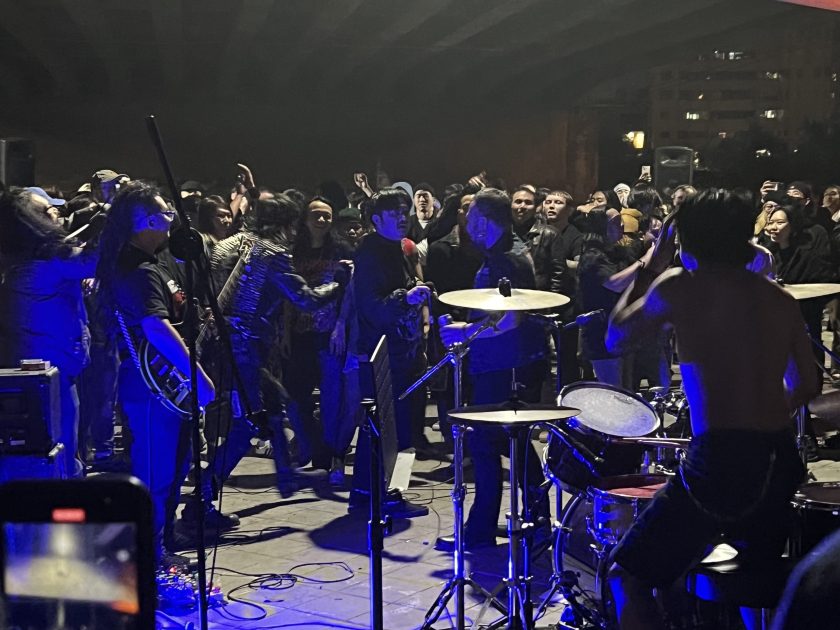
In Taiwan’s 2023 Death Metal Music Festival hosted by Jack Tung in his studio in Ximen, Taipei, I encountered two Indonesian heavy metal groups: Dream of Death and Jubah Hitam. Musicians are primarily male and are blue-collar migrant workers in manufacturing industries in various regions across the entire Island. Their emergence in the Taiwanese metal music scene has impressed many Han Taiwanese musicians, as my interlocutors, who are the musicians of a Taiwanese black metal group called Desecration, expressed.
Outside the studio, a Taiwanese guitarist and I chatted about heavy metal and race in Taiwan. He informed me that many Taiwanese metal musicians hold a problematic stereotypical idea about the skin tone of “good” metal musicians should be looking like. “The lighter one’s skin tone is, the greater his musicianship and performance techniques are.” “This idea has guided many Taiwanese people to learn metal music from white and Japanese musicians instead of the Southeast Asian ones,” he pointed out. Compared with the majority of Han Taiwanese musicians in the metal scene, these Indonesian musicians have darker skin tones, which are largely associated with a stereotypical imagination of a “bad” metal musician.
However, the presence of Dream of Death and Jubah Hitam questioned such racial ideas and stigmatization. It pushed many Taiwanese metal musicians to think deeply about metal music and racism, as the performances have profoundly demonstrated their advanced musicianship, creativity, and performance techniques.
Resisting Racism against Indonesian Migrant Workers
After the concert, I connected with long-term activists Ting Kuan Wu and Ú-Tsing Nâ to learn about racism against blue-collar Indonesian migrant workers and their resistance to Taiwanese racialization through music and musical performance. Ting Kuan and Ú-tsing are well-known and well-respected Taiwanese cultural activists in the Indonesian community in Taiwan. They introduced me to the musicians of an Indonesian punk group called Southern Riot. In the past few months since then, I have travelled back and forth between Taipei, Kaohsiung, and Pingtung to attend their rehearsals and concerts, learning about their work and live experiences.
They struggled with the racialized capitalism in the migrant work labour market in Taiwan and have been exploited by employers at work and by migrant worker agencies in Taiwan and Indonesia. Their freedom of activity is constrained by rigorous laws and regulations specified for migrant workers by Taiwan’s Ministry of Labor, and their maximum work hours are not protected by law in Taiwan until recently.
This resulted in the musicians’ shared difficulties in finding mutual availabilities for the bands while managing the excessively long work hours and travel expenses. Ting Kuan’s support in rehearsal, organizing concerts, communicating between musicians and the event organizers, and promoting their concerts online and offline have made the musicians’ travels easier. In December 2023, Southern Riot performed at the Migrant Worker Rally organized by the Migrants Empowerment Network in Taiwan (MENT) and sang in front of the office of the Ministry of Labor. Their performances expressed collective resistance against this oppressive racial hierarchy and various forms of exploitation in solidarity with other Southeast Asian communities in Taiwan. Their concerts have effectively empowered and provided cohesion within the Indonesian punk and metal fan community and beyond through moshing and other transgressive practices in the music culture.
Despite howling and screaming, their music emphasizes lyricism. The songs they composed are about issues such as leaving home and family, solitude, suicidality, mental health, being dehumanized at work, and racism. For them, these are everyday challenges. Due to extreme working conditions and minimum wage, many of them even lost their friends during their stay in Taiwan. Southern Riot put such experience in lyrics. Here is an excerpt of Ting Kuan’s, Ú-tsing’s, and my translation of the lyrics of “Lagu Cinta Dari Bmi (Love Song From Migrant Worker)” by Southern Riot from Indonesian to Mandarin and English:
Verse 1:
Hey, are you there trying to understand? 嘿!您在那裡明白嗎?
Hey sadarkah engkau yang disana
We feel neglected here 我們在這裡覺得被忽視了
Disini kami merasa terabikan
Isn’t that your job? 這不是您們的工作嗎
Bukankah tugas kalian semua
Support us and protect our rights? 協助我們,維護我們的權益?
Membantu dan melayani hak kami
But in fact, our rights have been disenfranchised 事實上我們的權利被剝奪了
Nyatanya hak kami dirampas
In fear, we are silenced 因恐嚇而噤聲
Dibungkam dengan sebuah ancaman
But we’re gonna stand up and fight 我們要起身反抗
Disni kami berdiri melawan
This system of slavery 這個奴化的制度
Sistem perbudakan
Of course 理所當然
Dan wajar saja
We are furious 我們憤怒
Jika kami marah
Come on! Friends! 來吧各位朋友
Dan mari kawan
Let’s Shout! 我們一起呼喊
Kita teriakan
Chorus:
Agencies! What a Mess! Agencies! 亂七八糟!
Agencies! Useless! Agencies! 沒有用!
Agencies! Fuck! Agencies! 幹!
Agencies! Brute! Agencies! 畜生!
In every chorus section, they shouted together with the audience. They used Mandarin curses, which the people from agencies used to curse them, expressing their anger. This strategic employment of Mandarin curses is essential to both the performers and the audiences, for the shouting expresses that they can support each other in solidarity and in fighting against racism in Taiwan.
From Multiculturalism to Antiracism
My dissertation fieldwork is still in progress, but the more I learn about the experiences of Indonesian migrant workers in Taiwan, the clearer I see the limitations of multiculturalism, as it cannot point out structural inequality and racial hierarchy that is deeply embedded in the Han-dominated and Han-centric Taiwanese music culture and policies. We need to go beyond the inadequacy of multiculturalism, and this is how critical race theories can be beneficial to Taiwan Studies. As global music history is gradually becoming one of the popular scholarly issues among the Taiwan Society for Music Studies, I urge applications of critical race theories in research and deep reflection on the ethnomusicological scholarship in Taiwan.
In my last discussion with Ú-tsing, she asked: Since they stay in this country as migrant workers, how might the society give them equal opportunities, as Taiwanese people do, in composing, developing their works, and expressing themselves as artists? How might these artists be treated equally while interacting with Taiwanese musicians in the music scene and further challenge the Taiwanese racial ideology? I have yet to find a satisfactory answer to these questions, and surely, there is still a long way to go in advancing diversity, inclusion, and equity in Taiwan.
Mark Hsiang-Yu Feng is a PhD candidate in Ethnomusicology at the Department of Music at the University of California, Davis. His research focuses on popular music and race in Taiwan. Please contact him via this email address: hyfeng@ucdavis.edu.
 Taiwan Insight