
Written by Wendy Cheng.
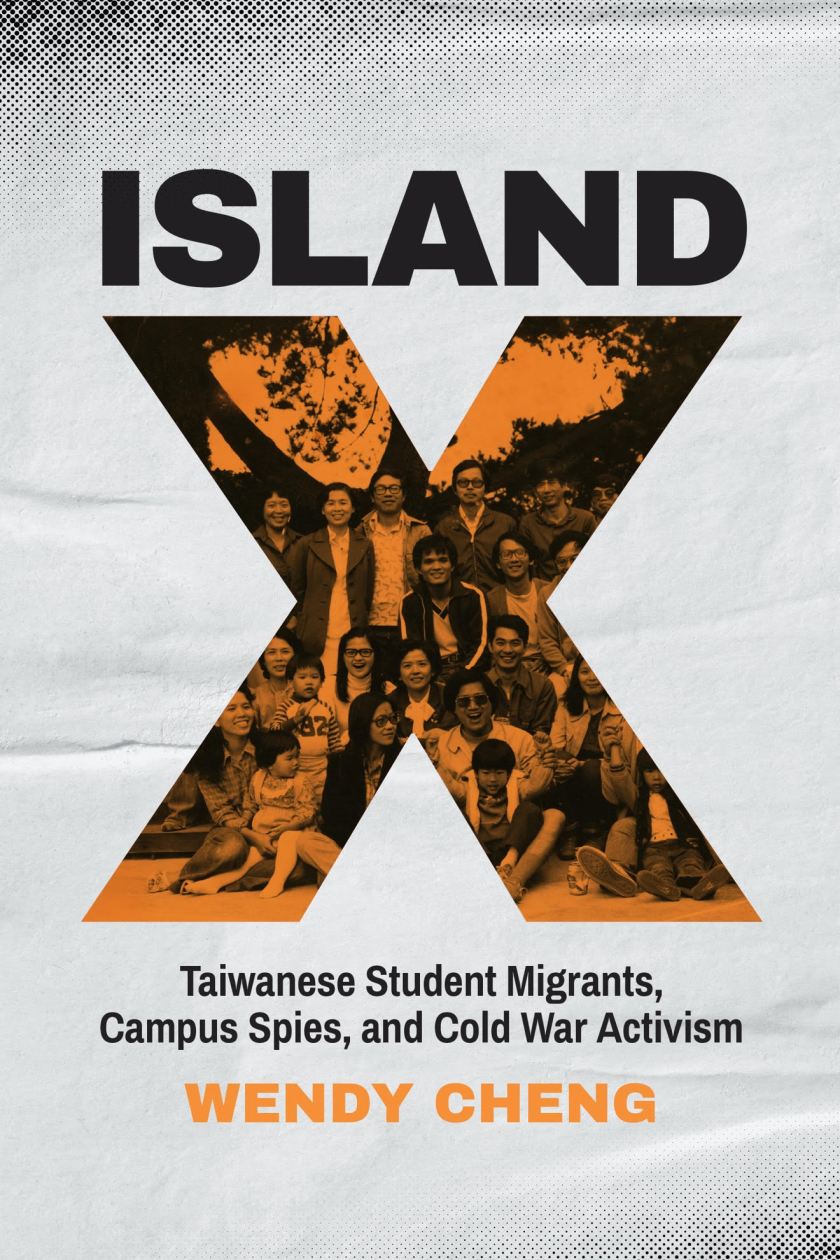
Image credit: Cover of Island X: Taiwanese Student Migrants, Campus Spies, and Cold War Activism by University of Washington Press and Wendy Cheng.
From conducting the first interview to completing the final manuscript, it took over twelve years to research and write Island X: Taiwanese Student Migrants, Campus Spies, and Cold War Activism. Of course, working on the book was not the only thing I was doing during those years, but there were many reasons why it took a long time. As an Asian Americanist with limited Chinese-language abilities, one major reason was the relative lack of critical English-language scholarship on this particular history (with the notable exception of Chih-ming Wang’s 王智明 essential monograph, Transpacific Articulations). To my surprise, however, after several research trips to Taiwan, I found that even among Taiwanese, knowledge about this history is not a given. The lingering silences and elisions of Taiwan’s 38-year period of martial law (1949-1987) and its incomplete process of transitional justice have created numerous intergenerational gaps in knowledge and understanding not only in the US but also in Taiwan.
Island X tells a political history of a generation of Taiwanese who migrated to the US from the 1960s to the 1980s as graduate students during the late Cold War and Kuomintang (KMT) martial law periods and became politically active in struggles for democracy, human rights, and Taiwan independence. Tapped for selective migration as part of the United States’ efforts to secure geopolitical advantage in science and technology, students from Taiwan began arriving en masse to the US for the first time, clustering especially in public Midwestern universities such as Kansas State University and University of Wisconsin-Madison who were offering competitive teaching and research assistantships and resident tuition. As student migrants, they tasted freedom of expression for the first time; they read texts they had been forbidden from reading in Taiwan, participated in local and transnational political debates and advocacy, and organized protests and other forms of direct action. However, they did not escape the KMT’s authoritarian reach: even in the US, they were regularly spied on by Republic of China (ROC) consulate officials and fellow students serving as informers who were sarcastically referred to as “professional students.” One did not have to do much to get on the KMT’s infamous blacklist: even taking a leadership position in a Taiwanese student association was considered to be subversive. Indeed, among the three cases of surveillance and persecution that I trace in detail – those of Hwang Chii-ming 黃啟明, Chen Yu-hsi 陳玉璽, and Chen Wen-chen 陳文成 – none were major activists or leaders of political groups.
In the book, I argue that this persecution of arguably minor subjects, aptly characterized by the Chinese proverbs of “killing one to warn a hundred” or “killing the chicken to warn the monkey,” was central to the consciousness formation of a generation of diasporic Taiwanese. By persecuting Taiwanese even outside of Taiwan, the KMT inadvertently strengthened its political opposition and contributed to the development of Taiwanese identity and consciousness in many who had not before felt strongly about such things. In the US, as in Taiwan, such consciousness and its assumed politics increasingly became ethnicized as a split between benshengren and waishengren. Yet, as one of my interviewees, the Nobel Prize-winning chemist Lee Yuan-tse 李遠哲, put it (describing his high school years in Taiwan in the 1950s): “This [is] the friction between the ruler and the oppressed, rather than Taiwanese and Mainland Chinese.”
In fact, Taiwanese students who came to the US during this period encountered and participated in a broad spectrum of global politics that played out among Chinese-speaking students not only from Taiwan but also from Hong Kong and born in the US – including anti-imperial and Third World decolonial political movements, socialism, and Maoism. While the mainstream of US-based Taiwan independence activists was centrist, focused more narrowly on democracy and human rights, and did not develop a critique of US imperialism and militarism (not to mention the inherent contradiction of US support as the necessary condition of KMT rule in Taiwan), this unstable zone of political possibility permeated even the most well-known cases of KMT oppression abroad, including that of Carnegie Mellon professor Chen Wen-chen, who was found dead on the campus of his alma mater, National Taiwan University, in the summer of 1981 after being taken in for questioning by the Taiwan Garrison Command the day before. As I have written elsewhere, although Chen is most commonly remembered as a straightforward martyr for democracy and Taiwanese independence, in fact, his politics were more complex than that. Although by the time of his death, he was unequivocally committed to Taiwanese self-determination, just a few years earlier, he had dedicated his University of Michigan PhD thesis to China and “his fellow citizens who work diligently in the country fields and urban factories for the greater advancement of society.” He aligned himself with Taiwan Era, a Marxist-Leninist, pro-independence, US-based group. And he retained an interest in a working-class-led, socialist future for a liberated Taiwan to the end.
Two other cases of surveillance (leading to arrest and imprisonment) the book explores in detail – those of Hwang Chii-ming (University of Wisconsin-Madison) and Chen Yu-hsi (University of Hawai‘i’s East-West Center) – also illustrate the complex local, national, and transnational political dynamics at play, both in the conditions for oppression and the conditions for solidarity and advocacy. Hwang’s case illuminates a shadow history of foreign graduate students in Asian Studies who worked as research assistants and native informants in a field then dominated by former US diplomats and intelligence officials, while Chen’s case reveals the limits of academic freedom in US Cold War universities as well as wide-reaching circuits of transpacific activism and advocacy centred in and emanating from Honolulu.
In the conclusion of the book, I quote Taiwanese American elder and longtime Pacific Times newspaper editor Hilda Lin 賴慧娜, who told me, “There has never been any generation like this.” (Lin herself came to the US as a graduate student in library science in 1973.) When I was researching and writing the book, I was keenly aware of the urgency of sharing the stories of this remarkable generation of elders while they are still here to tell them. What I have found so far while touring the book, however, is that the book is much more meaningful to younger generations – both in Taiwan and in the US – than I anticipated. Between the US and Taiwan, the dual conditions of the Cold War and martial law left a legacy of silence and transnational state terror; they also created legacies of courage, resistance, and collective organizing against authoritarian rule and for self-determination, which took different forms at different times and in different places. I hope the book serves as an invitation for more scholarly research on this understudied history as well as a catalyst for multigenerational conversations and dialogue.
Wendy Cheng is a Professor of American Studies at Scripps College and core faculty in the Claremont Colleges’ Intercollegiate Department of Asian American Studies. In addition to Island X, she is the author of The Changs Next Door to the Díazes: Remapping Race in Suburban California (University of Minnesota Press, 2013) and coauthor of A People’s Guide to Los Angeles (University of California Press, 2012).
This article was published as part of a special issue on ‘Student Migrants, Campus Spies and Island X‘.
 Taiwan Insight