
Written by Chieh-Ting Yeh.
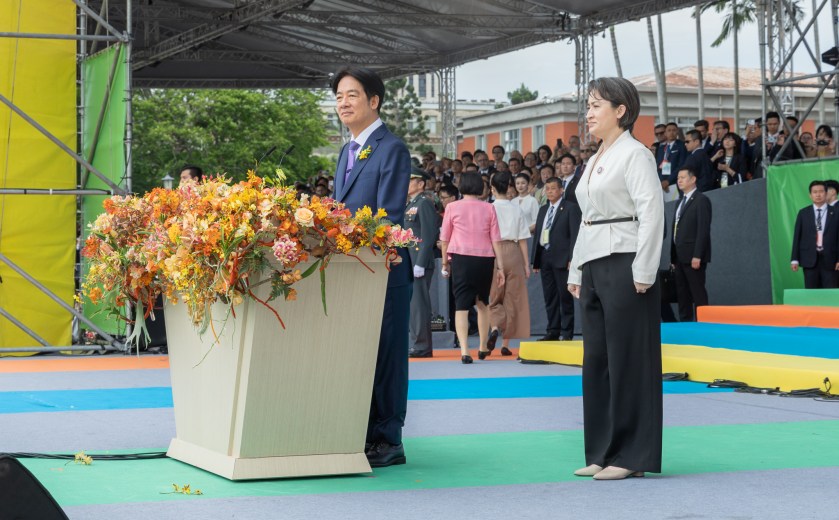
Image credit: 05.20 總統出席「就職慶祝大會」並發表就職演說 by 總統府/ Flickr, license: CC BY 2.0 DEED.
Taiwan had an eventful week starting May 20.
On Monday morning, Taiwan’s new president, Lai Ching-te, took his official oath of office. The next day, the China-friendly opposition parties, which control the parliament, expedited bills that were marketed as “reforms” but endowed legislators with vast new powers against the president and his administration.
On Thursday, Beijing conducted massive military exercises surrounding Taiwan and made clear that the live-fire exercises are “a strong punishment for the separatist acts of Taiwan independence forces and a serious warning against interference and provocation by external forces.”
The effect of these developments amounts to a campaign of total provocation and intimidation by China and its interlocutors against the Taiwanese people.
For international audiences who have not been following Taiwan-China relations closely, it may be easy to fall into a fallacy that all this “tension” stemmed from Lai’s inaugural speech; more specifically, his vocabulary and tone of voice. For example, he stated in his speech that Taiwan and China are not subordinate to each other and calls China “China” instead of other euphemisms that obscure the fact that Taiwan and China are separate countries.
The fallacy’s logic is that since it is known China will be displeased with this kind of language, it is up to Taiwan to avoid using these terms. Otherwise, Taiwan is the one provoking China. The Financial Times reports that even while textual analysis of the speech “verges on hair-splitting,” experts say Lai is in danger of upending the delicate peace in the Taiwan Strait.
More generally, this can be seen by the fact that until very recently, news reports on political developments in Taiwan almost always come with a headline that says Taiwan is “angering China” or “raising tensions.” Take, for example, this article on Lai’s election in January from the BBC (“Taiwan elects William Lai president in a historic election, angering China”). As international media headlines quote Beijing’s word choice of “punishment,” it risks creating an illusion that Taiwan was the party acting out of line and deserves to be reprimanded, while China is the one overreacting.
Over the years, this had meant that the onus of managing tensions was on Taiwan to soothe China by saying exactly what it wanted to hear. It is, in essence, blaming the victim rather than the bully. This line of reasoning is analogous to putting the onus on Ukraine to prevent Russia’s invasion; just as this reasoning justifies Russia’s invasion of Ukraine as a response to Ukraine shifting closer to Europe, so does it justify China’s sabre rattling as a response to an action on the Taiwanese side. Not coincidentally, this is exactly what Moscow and Beijing say about their “military actions.”
By succumbing to Chinese pressure and insinuating that Taiwan ought to be responsible for China’s bullying, the world is telling Beijing that its hardened stance and coercion of Taiwan is working, encouraging China to keep pushing the red line. China is tightening a literal noose of warships and warplanes around Taiwan and its neighbours, yet the blame falls on the unfortunate targets of Beijing’s aggression.
The biggest misunderstanding of China’s Taiwan ambitions is that somehow China will be amenable to meeting Taiwan in the middle if Taiwan would just tell China what it wants to hear — that Taiwan is not a country; rather, it is a part of China.
However, the Chinese Communist Party has shown no willingness in the last forty-plus years to accept anything other than the annexation of Taiwan into the People’s Republic of China. Leaders from Taiwan have tried proposals of a Chinese confederation, making China a cultural concept, calling both sides of the Strait in the same “family,” or agreeing Taiwan is part of China, but Taipei can interpret what “China” means, have all been proposed. Yet China has barely reciprocated. The only thing China is willing to discuss is whether this is done peacefully or with violence and how soon. Meanwhile, China has continued to ratchet up its intimidation, as seen by its heavy-handed influence with Taiwan’s opposition parties and taunting military harassment.
China has been consistent in its intentions to annex Taiwan, regardless of Taipei’s actions. And when a great power repeats, year after year, that it plans to forcibly annex another country — even explicitly stating that it would put that country’s people in “re-education” camps — perhaps it is time to take that threat seriously. The minute details of an inaugural speech are negligible to the threats that China has made to Taiwan for over four decades. A few word choices will not alter China’s plans for Taiwan.
Democratic societies, as well as anyone who cares about Taiwan’s fate, should not let Beijing have the power to unilaterally and arbitrarily impose red lines on Taiwan.
In the US, the narrative is changing. An analysis of Lai’s speech by Rush Doshi and David Sacks for the Council on Foreign Relations, for example, notes that even when Lai’s predecessor, Tsai Ing-wen, presented her stance in a way that was meant to show good faith to Beijing, she was not given much credit. The report explains the context of Chinese forces making incursions into Taiwan’s 24-mile coastal contiguous zone, which had not happened before. China’s intrusions are breaking long-standing red lines, which shows that China “may not appreciate responsible approaches by Washington and Taipei.”
Taiwan is a responsible stakeholder. But the responsibility of regional peace ultimately rests on China to renounce the use of force against Taiwan, to give up its territorial claims on Taiwan, and to engage the duly elected leaders of Taiwan as equal counterparts.
Chieh-Ting Yeh is a venture investor in Silicon Valley, the founder of Ketagalan Media, a Taiwan-focused news publication, and a director of US Taiwan Watch, an international think tank focusing on US-Taiwan relations.
This article was published as part of a special issue on ‘Presidential Inauguration‘.
 Taiwan Insight