
Written by Michael Reilly.
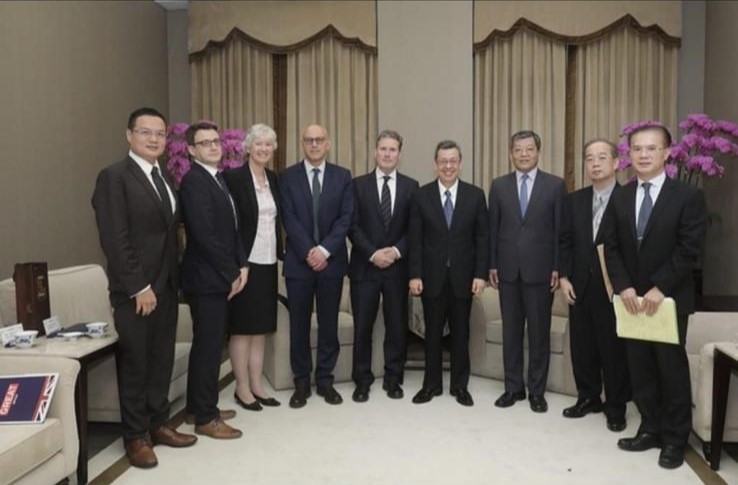
Image credit: Vice-President’s Office in Taiwan.
On 4 July, the British electorate returned the Labour Party to government after fourteen years in opposition. With one of the largest parliamentary majorities ever for a post-war government and the Conservative party in disarray after its humiliating defeat, the government has a real opportunity to implement changes and the British electorate, tired and frustrated after years of Tory infighting and incompetence, will be hoping for such.
But the government inherits record post-war public debt, crumbling public infrastructure, and a collapsing health service and judicial system, all of which will be higher priorities and preoccupations than foreign policy. An indication of its top foreign policy concerns was clear from its very first days in office: improving relations with European neighbours, maintaining support for Ukraine against the Russian invasion, and managing the security relationship with the USA, especially if Donald Trump wins power in the November presidential election.
British foreign policy has long been largely bipartisan in its conduct. The Foreign Affairs Committee of the House of Commons traditionally issues its reports on a consensual basis, even though the committee members are drawn from all parties. When its reports are critical of the government’s foreign policy, the criticism is usually over the detail, not the substance. The Brexit campaign saw Leavers and Remainers on both sides of the political spectrum, and even under the chaotic government of Boris Johnson, policy towards Ukraine remained largely consensual.
Labour paid a price for this consensual approach in the election, in which it lost five seats it previously held to independent, pro-Palestinian candidates critical of its stance on Israel’s conduct in Gaza. But there is no reason to believe that now it has won office it will abandon this cautious approach. Given the size of its victory, and with the Conservatives in disarray, this means any opposition to its policies is as likely to come from its own benches as from the opposition.
Any marked shift in British policy towards Taiwan, therefore, seems unlikely. Insofar as relations with Taiwan have featured at all in British foreign policy, it has usually been as a sub-text of, or reaction to, relations with China and rarely out of interest in Taiwan per se. There was something of an exception to this in the late 1990s when the British government responded to the booming growth in bilateral trade by establishing a trade and cultural office in Taipei, but its response at the time was more cautious than that of many of its then EU partners, a position it justified by the need for caution given the difficult ongoing negotiations with China over the future of Hong Kong.
The recent apparent surge in British political interest in Taiwan, with statements of support issued from ministers as well as other parliamentarians and a significant increase in the number of British diplomats based in Taipei, should be seen in this wider context. Relations with China have deteriorated sharply following the imposition of a National Security Law in Hong Kong and amidst growing concern about Chinese behaviour more generally.
With the change in government, however, the UK now has a prime minister who has the rare, if not unique, distinction of having visited Taiwan before taking office, Sir Keir Starmer having done so in 2016 and again in 2018. Within the Labour party, there is also now a ‘Labour Friends of Taiwan’ group, and as part of preparations for potential office, party researchers have been active for over a year in drawing up recommendations on a Labour government’s foreign policy positions. This has included explicit consideration of policy towards Taiwan, possibly the first time a British political party has done this.
Welcome though this interest is, it would be unwise to assume that it will translate into unquestioning support for Taiwan. First, the blunt reality for any government is that China, as the world’s second-largest economy, a nuclear power, and a permanent member of the UN Security Council, is too big to ignore, even less so as it supports Russia in its aggression and is increasingly assertive in its actions in the South China Sea. Dealing with China will almost inevitably require some trade-offs, including circumspection in some policy areas.
A reminder of the possible difficulties came from an article in the Financial Times of 25 June, reporting that Labour-controlled Edinburgh council had put on hold a proposed town-twinning agreement with Kaohsiung over business fears that it might provoke a Chinese backlash, despite Kaohsiung already having such agreements with cities as varied as Busan, Brisbane, Durban and Seattle. One can be depressed, frustrated, or annoyed by the ignorance such caution reflects, but it is a timely reminder that no government is likely to wish gratuitously to annoy China, and advice from the FCDO is likely to continue to advocate caution.
Second, Sir Keir Starmer’s visits to Taiwan were not to promote friendly relations but to press Taiwan to abolish the death penalty. Similarly, the party researchers producing policy recommendations included members of the party’s human rights group, concerned about Taiwan’s treatment of migrant workers.
This does not mean that the new Labour government is likely to be less friendly to Taiwan than its predecessor. A return to the fatuous ‘golden era’ of relations with China that we saw under the earlier Conservative government after 2010 is most unlikely. Instead, we should expect to see the close cooperation with Japan and Australia over regional security policy, including through their trilateral reciprocal access agreement and the AUKUS pact, to continue. This will have a beneficial if indirect, effect on Taiwan.
On the other hand, while the new government will not withdraw the UK from membership of the CPTPP, its trade policy priority will be to reduce trade friction with the EU, initially by improving regulatory alignment and removing impediments to trade wherever possible. This means it is likely to take a back seat in any CPTPP discussions about Taiwanese membership. Nor will negotiating a bilateral investment agreement with Taiwan be a priority. If Taiwan wants to see progress on bilateral trade, the key will be to continue to seek sector-specific agreements, which will be both lower profile and require fewer resources to negotiate than would a full-fledged agreement.
Whether one feels hope or frustration about possible future policy towards Taiwan, the overriding reality for the new government is that it will have to grapple with many more pressing foreign policy priorities, chief among them being to improve relations with European neighbours and continue support for Ukraine. The initiative for further developing bilateral relations, therefore lies with Taiwan. If it can offer practical, low-key steps for improving relations, or show that it is alive to international concerns over the death penalty and migrant workers, it is likely to receive a sympathetic response from the new British government.
Michael Reilly has been a Senior Fellow in the Taiwan Research Hub of the School of Politics and International Relations at the University of Nottingham since 2015. From 2005 – 2009 he was the British representative in Taiwan and from 2011 – 2014 the chief representative in China for one of the UK’s largest manufacturing companies. In 2016 and again in 2019 he was a Visiting Fellow in the Institute for European and American Studies at Academia Sinica in Taipei. He is a member of the Advisory Board of the Global Taiwan Institute and has written or co-edited many books related to Taiwan or British foreign policy. His most recent book, The Great Free Trade Myth: British Foreign Policy and East Asia since 1980, was published in 2020.
This article was published as part of a special issue on ‘Taiwan-UK relations: continuity or change?.’
 Taiwan Insight