
Written by Max Dixon.
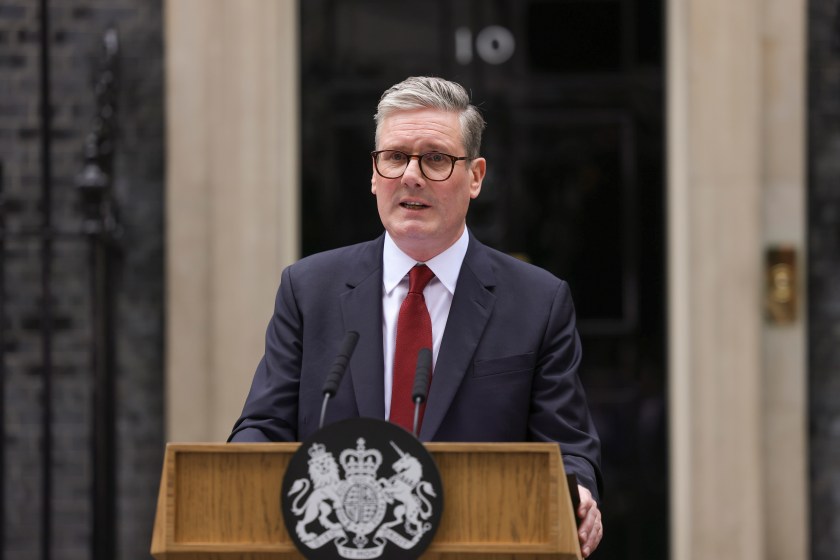
Image credit: Prime Minister Sir Keir Starmer arrives at Number 10 Downing St by Number 10/ Flickr, license: CC BY-NC-ND 2.0.
‘A new dawn has broken, has it not?’
The question once posed by British Prime Minister Tony Blair following his 1997 Labour landslide is once again in fashion in British politics, following Keir Starmer’s 2024 Labour landslide on July 4th. Yet, given new Foreign Secretary David Lammy’s promise of a ‘foreign policy reset’ following fourteen years of Conservative governance, it remains unclear how much of the 2021 Integrated Review, its ‘Indo-Pacific tilt’ and its cautious consideration of an increasingly important ‘Taiwan issue’ will be discarded in Lammy’s reset. Thus, does Labour’s landslide mean a new dawn for the role of Taiwan in British foreign policy?
The Labour Party has an intriguing historical relationship with Taiwan and East Asia; it was British Prime Minister Clement Attlee, a giant of the British Labour movement, who downgraded British diplomatic recognition of the ROC on Taiwan in 1950, whilst fellow British Labour Prime Minister Harold Wilson broke away from British support for the US’s committed Cold War footing in Asia, to which Taiwan was key, in the 1968 withdrawal ‘East of Suez’ of British military infrastructure and personnel. Indeed, foreign policy was long seen as the ‘the special prerogative’ of the Conservative Party, with Labour’s foreign policy focus often rigidly centred on relations with Europe.
Europe or the Indo-Pacific?
Therefore, the incoming Labour government’s primary focus on re-building relations with Europe, often strained since Brexit appears to signal a downgrading of the Indo-Pacific as an immediate focus area from the high importance placed upon the region by numerous Conservative Governments seeking an alternative to Europe post-Brexit. Indeed, the ‘Indo-Pacific’ isn’t mentioned once in Labour’s Manifesto chapter on foreign policy. The UK’s relationship with China, however, was addressed with Labour promising a China ‘audit’ whilst seeking to ‘co-operate where we can compete where we need to, and challenge where we must’ in Sino-British relations. Naturally, given the vast advantage in opinion polls enjoyed by Labour throughout much of the campaign, any substantive reference to a topic as fraught with diplomatic danger as Taiwan and Cross-Strait relations was highly unlikely. Still, the apparent downgrading of the Indo-Pacific in Labour’s foreign policy priorities will check Taiwan’s nascent noteworthiness in British foreign policy debates.
Moreover, an analysis of parliamentary references to Taiwan in the House of Commons since 2010 further indicates the extent to which Conservative politicians dominated foreign policy debates on Taiwan and focused on the Indo-Pacific. Indeed, of the 442 references made to Taiwan since 2010, 296 of those came from Conservative Party MPs. By contrast, only 71 references to Taiwan came from Labour MPs during the same period. Such a disparity is a testament to the extent to which Taiwan and the Indo-Pacific have come to be seen as a central facet of Conservative foreign policy yet appears to be peripheral in Labour’s foreign policy priorities. There has, however, been a growing recognition of Taiwan’s international importance in the Labour Party in recent years, with the ‘Labour Friends of Taiwan’ established in 2023, a loose grouping of Labour MPs and peers that seek to highlight Taiwanese culture and geopolitical importance and to “strengthen the UK government’s support for Taiwan”.
Furthermore, an April 2024 Labour Party parliamentary delegation of MPs and peers to Taiwan met with Tsai Ing-wen. Such developments indicate a growing appreciation of the role of Taiwan in global politics, yet are by no means intrinsic to Labour’s overall foreign policy approach. It is likely that the Labour Friends of Taiwan, as an organisation linked to, but not central to, the party, will serve to raise the profile of Taiwan as a growing foreign policy focus amongst incoming Labour MPs and will facilitate future parliamentary exchanges between London and Taipei yet the extent to which it will be reflected in parliamentary debates and priorities is at present questionable. Indeed, with some of the most vocal MPs on Taiwan leaving Parliament following the 4th of July, including former Prime Minister Liz Truss, Bob Seely and Tim Loughton, there is a clear possibility that the salience of Taiwan in parliamentary debates in a Labour majority commons will dissipate considerably.
Progressive Realism and Taiwan
Moreover, in the Foreign Office, it is unlikely that incoming Foreign Secretary David Lammy will instigate any major change in the Labour government’s approach to Taiwan. At the heart of Lammy’s philosophy of foreign policy is the concept of ‘progressive realism’, set out in an essay in Foreign Affairs, an approach that advocates for the combination of ‘realist means to pursue progressive ends’, where the UK must be ‘realistic about the state of the world and the country’s role in it’ whilst also adopting progressive values, including the defence of democracy and the rule of law.
‘Progressive Realism’ thus seeks to balance engagement with China on key issues, such as tackling climate change, with a stringent defence of fundamental British values. Yet this approach has drawn criticism on the lack of clarity afforded to the inevitable trade-offs it will propagate, where, for instance, a compromise between trade and values will arise in the pursuit of net zero goals that require considerable investment in Britain’s solar power, yet where many of the solar panels required are manufactured in Xinjiang amidst numerous reports linking them to the forced Labour of Uyghur Muslims.
Moreover, the concept of ‘progressive realism’ provides little insight into how the UK would apply it to Taiwan. Indeed, when asked by Financial Times columnist Gideon Rachman on how far he agreed with Joe Biden’s persistent commitment to coming to the defence of Taiwan, Lammy was coy, refusing to ‘talk up the prospects of war’ in Taiwan whilst bemoaning the ‘sabre-rattling’ of Liz Truss’s visit to Taiwan. A degree of ambiguity, therefore, appears to be central to how ‘progressive realism’ applies to Taiwan, whether Taiwan’s democracy would appeal to its ‘progressive’ element or if China’s military might. The six thousand miles between London and Taipei would result in a ‘realist’ calculation of how far the UK could and would support Taiwan.
In essence, which ‘Taiwan’ is being perceived is key: Taiwan as a stable and vibrant liberal democracy or Taiwan as an ‘unsinkable aircraft carrier’ central to Sino-US geopolitical competition. Intriguingly, Lammy’s ‘progressive realism’ argues for the moral imperative in recognising statehood, arguing that ‘a Labour government would see its mission as supporting states’ sovereignty’ yet, predictably, such calls are limited in Lammy’s essay to Ukraine, Israel, and Palestine with Taiwan conspicuous in its absence. As such, it is likely that Lammy’s ‘Progressive Realism’ would serve as a dialling down on the salience and severity with which Taiwan is invoked in British foreign policy discourse. Indeed, such ambiguity is in vogue; indeed, Australian Labor Party Foreign Minister Penny Wong criticised the growing commitment to Taiwan of her predecessors as ‘dangerous parlour games’ whilst reviving and maintaining ‘strategic ambiguity’ in how Australia would respond to a change in the status quo in the Taiwan Strait. It appears Lammy and the British Labour Party would follow a similar cautious course.
Thus, Lammy’s approach appears to be cognisant of the exposure Britain faced outside the European Union from a vigilant Chinese geoeconomics regime that polices any perceived violation of China’s red lines. Therefore, Lammy’s overall focus on pursuing ‘closer foreign and security cooperation’ in a ‘new geopolitical partnership with the European Union’ provides the UK with a degree of leverage. Should he be successful in renewing closer ties with Europe, it will offer the UK a stronger, collective platform from which to challenge Chinese assertiveness in Hong Kong, Xinjiang and, indeed towards, Taiwan.
Another Labour/Labor connection is a recognition from Lammy that, like Australia, the UK economy is entwined and reliant on China and thus, a degree of ‘realism’ is inevitable in recognising that the UK cannot ‘de-couple’ but must ‘de-risk’, with incoming Chancellor of the Exchequer Rachel Reeves ‘securonomics’ seeking to securitise key industries and in turn safeguard against the prospect of sudden disruption to supply chains vital to the British economy. Here, then, it is possible that the UK could follow Australia in seeking to renew and stabilise relations with China. Such an approach would potentially see Taiwan delicately deferred in British foreign policy debates as the prospect of re-appraising Chinese trade could lead to some cautious diplomatic engagement.
Crucially, however, there is a great deal of continuity in Labour’s commitment to pre-existing agreements in the Indo-Pacific. Labour’s manifesto made clear that the party was ‘fully committed to AUKUS’, whilst Lammy has pledged to maintain and deepen security partnerships with Japan and South Korea whilst also committing to the CPTPP. Therefore, the Labour Party clearly recognises that the Indo-Pacific is central to the direction of travel in Washington and, therefore, by extension, in the UK. Yet Taiwan is central to all three commitments, as a key concern in Tokyo and Seoul, an emergent issue in the CPTPP given both Chinese and Taiwanese bids to join and as a quintessential underlying question of if and how far entwined in the AUKUS agreement. As such, whilst Labour may wish to defer the Taiwan issue, it is highly likely that for ‘progressive realism’ to graduate from the academic to the actionable, it must find answers to the crucial question of how to approach a Taiwan that is increasingly insistent on its distinctiveness, where a Taiwanese identity, enshrined in the DPP’s three consecutive presidencies, indicates that the status quo is steadily shifting regardless of the wishes of Beijing, Washington or London.
Max Dixon is an ESRC-funded PhD student at the University of Portsmouth, researching British-Taiwan relations since the 1996 democratisation of Taiwan as part of the South Coast Doctoral Training Partnership. He is also a longtime Labour Party member.
This article was published as part of a special issue on ‘Taiwan-UK relations: continuity or change?.’
 Taiwan Insight