
Written by Ti-han Chang.
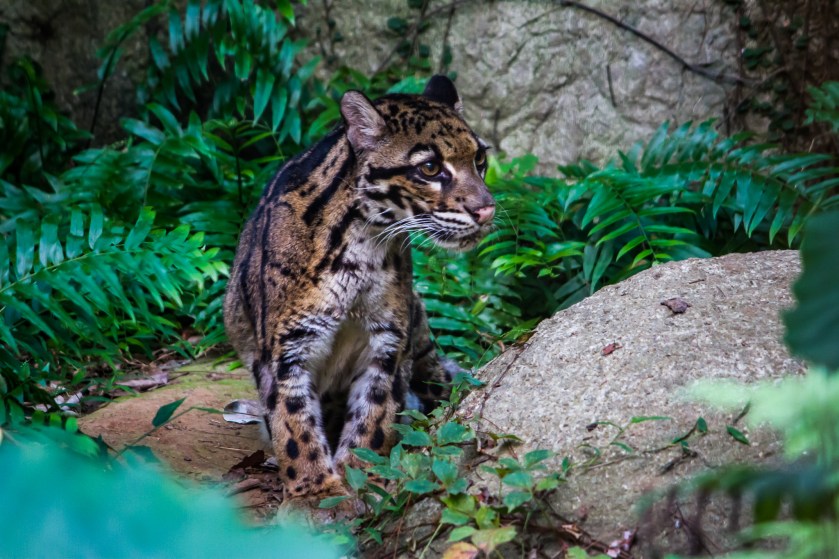
Image credit: 台灣雲豹 @Taipei Zoo by Simon Hsu. / Flickr, license: CC BY-NC 2.0.
The Rise of Artificial Indigeneity in Taiwan Eco-literature
Imagine a literary landscape where unique Austronesian cultural references blend with fantastical narratives of speculative realism. In Taiwan, this innovative confluence has given rise to a groundbreaking subgenre in eco-literature: Speculative Indigenous Fiction. This new wave of fictional writing, which I call the new AI—‘Artificial Indigeneity’—is not only taking the lead in shaping Taiwan’s literary scene, but it also holds the promise of enriching and diversifying global eco-critical studies.
From the perspective of literary history, Taiwanese Indigenous literature has long been regarded as a powerful means to voice the social injustices and political struggles of Indigenous peoples. Topics of racial and gender discrimination, colonial or neoliberal exploitation, as well as human and land rights issues, were extensively examined in most of the Indigenous writings from the 1990s to the early 2000s. Nevertheless, at the turn of the New Millennium, a transformative shift emerged; we see more and more writings produced by Indigenous authors being analysed through an eco-critical lens. Indigenous authors thus became conscious that their writings and their representations of the Traditional Ecological Knowledge (TEK) could positively influence the understanding of the distinctive ontologies and cosmologies of their cultures. Writers such as Syaman Rapongan 夏曼 藍波安 and Aronglong Sakinu 亞榮隆 薩可努 are the forerunners of this movement. They systematically contextualise in their literary works the pluri-verse that humans and nonhumans share, which is unique to their Austronesian cultures.
Interestingly, the uniqueness of this Austronesian pluri-verse was not unfamiliar to Taiwanese non-Indigenous nature writers. In the 1990s, nature writers like Wang Chia-hsiang 王家祥 already incorporated elements of Indigenous mythology interconnected with the environmental and colonial history of Taiwan. Novels like The Myth of Negrito《小矮人之謎》(1996) or The Riddle of the Negrito Legend 《海中鬼影: 鰓人》 (1999) not only demonstrate his attempts to decipher the Austronesian cosmologies from a non-Indigenous perspective but also showcase how he effectively employed magical realism to reconstruct the intricate hybridity between human and nonhuman worlds.
The contemporary eco-literature scene in Taiwan has inherited this distinctive quality. Whereas traditional nature writings would focus on the author’s empirical experiences and scientific knowledge about nature, and typical Indigenous writings would highlight the debate about the author’s ethnic and cultural identification, the current trend of eco-writings breaks away from these constraints. It takes a different turn by reworking Indigenous ontologies with scientific knowledge in the form of speculative fiction, rendering the boundary between science, Indigenous belief systems, and ontology more equivocal and obscure. And although the writing of Indigeneity is in some respects ‘artificially generated,’ it fosters a wider disciplinary engagement among literary studies, Indigenous studies, history, natural science, and environmental philosophy.
Proposed Definition of the New ‘AI’
The convergence of Indigenous writings and speculative fiction is a highly popular subgenre in Taiwan’s eco-literature, but the theorisation of this subgenre is yet to be concretely established. One can borrow from the ideas put forward in Hsu Chen-fu’s 徐振輔 Taming the Blue Sheep《馴羊記》(2020). This semi-fictional ethnography blends eco-writing, travel writing, and historical and religious writing with a view to theorising this new subgenre.
Hsu contends that the worship of nature was a big part of human culture, with shamanism highly praised as a social practice in ancient times. Shamans were often tasked to learn the ‘language of the earth’ and further draw on that knowledge they acquired from the earth to solve problems in people’s daily lives. In modern times, humanity discovered different knowledge systems—notably science—that aimed to ‘master’ nature, leading us to cease listening to the obscure messages concealed in nature. Paradoxically, scientific development is also the primary cause of today’s anthropogenic climate change. As a result, humans again yearn for the words of the lakes, the stones, and the trees.
To Hsu, geologists now assume the role of shamans as attentive listeners of nature. In his book, Hsu underlines the ambivalent role between science and spiritual empiricism (i.e. shamanism), each interpreting what nature communicates. Ultimately, Hsu deconstructs how we perceive our relations to nature and how we employ science in understanding nature in modern times. Drawing on his ideas, one can argue that the ancient wisdom of Indigenous cultures could be seen as the other side of the coin of today’s scientific discoveries. Taiwan’s unique yet diverse Indigenous cultures, therefore, lend themselves easily to the development of Speculative Indigenous Fiction.
For this reason, I claim that the New ‘AI’ offers a new ground to bridge scientific epistemology with the mystical understanding of nature. Contemporary Taiwanese authors who engage with this Speculative Indigenous Writing in some ways also assume the role of shaman/scientist. Through their artistic expressions, we are able to glimpse the interconnected worlds of humans and nonhumans.
Wu Ming-yi and Chiou Charng-ting’s Speculative Indigenous Fiction
The short stories of Wu Ming-yi 吳明益 and Chiou Charng-ting 邱常婷 successfully demonstrate the emergence of this ‘Artificial Indigeneity’. Wu Ming-yi’s ‘Cloudland 雲在兩千米’, included in his short story collection, The Land of Little Rain 《苦雨之地》(2019), leads the readers through a metafictional journey to retrace the footprints of the extinct ‘mythical’ figure of the Formosan cloud leopard in the Rukai people’s beliefs. The story begins with an unfinished tale about the cloud leopard pelt written by the deceased wife of the protagonist. Determined to uncover the trails of this mythical mountain cat, the protagonist uses modern technologies—such as hair traps and infrared cameras—believing it will help solve the mystery left by his wife. However, the story spirals into a surreal narrative in which the protagonist eventually encounters a fictional character invented by his wife. This narrative redefines the border between the real and the unreal and simultaneously challenges the boundary between scientific epistemology and Indigenous ontology. The protagonist’s sexual intercourse with the mythical clouded leopard in the final scene alludes to an ambivalent ‘animal-becoming,’ reflecting the complex intersections of various knowledge systems rooted in the Indigenous worldview.
Chiou Charng-ting’s ‘Zebra Finch Rain 斑雀雨’ (2020) addresses a similar (dis)juncture between Indigenous cosmology and modern epistemology. The story stages a complex relationship between a daughter and her mother. The daughter, returning from the UK without completing her degree in animal behaviour studies, assists her mother on their farm. The mother, a former shaman in an aboriginal village, sought to acquire new knowledge for organic farming by adopting the ‘modern scientific’ method. The narrative of the story reflects the daughter’s struggle to reconcile her mother’s mystical beliefs with her scientific understanding. Themes of Indigenous shaman culture, belief systems, and the clash between scientific and supernatural worldviews are unravelled throughout the story. The story takes a dark turn when a thief intrudes on their farm. While the narrator is aware of the physical fight between the mother and the thief, she only watches her mother’s struggle from a distance – via the surveillance camera feed on her mobile. The unsettling ending, with the dead zebra finch raining from the sky, indirectly refers to the fading shaman culture of the Puyuma people.
To conclude, the emergence of Speculative Indigenous Fiction in Taiwan represents a unique fusion of traditional Austronesian cultural elements with philosophical ideas of speculative realism. The concept of ‘Artificial Indigeneity’ not only enriches the field of Taiwanese literature but further sets the tone of this new wave for global eco-critical studies. Works of Wu Ming-yi and Chiou Charng-ting deconstruct the conventional boundaries we draw between Indigenous beliefs and modern science. As these narratives illustrate, the wisdom of traditional knowledge or belief systems can coexist with modern science. To some extent, it could even influence the development of science, offering a holistic approach to ecological understanding. Ultimately, Speculative Indigenous Fiction can be regarded as an experimental ground or a powerful platform which revitalises Indigenous knowledge in order to address pressing ecological concerns.
Dr Ti-han Chang is a Lecturer in Asia Pacific Studies, University of Central Lancashire, UK. She published a book review, ‘The Land of Little Rain (苦雨之地), written by Ming-yi Wu (吳明益), (2019)’, in the International Journal of Taiwan Studies 3(2): 380–382.
In this essay, Dr Chang made a reference to how the novels by nature writer Wang Chia-hsiang incorporated Indigenous mythology. Readers who are interested in the topic may find this research article useful too: Christopher N. Payne, ‘In/Visible Peoples, In/Visible Lands: Overlapping Histories in Wang Chia-hsiang’s Historical Fantasy’, International Journal of Taiwan Studies 2(1): 3–31.
This article was published as part of a special issue on ‘International Journal of Taiwan Studies: Contemplating AI & Taiwan Studies‘.
Adam Barnett is the coordinator of the Taiwan Insight-International Journal of Taiwan Studies Special Issue for August 2024.
 Taiwan Insight