
Written by Mori Lin.
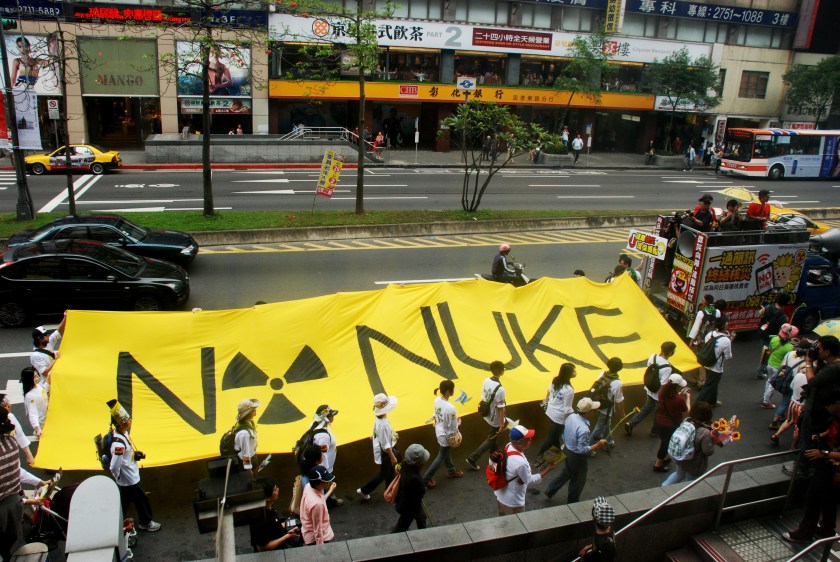
Image credit: DSC_3891 by 苦勞網 / Flickr, license: CC BY-NC-ND 2.0.
To understand Taiwan’s journey towards a nuclear-free homeland and energy transition, we need to examine the historical, legal, and geopolitical factors shaping this path. This article examines Taiwan’s steps towards a nuclear-free homeland, the challenges and opportunities that have emerged along the way, and the legal adjustments that continue to influence the country’s energy landscape.
Taiwan’s goal toward a nuclear–free homeland
Taiwan’s journey towards a nuclear-free homeland began in 2002 when the Basic Environment Act stipulated this goal, although it did not set a specific timeline. Following the Fukushima nuclear disaster in Japan in 2011, the civil society in Taiwan has generally and is more firmly determined to move towards a nuclear-free homeland. In 2016, the ruling Democratic Progressive Party (DPP) advocated for achieving a nuclear-free homeland by 2025. They projected a power generation mix consisting of 20% renewable energy and 80% thermal energy, with an increase in gas and a reduction in coal dependence. By 2017, the national power mix consisted of less than 10% nuclear power, about 5% renewable power, and over 80% thermal power. However, in 2022, the Executive Yuan stated that 20% of renewable energy power generation in 2025 would have to be postponed until 2026.
When the DPP took power for the third time in 2024, President William Lai referenced “Taiwan 2050 Net Zero Emissions Pathway,” proposed by the Executive Yuan in 2022. He planned on the phased goals for the power mix individually in 2030 and 2050 (Table 1). If Taiwan aims to achieve its goal of a nuclear-free homeland by 2025, the current status of Nuclear Power Plant No. 3 is crucial. This plant is still operational, but its operating license is set to expire in 2025. According to the law, Taiwan Power Company (TPC) would have to apply for a license extension five years in advance to allow time to scientifically assess the risk of extending the operation of nuclear power plants. Even if Taiwan amended the law to reduce the time for submitting applications, TPC still needs a certain amount of time to evaluate the risks. As TPC already missed the deadline to apply for an extension, if Nuclear Power Plant No. 3 is decommissioned as scheduled, Taiwan has the opportunity to become the first country in East Asia to shift from nuclear power generated to nuclear power free in 2025.
Table 1 The status and roadmap of the national power mix in Taiwan
| Source / Policy | Year (Released/Target) | Nuclear | Renewable | Gas | Coal |
| 2017 Actual Power Mix | 2017 | 8% | 5% | 35% | 47% |
| 2023 Actual Power Mix | 2023 | 6% | 10% | 40% | 42% |
| 2025 Nuclear-Free Homeland | 2016/2025 | 0% | 20% | 50% | 30% |
| 2030 Phased Goals to Net Zero | 2024/2030 | 0% | 30% | 50% | 20% |
| 2050 Phased Goals to Net Zero | 2024/2050 | 0% | 60-70% | 20-27%(+CCUS) | |
*CCUS stands for Carbon Capture, Utilization, and Storage.
Electricity Law and its Impact on Renewable Energy Development
Despite minor and incremental changes since its passage in 1947, Taiwan’s Electricity Act has long been criticized for failing to promote sustainability. By the end of 2016, a major revision was underway, which aimed at the reform of the electricity market, the nuclear power phase-out agenda, and progress in renewable energy. By 2017, important amendments were passed by the Legislative Yuan and went into effect. The guiding principle for these changes is to “open the two ends while holding onto the middle.” By this phrase, the Bureau of Energy means that the goal is to open the electricity market to allow competition and promote efficiency and sustainability. Still, the electrical grid and relevant infrastructure shall remain nationalized to ensure equity.
The 2018 referendum also led to an amendment to the Electricity Act. However, the public rejection of the 2050 nuclear-free homeland goal may have been influenced by misconceptions about the energy structure. In response to the referendum result, the Legislative Yuan passed an amendment in 2019 to Article 95 of the Electricity Act, deleting the article that “nuclear power plants shall cease to operate before Year 2025.” However, a public opinion survey conducted by the Risk Society and Policy Research Center (RSPRC) at National Taiwan University before the 2018 referendum showed that 43.6% of the respondents mistakenly believed that nuclear power was the main energy source for power generation in Taiwan. They were unaware that nuclear power accounted for less than 10% of total generated power in 2017. The survey shows that the energy literacy of Taiwanese citizens needs to be improved to avoid referendums from determining the direction of Taiwan’s power development when the perceived facts are incorrect.
In 2024, the Executive Yuan proposed a draft amendment to the Electricity Act. Due to the increased power generation costs caused by the Russia-Ukraine war, TPC suggested that the split of TPC is not in line with the international energy status. Initially, TPC was set to become a holding company and be divided into three separate subsidiaries responsible for generation, transmission and distribution, and electricity sales. However, TPC recommended that the Executive Yuan remove the legal goal of “the split of TPC” in the Electricity Act, leading to the decision that TPC would remain an integrated utility. This move aimed to stabilize the power supply and better align with government policy goals by consolidating resources in the face of increased power generation costs. As a result, establishing an electricity regulation and supervision mechanism has emerged as a new challenge in policy design.
In addition, the amendment to the Electricity Act in 2017 promoted the reform of the electricity industry and affected the coordination and amendment of the Renewable Energy Development Act. For example, the Ordinance’s “Larger Electricity Consumers Clause” has far-reaching legal and social implications, meaning that power generation is no longer only the responsibility of the state. Still, larger electricity consumers must bear the responsibility for power generation. However, Taiwan still has space to amend its Electricity Act to reform the electricity sector, invigorate the electricity market, and accelerate the development of renewable energy.
Challenges in Taiwan’s Energy Transition and Legal Reforms
Taiwan’s energy situation is indeed at a critical stage, mainly due to the multiple challenges in seeking solutions for the energy transition. For example, although natural gas is considered a transitional energy source, its usage raises energy security concerns. Similarly, although nuclear energy is a low-carbon option in operation, it is accompanied by concerns about environmental mining, operational safety, and waste disposal. Furthermore, Taiwan is facing a series of political and economic challenges. For example, when former Speaker of the U.S. House of Representatives Pelosi visited Taiwan in 2022, Beijing responded violently with large-scale military exercises. Taiwan faced not only a political demonstration by China but also was exposed to the vulnerability of energy security. This is especially true when it comes to liquefied natural gas (LNG) supply. There were concerns at the time that if a blockade of the Taiwan Strait occurred, it would seriously affect Taiwan’s LNG supply. At the legal level, President Lai’s administration had secured the mandatory stock of LNG via regulation, gradually increasing it from only seven days of reserves in the past to longer periods to enhance energy security.
Moreover, Taiwan has paid more attention to the scaling market of wind power or solar photovoltaics rather than developing community renewable energy in the past. However, due to geopolitics challenges or national defence, Taiwanese civil society has begun to think about community renewable energy not only for adaptation to climate change but also as a strategy for disaster risk reduction. In war times, when power supply by the state may be disrupted, community renewable energy can serve as a critical backup.
Furthermore, because Taiwan has advantages in information and communication technology-related industries, the Electricity Law and Renewable Energy Development Act have also been gradually revised in recent years to promote energy transition (or broader “Sustainable Transition”) and digital transition, approached through legal transition, called as “Taiwan Triaxial Transitions, TW3X”. TW3X is both a challenge and an opportunity for Taiwan’s new energy development while also providing a timely chance for multinational companies to develop new industries with Taiwan and for research institutions to generate new knowledge.
However, Taiwan’s energy transition is still full of challenges, influenced by international energy developments and price fluctuations. For example, the revision of the Electricity Act has been reconsidered due to the impacts of the Russia-Ukraine war, and there is still some space for reforming the electricity sector in Taiwan. Regarding the issue of energy transition, President William Lai recently mentioned the second phase of the energy transition plan, raising questions about whether it is necessary to amend the Electricity Act again. It is worth noting that after the passage of the Electricity Act, the original plan to establish an independent electricity regulatory agency and to implement a review of the provisions for larger electricity consumers has not yet been realized. This shows ongoing issues in improving energy supervision and regulation.
More importantly, in addition to the regulations for larger electricity consumers to the electricity generation by themselves, Taiwan is also considering enhancing the legal infrastructure to support the development of citizen power plants and community renewable energy for self-consumption. Integrating disaster risk reduction with renewable energy will not only help decentralize power generation and increase energy autonomy but also address Taiwan’s energy security problems, such as LNG supply during disasters and even in wartime.
Mori LIN is a post-doc researcher at the Risk Society and Policy Research Center at National Taiwan University and the Research Center for Environmental Changes at Academia Sinica, Taiwan. He is involved in the intersection of technology law and the Society for Sustainable Development and Disaster Risk Reduction. He conducts studies on Science, Technology and Society, Comparative Law and Policy, and Risk Governance.
This article was published as part of a special issue on ‘Taiwan’s Legal Landscapes for Environmental Justice and Climate Action.’
 Taiwan Insight