
Written by Alex Hsu-Chun Liu.
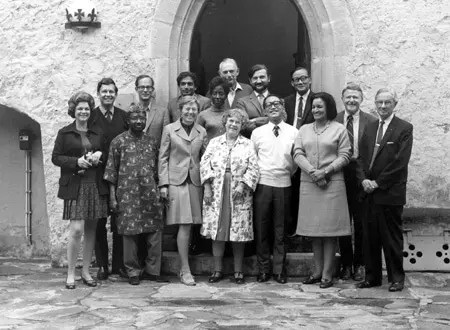
Image credit: Posted with permission of the Wenner-Gren Foundation for Anthropological Research, Inc. New York, New York.
What can Taiwan, an island caught in precarious geopolitics on the verges of empires, tell us about the history of global mental health, anthropology, and transcultural psychiatry? Cultural inquiries of Taiwanese psychiatrists could be informative for this question: In 1996, to celebrate the retirement of Hsien Rin (1925-2016), the longest-serving chief of the Department of Psychiatry at National Taiwan University, Rin’s papers were collected and published with a focus on socio-cultural psychiatry. When Rin passed away, his disciples and colleagues remembered him as a poet, a humanist, and, quite surprisingly, an anthropologist. This marked the academic recognition of his cultural inquiries, especially those of transcultural psychiatry, from the 1950s to the 1970s. However, Hsien Rin is rarely acknowledged in the historiography of transcultural psychiatry.
Transcultural psychiatry can be loosely defined as a subdiscipline of psychiatry or a dynamic international network of “transculturalists,” including psychological anthropologists and psychologists. In recent years, transcultural psychiatry has been explored in postcolonial settings by medical/psychological anthropologists like Stefania Pandolfo and Katie Kilroy-Marac and historians, including Ana Antić, Sloan Mahone, Emmanuel Delille, Howard Chiang, Wen-Ji Wang, and Harry Yi-Jui Wu, etc. Wu’s monograph, Mad by the Millions: Mental Disorders and the Early Years of the World Health Organization, depicts the intersection of transcultural psychiatry and the WHO on the issue of global mental health; it also tells a sometimes-forgotten history of Taiwanese psychiatrists’ engagements in psychiatric epidemiology and public health. Reviewing this ground-breaking volume, China Mills interrogates the connections between the networks of transcultural psychiatrists and the eugenicists/racial scientists, raising critical questions about the colonial or imperial legacies and decolonisation in global mental health. To answer these questions, it is crucial to delve into the cultural inquiries of psychiatrists in the postwar years, a period that saw the birth of transcultural psychiatry.
Farewell to the Japanese Empire, Encountering the North America
The stories of Hsien Rin, along with Tsung-Yi Lin and other contemporaries, reveal how intellectuals were caught between empires and reestablished the discipline in a postcolonial condition. After WWII, Tsung-Yi Lin and Hsien Rin left Japan and returned to Taiwan, their native land. Rin enrolled in the NTU as a medical student, whereas Lin, five years older than Rin, became a professor at the NTU Hospital. They faced a situation that they were unfamiliar with after the war: Taiwan was no longer a colony of Japan. It was incorporated into China under the KMT’s colonial governance, and public agencies, including the NTU, underwent institutional reorganisation. The reorganisation of the university and the repatriation of Japanese scholars left Taiwan a psychiatric discipline that had to be reestablished to tackle mental health issues.
These Taiwanese psychiatrists had to learn the North American trends of psychiatric knowledge and reassemble their Japanese training with it. The KMT’s administration aimed to “Americanise” the NTU. For psychiatrists, this meant introducing dynamic psychiatry, which was different from their German-Japanese training in descriptive psychiatry. What these Taiwanese psychiatrists faced was a form of intellectual imperialism, and they managed to reassemble different approaches to their knowledge production. For example, Tsung-Yi Lin resorted to his training in Tokyo. In Tokyo, he was a disciple of Yushi Uchimura (1897-1980). Uchimura studied psychiatry in Germany and was greatly influenced by Emil Kraepelin (1856-1926), Ernst Kretschmer (1888-1964), and Ernst Rüdin (1874-1952), who was a crucial advocate of racial hygiene of the Nazis. Influenced by the discourse of racial hygiene, Uchimura conducted field surveys among the Ainus in Hokkaido and people on Miyake and Hachijo Islands, and his surveys became the basis of the legislation of eugenic policies in Japan. These ideas concerning racial hygiene, which emphasised the heredity of the “racial constitution” of psyche and physique, were shared by many German and Japanese physicians. Tsung-Yi Lin was familiar with Uchimura’s eugenic and racial-scientific approach to psychiatry, and he applied this approach to studying the Taiwanese mental landscape.
Tsung-Yi Lin’s appropriation of Uchimura’s method appeared in his Formosa Study, a psychiatric-epidemiological survey of three Taiwanese communities that earned him the opportunity to the WHO. The survey was conducted between 1946 and 1948 and published in 1953. Although Uchimura’s eugenic approach inspired it, Lin’s paper only mentioned the word “heredity” once. Similarly, in Hsien Rin’s subsequent study among the Indigenous Peoples published in the 1960s, the eugenic focus on heredity was also missing. Both Lin and Rin emphasised the impact of socio-cultural factors on the incidence of mental disorders. “Family” used to be an indicator of heredity burdens in Uchimura’s work, but family and “tribal society” were interpreted as therapeutic communities in Lin and Rin’s work. What made these differences between the work of these Taiwanese psychiatrists and that of Uchimura?
The time gap between the fieldwork and publication revealed the cause. In the early 1950s, Lin and Rin were sent to Boston and other major cities in North America to study psychiatry; they not only absorbed the North American dynamic psychiatry but also witnessed the rise of social psychiatry in the United States and the transcultural psychiatry network at McGill University. Lin and Rin’s autobiography and reports documented their attention to the anthropological and sociological engagements in these projects. While they had conducted their fieldwork with a eugenic focus, they might soon realise that this did not fit into North American psychiatry. Reestablishing a discipline in Taiwan, these psychiatrists reinterpreted their empirical data with socio-cultural analysis. This reinterpretation was a strategy for these Taiwanese psychiatrists to gain opportunities to later engage in the international arena of transcultural psychiatry.
The “Not-Yet Anthropologist” in a Settler Colonial Society
The 1950s not only marked the shift from eugenics to socio-cultural psychiatry; it also marked the critical period when psychiatrists and anthropologists collaborated to study the mind of the Other culture, or the Indigenous minds. This interest in the Indigenous minds was transcultural, transnational, and interdisciplinary. Hsien Rin’s work in ethnopsychology responds to this trend, and his fieldwork on alcoholism among the Indigenous Peoples, especially the Nan-Shih Amis, was regarded as a ground-breaking ethnography on the topic.
Rin’s ethnography revealed his role as a “not-yet anthropologist” in a settler colonial society. Hsien Rin was not systemically trained in anthropology, yet his contemporaries widely recognised his ethnographic efforts. He was keenly aware of the socio-economic oppression of the Nan-Shih Amis and their sufferings in settler colonialism, but he did not provide a genuine critique of colonialism. He attributed alcoholism among males in Nan-Shih Amis to the matrilineal kinship system and acculturation through contact with modern forms of life, both causing economic stress. In other words, Hsien Rin located the pathology in masculinity (perhaps also sexuality) and modernity. To be clear, acculturation was mediated by contact with the Han Taiwanese settlers who colonised the land. Land loss, in Rin’s observation, was a crucial element in the economic stress for the Nan-Shih Ami and thus resulted in alcoholism. Although Rin clearly saw the mental impact of land loss and acculturation, he never criticised settler colonialism per se. As Taiwanese psychiatrist-anthropologist Yi-Cheng Wu comments, a genuine decolonial psychiatry was yet to come.
Rin’s ethnography was influential in three aspects: first, it initiated the psychiatric studies and interventions of alcohol consumption among the Indigenous Peoples. Second, his account of masculinity and acculturation among the Indigenous Peoples informed his later career in forensic psychiatry. Third, and perhaps most importantly, his ethnography was highly regarded by psychological anthropologist Yih-Yuan Li (1931-2017), who would later become Rin’s ally, and economic anthropologist Ying-Kuei Huang (1947-2022), who criticised Rin’s methodology and writing while recognising Rin’s contribution to the topic.
The stories of Taiwanese psychiatrists’ cultural inquiries indeed do not end here. By the end of the 1950s, after overseas experiences and domestic cross-cultural explorations, some joined the transcultural psychiatry network. Hsien Rin later became a crucial figure in this network and communicated with McGill psychiatrists like Eric Wittkower (1899-1983) and H. B. M. Murphy (1915-1987); but more interestingly, his collaboration with anthropologists revealed the prehistory of transcultural psychiatry, psychological anthropology, and medical anthropology in Taiwan. In the 1970s, together with Yih-Yuan Li, Hsien Rin participated in training next-generation psychological anthropologists in Taiwan. It thus provides an entry point in historicising interdisciplinarity in Taiwan. After the 1950s, this not-yet anthropologist would frequently communicate with Georges Devereux (1908-1985), Norman A. Chance, William Caudill (1920-1972), George A. DeVos (1922-2010), and Arthur Kleinman, some of whom were Rin’s collaborators. The stories of their communication and collaboration reveal the transnational intellectual history of psychological anthropology in motion. This intellectual history could inform the emergent Taiwan Studies of the transcultural and interdisciplinary endeavours struggling under the domination of intellectual imperialism and Cold War geopolitics and, hopefully, toward genuine decolonisation of psychiatry in a postcolonial society.
Alex Hsu-Chun Liu is pursuing an MSc at the Institute of STS, National Yang Ming Chiao Tung University (NYCU, Taiwan), and an M.D. at Chang Gung University, Taiwan. He is interested in medical anthropology and history. He currently works on a transnational history of transcultural psychiatry and psychological anthropology.
This article was published as part of a special issue on ‘SOAS Taiwan Studies Summer School’. Taiwan Insight has previously published a special issue on ‘Psychoanalysis And Taiwan: A Contested Discourse In A Small Country?’, please read more relevant articles here.
 Taiwan Insight