
Written by Mark G. Murphy.
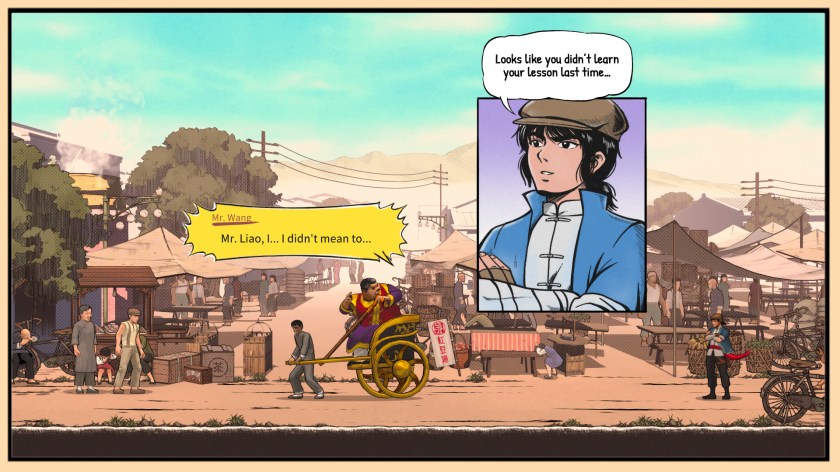
Image credit: screenshot of The Legend of Tianding by Neon Doctrine.
This article is presented in two parts. The first part, published on the 19th of November, established the cultural and historical framework of wuxia mythology in gaming, examining how these uniquely Chinese narrative traditions have shaped interactive storytelling.
The contrast between The Legend of Sword and Fairy (1995) and Ultima IV: Quest of the Avatar (1985) offers a revealing window into these distinctions. Ultima IV tasks players with mastering eight virtues – including honesty, compassion, and humility – in their quest to become the Avatar, reflecting a distinctly Western, Christian-influenced tradition of personal salvation and heroism. The game presents a clear path toward moral perfection, where individuals must adhere to specific ethical codes. This approach to character development emerges from Western philosophical traditions that emphasize individualism and moral clarity, creating a narrative where players strive toward transcendent ideals of virtue.
The Legend of Sword and Fairy (仙剑奇侠传) exemplifies the moral philosophy found in wuxia and xianxia traditions, blending elements of both genres through its exploration of the jianghu (江湖, the martial world) and the supernatural realm. The series presents morality as fundamentally situational, where characters navigate conflicting obligations between personal honor (义气), familial duty (孝), romantic love, and broader societal responsibilities. The narrative draws on Buddhist and Taoist concepts of yuanfen (缘分, fated relationships) and karma, where characters’ choices ripple through multiple lives and dimensions.
The series treats the cultivation (修炼) journey not just as a path of martial or spiritual advancement, but as moral development through relationships and trials. Characters face situations where conventional notions of right and wrong prove inadequate, and must wrestle with competing virtues and obligations. The tragic elements in the story illustrate core philosophical concepts about the nature of attachment, sacrifice, and transcendence.
This approach differs from binary moral systems by showing how ethical cultivation occurs through direct engagement with moral ambiguity rather than adherence to fixed principles. Players consider how virtues like loyalty, justice, and compassion might conflict with each other, and how personal choices reverberate through both the material and spiritual realms. Yilan Wang states
The speculative element is not necessarily the supernatural or magical but rather the mere existence of the [hero] who challenges existing power structures and dwells in a jianghu world outside of the seats of power.
The focus on martial arts in these stories is also a key element, as it connects the characters’ physical skills with spiritual growth, offering a more holistic approach to heroism that is tied not just to individual achievement but to a broader sense of responsibility in the world. In these narratives, personal development often centres around the concept of cultivation—a journey that unfolds within a physical and spiritual landscape that is both internal and external. Here, cultivation is an embodied struggle (a body struggling within a larger landscape as Body). The character refines their skills, energy, and essence within a landscape that is as much an environment as a representation of their internal state. This world, whether a lush wilderness or a series of training grounds, is usually based on a real place in the game’s universe, presenting challenges that mirror the player’s internal development.
In contrast, personal development in Western fantasy gaming often focuses more on external quests, where characters grow by facing external conflicts and amassing power. The landscape, while rich in lore and detail, is not typically an intrinsic part of the character’s growth. It functions more as a setting or backdrop than as an active, breathing entity intertwined with the character’s journey. In Western games, the landscape exists for exploration rather than as a force that shapes the protagonist’s very being. This resulted in the ubiquitous Open World format that now saturates much gaming and very much leads to fatigue.
One of the key elements in the dualism often found in Western fantasy games is the notion that mythology, particularly in works like J.R.R. Tolkien’s The Lord of the Rings, exists in a kind of strange hinterland, disconnected from the world itself. Tolkien’s creation of an Anglo myth was, in part, inspired by the loss of connection to the earth and the land that characterised much of modernity. His mythological universe was imbued with an air of separation from the real world, existing in an idealised, often nostalgic space, distant from the struggles and real-life geography of contemporary life. It is noted that Games Workshop famously inverted this with the ironic nihilism of the Grim Dark.
This grounded approach to myth-making is something Taiwan builds upon, especially as newer Taiwanese games explore unique ways to tell stories that connect identity, embodiment, and struggle within contemporary or historically significant landscapes. Games like Devotion (2019) and Detention (2017) employ elements of Chinese folk horror, blending social and historical commentary with supernatural elements. Although not strictly wuxia, these games do not shy away from confronting real-world issues and identity struggles within Taiwan’s distinct cultural and geographical context. For example, Devotion uses its setting to explore the tensions between modernity and tradition. At the same time, Detention taps into the traumatic history of Taiwan during the White Terror period, grounding its horror in a real, painful past. They cultivate a narrative from an existing body.
These games continue Taiwan’s tradition of creating narratives that engage with both the real and the mythological, avoiding the separation often seen in Western mythologies. The Legend of Tianding focuses on a Taiwanese folk hero who fought against Japanese colonial authorities in the early 20th century, embodying resistance and justice much like the legendary figure of Wong Fei-hong. Tianding, a character drawn from Taiwanese folk history, becomes a symbol of the oppressed standing against colonial powers, using martial arts for the people’s cause. This draws parallels to the archetype of Wong Fei-Hong in Chinese folklore, a heroic figure who used his martial skills to protect the common people.
What sets The Legend of Tianding apart, and why it is significant, is its use of a local hero in the context of Taiwan’s specific history. By drawing upon the real-world resistance movements during the Japanese occupation, the game places the struggle of Tianding within an actual historical context, blending the folk hero with the lived experience of oppression.
This provides a grounded narrative in contrast to the often fantastical settings of Western mythologies in games, which frequently focus on a more universal or transcendental ideal in a non-existent world. And I think this is the difference between wuxia cultivation vs Western Fantasy.
The concept of cultivation in Chinese tradition extends far beyond mere physical or spiritual training. Rooted in practices like Tai Chi and Qigong, cultivation encompasses a holistic approach to developing body, mind, and moral character. When games incorporate these elements, they tap into living traditions that continue to shape Chinese cultural life. The fantastical abilities portrayed in games thus become metaphors for real practices of self-development and the pursuit of harmony between inner and outer worlds. The in-game cultivation processes are intensifications of martial and spiritual disciplines that are part of Chinese history and contemporary life, making the game world a kind of “intercise”—a reflective space in which players explore real principles in an enhanced yet grounded way. And it is this principle of cultivation – in its widest sense – that I find fascinating. It takes as principal situatedness and the word as such and ‘cultivates’ something from it as opposed to a creation of fantasy ex nihilo that results in a disembodied world that we want to escape into. This is why these narratives are so effective as soft power as a rethinking of internal power, the principle of cultivation. Taiwan’s approach embeds new mythologies in real, resonant landscapes, letting players experience stories that do not merely offer escape but strengthen identity, cultural memory, and the living connection to the land.
Mark Gerard Murphy is an academic and lecturer in theology and philosophy and also a practitioner of martial arts. He is the author of several academic books and articles.
This article was published as part of a special issue on ‘Gaming Taiwan’.
 Taiwan Insight