
Written by Chen-Dong Tso.
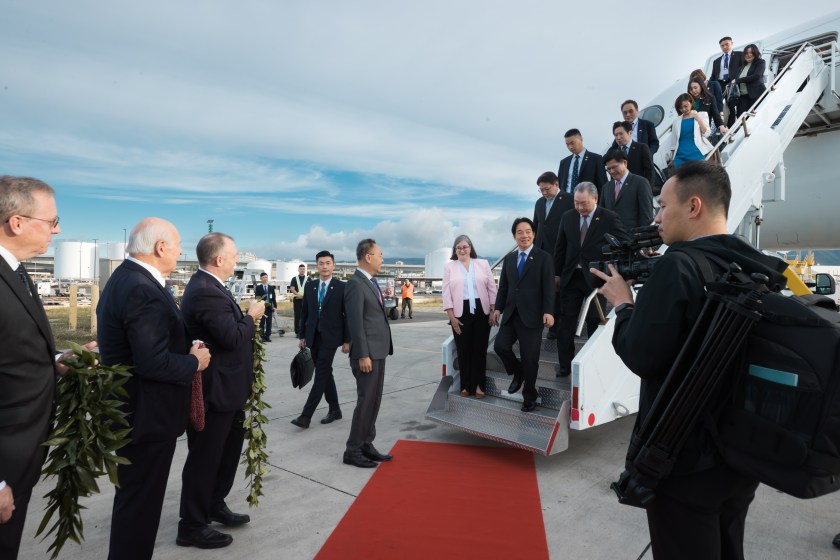
Image credit: 12.01「繁榮南島 智慧永續」專機抵達夏威夷 by 總統府/ Flickr, license: CC BY 2.0.
For the incoming Trump administration, the tension over the Taiwan Strait is one of the difficult issues on its foreign policy agenda. It is a long-standing position by consecutive American governments to prevent either side of the Taiwan Strait from changing the status quo unilaterally. In this sense, Taiwanese President Lai Ching-te’s statement of mutual non-subordination in his inauguration speech, did cause a shock.
In his inauguration speech on May 20, 2024, President Lai did not repeat the core message of President Tsai on cross-trait policy, that is, conducting cross-strait affairs in accordance with the Republic of China Constitution and the Act Governing Relations between the People of Taiwan Area and the Mainland Area. While Lai pledged to maintain the status quo, he caught many by surprise with the statement that the Republic of China (ROC, Taiwan’s official name) and the People’s Republic of China (PRC) are not subordinate to each other according to the ROC constitution’s clauses on popular sovereignty and nationality. It can be taken as one step further toward Taiwan’s independence. It deviated from former President Tsai Ing-Wen’s original expression in October 2021 that brought up the mutual non-subordination thesis but was short of clarifying the legal basis of that. In response, the PRC government made harsh criticism of President Lai himself, conducted a two-day military exercise encircling Taiwan, and cancelled the tariff exemption programme on more than a hundred items of Taiwanese imports. In addition, the PRC published 22 judicial guidelines imposing criminal punishments on diehard Taiwan independence separatists.
Afterwards, Lai revised his position a few times. First, Lai stressed that his mutual subordination is no different from that of Tsai and Ma in an exclusive interview with Time Magazine on June 13. Second, Lai put his “mutual non-subordination” statement within his predecessor Tsai’s four commitments framework to illustrate the continuity between the two presidents. Third, Lai refrained from talking about “mutual non-subordination” on occasions with foreign guests.
In his speech on National Day, Lai kept the formula of mutual non-subordination with no touch upon sovereignty and nationality issues but added that the PRC could not represent Taiwan internationally. In addition, Lai did not mention the phrase of resisting authoritarian expansion that he liked to quote numerous times during the election campaign. Instead, Lai expressed hope in cooperating with China to address global challenges. The two points seemed to echo the US-led push for clarification of UN Resolution 2758 and Biden’s approach to China of “Compete, confront when necessary, Cooperate when possible.”
In parallel to the subtle shift, the Biden administration has sent a series of signals to the Lai government. After the inaugural speech, the US State Department was reluctant to comment on “mutual non-subordination.” A week later, Michael McCaul, chairman of the House Foreign Affairs Committee, visited Taiwan and reminded that there are some red lines that the mainland cannot cross. During US Secretary of State Anthony Blinken’s meeting with PRC’s Foreign Minister Wang Yi at Vientiane in late July, US National Security Advisor Jack Sullivan’s visit to Beijing in late August, and Blinken’s meeting with Wang in New York in late September, the US official statement seemingly took a neutral stance on the situation in the Taiwan Strait. Whenever asked about the Taiwan question, the Biden administration official replied over and over again that it would maintain the One-China policy and not support Taiwan’s independence.
This time, the PRC’s response was similar to that of Lai’s inauguration speech but at a lesser level. It includes harsh criticism of President Lai himself, a one-day military exercise encircling Taiwan, and an announcement of evaluating possible actions to counter Taiwan’s trade barriers on Mainland Chinese imports. In addition, it announced the inclusion of a Taiwanese legislator and a businessman in the diehard Taiwan Independence list.
Entering into the transition period, the Biden administration agreed to President Lai’s stopover in his way of the first visit to Taiwan’s diplomatic allies in the South Pacific. This arrangement can be interpreted as a show of constraint because the visit was made several months later than the first overseas visits by Lai’s predecessors, and the places of the transit stop are Hawaii and Guam, neither of which is in the contiguous United States. In addition, the managing director of AIT, Ingrid Larson, stressed the US One-China policy in a meeting with President Lai, and the State Department highlighted that the transit is private and unofficial. In the meantime, a nuanced arrangement is observed, such as receiving President Lai at the airport with a red carpet and flowers, which the Lai team can interpret as the highest level of courtesy ever.
For his part, President Lai sent a message of both resolve and restraint. On the one hand, Lai picked up the confrontational message of resisting the authoritarian expansion in Palau, by which he refers to the common purpose not only for Palau and Taiwan to work together but also for his administration and the incoming Trump administration to work together. In addition, Lai’s office revealed in Palau that President Lai made phone calls with US House Speaker Mike Johnson, House Democrat Leader Hakeem Jeffries, and Senate Armed Services Committee ranking member Roger Wicker. In their conversation, both the president and these congressional members highlight the threat posed by China and the US and Taiwan’s response to it. On the other hand, there were very few Federal-level office-holders meeting Lai. For his part, Lai did not repeat the “mutual non-subordination” phrase in all his speeches and remarks during the entire trip. On the last day of the trip, Lai seemed to send a softer message by urging China to open hands rather than clench fists to win respect from the international community.
In sum, Biden’s approach to managing cross-strait turbulence, as manifested in the shock of mutual non-subordination, has two components. One is to maintain a line of communication with the PRC, and the other is to work with Taiwan to display signs of constraint through a combination of support and signalling. It is fair to say that this approach managed to gradually lower cross-strait tensions. Nevertheless, the incoming Trump administration may not follow the same playbook. It will take some time for both sides of the Taiwan Strait to learn to adjust to it. For good or for bad, the shadow of President-elect Trump that looms so large seems to shorten the transition period. In this sense, the PRC’s military action in the wake of Lai’s first state visit, emerging right after the revelation of the Xi-Trump phone call, can be a mock test to see how the Trump team will manage future turbulence in the Taiwan Strait.
Chen-Dong Tso is a Professor of Political Science at National Taiwan University.
This article was published as part of a special issue on ‘US Election: Implications for Taiwan’.
 Taiwan Insight