
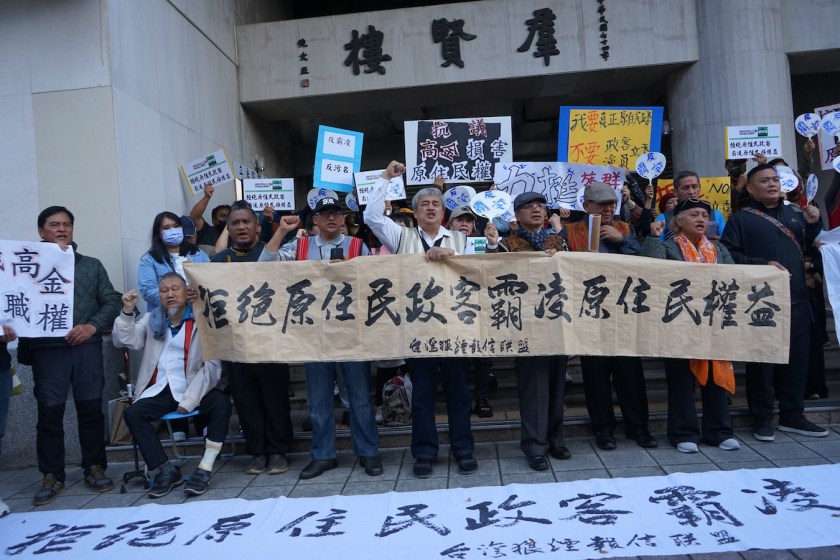
Written by Indigenous Youth Front.
Photos courtesy of Indigenous Youth Front.
Introduction
The Indigenous Youth Front (IYF) is an advocacy organisation composed of Indigenous youth and students from Taiwan. Founded in 2013, our first action was to challenge claims made by certain church leaders that “Indigenous people are against same-sex marriage” and to advocate for gender equity. We seek to amplify the voices of Indigenous youth on a broad range of social issues, striving to ensure that Indigenous perspectives are represented and included in Taiwan’s societal discourse. In 2024, the IYF engaged in numerous advocacies to promote the rights and self-determination of Indigenous peoples in Taiwan, including the right to use Indigenous names without being transliterated into Mandarin characters, opposing irrational disputes over forestation compensation, and speaking out against the abuse of legislative power by certain Indigenous legislators.
On December 13th, 2024, Taiwan’s Legislative Yuan passed a controversial amendment to the Organization Act of the Council of Indigenous Peoples, raising significant concerns among Indigenous communities and allies. Spearheaded by legislator Kao Chin Su-Mei (Ciwas Ali) and other Kuomintang (KMT) Indigenous representatives, the new legislation downgrades the role of Indigenous group representatives from paid positions to honorary roles, citing alleged political patronage under the Democratic Progressive Party (DPP). While framed to ensure fairness and eliminate favouritism, this move has been criticised as a step backwards for Indigenous political participation and self-determination.
Under the revised law, Indigenous group representatives—16 members appointed from Taiwan’s recognised Indigenous groups—will no longer receive salaries. Furthermore, the Chair of the Council of Indigenous Peoples (CIP) will alternate between representatives from the “mountain” and “plains” Indigenous communities. This amendment is ostensibly aimed at ensuring equal representation but has been criticised for perpetuating colonial classifications of Indigenous peoples and marginalising smaller groups. The Executive Yuan and the Presidential Office signed the changes into law without requesting the Legislative Yuan for reconsideration. Although the CIP indicated it would seek a constitutional interpretation of the amendments, procedural hurdles, such as delays in constitutional reform and judicial appointments, have left the issue in limbo.
The importance of Indigenous group representatives in CIP for political participation must be understood in the context of the long-standing, problematic electoral system, and the continuous marginalisation of Indigenous peoples in Taiwan. Therefore, this article will begin by explaining this historical context and the current system of Indigenous political participation and then discuss the implications of this 2024 amendment for Indigenous self-determination.
The marginalisation of Indigenous peoples in political participation
Taiwan’s Indigenous peoples have endured systemic marginalisation since the Japanese colonial period (1895–1945), which implemented assimilation policies aimed at erasing Indigenous identity. After 1945, the Republic of China (ROC) government inherited and reinforced these structures under the imposition of Martial Law and the guise of an anti-Chinese Communist Party (CCP) campaign. The 228 Incident and the subsequent White Terror period further suppressed Indigenous voices, as many Indigenous elites were imprisoned or executed, stifling political participation for decades.
In the mid-20th century, the KMT government’s policies for Indigenous peoples — such as the “Mountain-to-Plains Transformation Policy” (山地平地化政策) —aimed to assimilate Indigenous peoples into the dominant Han Chinese society. Organisations like the Mountain Youth Service Corps (山地青年服務團) and the Civic Service Centres (民眾服務社) facilitated the party’s penetration into Indigenous communities using state resources, fostering their dependency on the party and eroding traditional leadership structures. The rise of the Indigenous Rights Movement in the 1980s called for Indigenous autonomy and sovereignty, but only incremental progress was achieved in securing political rights.
Although Taiwan’s democratisation brought opportunities for greater political participation, Indigenous representation remains constrained. The CIP, established in 1996, remains under the jurisdiction of the Executive Yuan, and lacks genuine autonomy. It primarily serves as a consultative body with limited authority to influence cross-ministerial policies, particularly those involving conflicts between Indigenous sovereignty and colonial laws, such as the regulation of hunting, natural resource use, and the advancement of more comprehensive Indigenous jurisdiction within the respective traditional territories.
Regarding legislative rights, Indigenous participation is constrained by a problematic electoral system dominated by larger ethnic groups and major political parties, especially the KMT’s long-established patron-client relationships. Indigenous representation in Taiwan’s Legislative Yuan is limited to six seats and divided into two multi-member districts: one for “Mountain Indigenous” communities and one for “Plain Indigenous” communities, with three representatives elected from each district. This classification is inherited from the geographic and administrative divisions of assimilated and non-assimilated areas during the Japanese colonial period. This electoral system, which treats Indigenous communities as a nationwide constituency, disproportionately favours larger groups and entrenched political networks formed by KMT. Furthermore, since 2008, only four Indigenous people have been elected to the at-large seats in Legislative Yuan. Major political parties do not include Indigenous candidates in every election; when they do, they are often placed low on the candidate list.
Indigenous electoral participation is hindered by systemic challenges, such as lower voter turnout due to the nationwide constituency model and the logistical burdens of voting for dispersed communities. Voting behaviour is often shaped by clientelism, with entrenched KMT networks dominating many Indigenous areas. The electoral system’s design also reinforces the marginalisation of smaller tribes and unrecognised Indigenous groups, perpetuating a cycle of underrepresentation. Under this context, it is also challenging for Indigenous voters to recall Indigenous legislators. The regulation requiring more than half of the legislative seats in an Indigenous electoral district to be vacant before a by-election can be initiated further limits the representativeness of Indigenous peoples, should a recall succeed.
Implications of the Amendments
Given the above context, Indigenous group representatives are crucial in fostering political participation, particularly for marginalised communities. The mechanism for selecting committee members is not solely based on nepotism. Multiple groups have long-established nomination processes sufficient to represent the majority consensus within each group. Their responsibilities include policy formulation, cross-ministerial coordination, reviewing projects affecting Indigenous peoples, communicating policies to communities, mediating disputes, and addressing grievances—all of which require full-time commitment and adequate resources.
The recent amendment downgrades Indigenous group representatives from paid positions to honorary roles, undermining their ability to advocate for their communities effectively. Without remuneration, their capacity to fulfil their responsibilities is severely restricted, weakening a crucial channel of Indigenous participation in national governance. In addition, the amendment mandates the alternation of CIP leadership between mountain and plains representatives, perpetuating outdated colonial classifications of Indigenous peoples. This approach not only reinforces historical divisions but also marginalises smaller and unrecognised Ping-Pu Indigenous groups, whose issues often receive less attention under the current system.
In a broader context, this amendment is part of a series of recent legislative actions to weaken executive power. The pro-China KMT, now aligned with the power-seeking Taiwan People’s Party (TPP), formed a majority in the Legislative Yuan. By undermining constitutional balance and obstructing funding for crucial government agencies through means that violated legislative procedures, they aimed to weaken the ruling Democratic Progressive Party’s (DPP) ability to uphold national security and ensure the smooth functioning of government operations. Their ultimate goal was to revoke any political actions by government agencies that conflicted with their agenda and to send a message to civil society that opposing voices would face severe consequences. Regrettably, the Indigenous legislators leading this amendment appear to have compromised Indigenous sovereignty in exchange for political gain, joining forces that perpetuate colonial dominance.
Toward Genuine Self-Determination
In the short term, we urge the Indigenous legislators who proposed this amendment to reflect on their role as representatives of Indigenous rights rather than prioritising their own political agendas. Considering the recent election results, their continued hold on these seats is far from guaranteed, and they should tread carefully to avoid backlash from the Indigenous community. We call on the current government to take action to reinstate paid positions for Indigenous group representatives, ensuring their effective participation and safeguarding Indigenous political involvement. Neglecting Indigenous rights perpetuates institutional colonisation and risks further distancing Indigenous communities from establishing meaningful partnerships with the government.
In the mid-term, we advocate for establishing a selection mechanism for group representatives to the CIP that is rooted in the autonomy of each Indigenous group. This mechanism should guarantee the legitimacy and accountability of representatives to the communities they serve, with their selection based on genuine group consensus. Furthermore, transitioning the CIP’s leadership structure to a consensus-based model—where all Indigenous groups are ensured an equitable voice in decision-making—presents a practical interim step toward achieving genuine sovereignty. This approach would foster inclusivity, self-determination, and a stronger foundation for meaningful partnerships between Indigenous groups and the state.
Ultimately, we call for reimagining Indigenous political participation rooted in prioritising Indigenous sovereignty. The Council of Indigenous Peoples (CIP) could be empowered with greater autonomy and authority to shape policies directly impacting Indigenous communities. Moreover, reforming the electoral system for Indigenous representation is essential to ensure it genuinely reflects the collective interests of every Indigenous group, free from external political influence. Drawing inspiration from international examples such as Aotearoa New Zealand’s co-governance model, rooted in the Māori-Crown relationship under Te Tiriti o Waitangi, Taiwan could work toward establishing a nation-to-nation relationship with its Indigenous peoples. Achieving these transformative goals would require bold constitutional reform. However, any decisions must respect the unceded sovereignty of Indigenous peoples and be grounded in their authentic and unaltered collective consensus, free from the influence of colonial legacies or political agendas.
Broader Implications for Taiwan’s Democracy
The recent amendment underscores long-standing issues surrounding equitable participation and self-determination for Indigenous peoples in Taiwan’s political landscape. Taiwan has made considerable progress in democratic development since moving away from the Martial Law era and the autocratic rule of the KMT regime. However, its treatment of Indigenous peoples reflects lingering colonial attitudes and structural inequities that continue to hinder and marginalise the participation of Indigenous peoples in the democratic system. The political participation of Indigenous peoples remains constrained by factions that prioritise individual political interests over respect for diversity and self-determination, failing to represent Indigenous voices genuinely.
As Indigenous peoples whose sovereignty has never been ceded since the onset of colonisation over 400 years ago, we share the aspiration of many others for the normalisation of Taiwan as a nation. However, this vision must be built on the premise that Indigenous sovereignty is fully respected and exercised within the new structure rather than marginalised once again. We sincerely urge all who share this path to recognise our current political hardships and initiate conversations about establishing Indigenous sovereignty as an indispensable pillar in Taiwan’s democratic process.
Finally, we hope this incident serves as a bridge, connecting Taiwan’s Indigenous sovereignty movement with global Indigenous efforts. Due to colonial history, language barriers, and international challenges, Taiwan’s Indigenous peoples have long been isolated, limiting opportunities for collaboration with global Indigenous movements. We seek to break free from these constraints, sharing our struggles and developments with the world while standing in solidarity with Indigenous communities worldwide. Through this connection, we aim to amplify our voices and contribute to the broader fight for Indigenous rights and self-determination.
This article was published as part of a special issue on ‘Farewell 2024, Fresh start 2025?’.
 Taiwan Insight
One comment