
Written by Rose Kuo and Rachel Levine.
Image credit: author.
This special issue is in collaboration with the Center for Taiwan Studies (CTS) at the University of California, Santa Barbara, currently led by Dr Howard Chiang. The CTS was founded in 2003 by Dr Kuo-Ch’ing Tu, a renowned expert in Chinese poetry and poetics, Taiwanese literature, and world literature in Chinese. Since its inception, the CTS has promoted interdisciplinary research and cultural events that enhance knowledge of Taiwanese culture in regional and global contexts. The CTS organises events on Taiwanese literature, culture, and the arts, including public lectures, conferences, and workshops. In 2023, the new holder of the Lai Ho and Wu Cho-liu Endowed Chair in Taiwan Studies, Professor Howard Chiang, assumed the directorship of the Center. This special issue features three articles. In the first article, Rose Kuo and Rachel Serena Levine document and reflect on a recent talk hosted by CTS featuring Dr Pei-Chia Lan on marriage migrants and children of mixed heritage in Taiwan. Linshan Jiang, a UCSB alumna, shares her memories of her Ph.D. mentor, Professor Kuo-Ch’ing Tu, and inspiring events in which she participated while a student there in the second article. Last but not least, the third article visits the curatorial process of the CTS-hosted event.s
To learn more about the Center for Taiwan Studies (CTS) at the University of California, Santa Barbara, and the events they host, visit their website or follow them on social media.
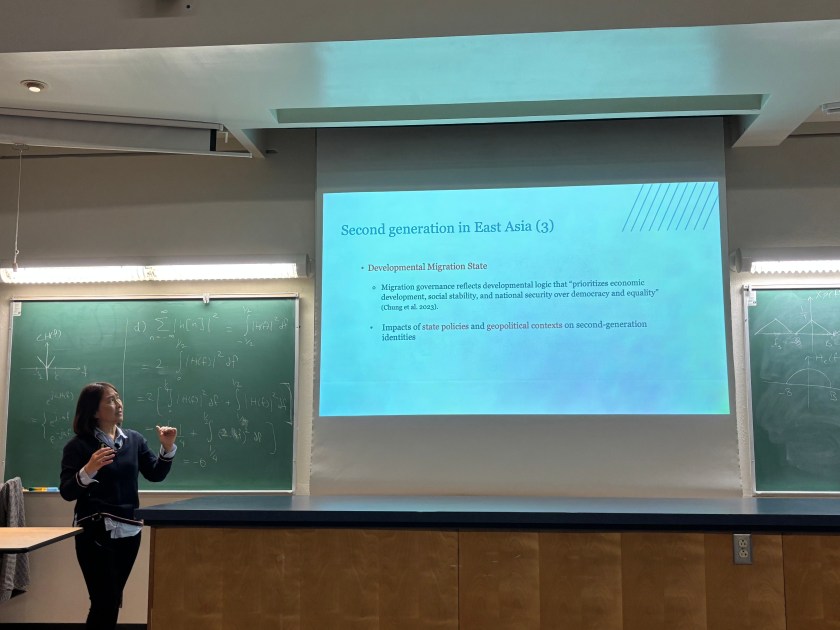
In the 2025 Spring Quarter, the Center for Taiwan Studies (CTS) warmly invited Dr Pei-Chia Lan, who travelled from Stanford University to the University of California, Santa Barbara (USCB), as a special guest speaker. Dr Pei-Chia Lan is a Distinguished Professor of Sociology and Founding Director of the Global Asia Research Center (2017-2023) at National Taiwan University. Featuring Dr Lan’s research, CTS aimed to promote interdisciplinary dialogues and intellectual exchanges of Taiwanese culture, history, and social issues across UCSB. Moderated by Dr Phung Su, Assistant Professor of Sociology at UCSB, Dr Lan’s talk, “Second Generation, Multiculturalism, and Geopolitics in Taiwan,” focused on the influx of marriage migrants and their children of mixed heritage in Taiwan. She shed light on the complex dynamics of identity formation and the multicultural dividends shaped by geopolitical stigma by exploring how geopolitical factors address the ethnic landscapes of “second generation” kids from Southeast Asian or mainland Chinese immigrant families. The event drew an audience of over 80 participants, including faculty members, graduate students, and undergraduates. Without a doubt, this inspiring talk successfully engaged participants in scholarship and provided an in-depth analysis of the intersection between migration, geopolitics, and multiculturalism in contemporary Taiwan. Additionally, it contributed to broader discussions about belonging and social inclusion across Asia.
Migrant marriages, as a process of transformation and negotiation of identity, relationships, and social status, were key aspects of Dr Lan’s talk, a major part of which centred on cross-national marriage in Taiwan. Globalisation, economic disparity, demographic shifts, traditional marriage values, and the commodification of marriage through matchmaking agencies have contributed to the rise of cross-national marriage in Asia, particularly among the Four Asian Tigers: Hong Kong, Singapore, South Korea, and Taiwan (Lu & Yeung, 2024). Female marriage migrants are often negatively portrayed in the media and public discourse, leading to widespread prejudice that hinders both their own and their children’s social integration in Taiwan (Qian & Tsai, 2022). On the other hand, highlighting the context of brokered marriages, Dr Lan emphasised that intermarriage has become a primary driver of immigration, serving as a conduit through which women from Southeast Asia and mainland China (PRC) enter Taiwan to establish families or seek the potential for upward mobility.
Dr Lan’s research contributes to the scholarly discourse surrounding the identity negotiation of immigrants in East Asia. This topic is also addressed by Chris Burgess, who researched how female marriage migrants in Japan garner social capital and status by participating in the public sphere. Working outside the home allows women to gain not only a sense of agency through exploring their identity but also contribute to cultural exchange. Through their visibility, these women, Burgess argues, create the potential for social change and a more multicultural Japan (Burgess, 2004). Similarly, in Lieba Faier’s research on Filipina women in Central Kiso, she finds that the former entertainers who married Japanese men use the concept of love, specifically love for their husbands, as a form of “global self-making,” positioning themselves in a web of transnational relationships. Professing love to their spouses allows them to mitigate stereotypes associated with their past as entertainers, solidify their identity as faithful wives, and emphasise their commitments to both supporting their families in the Philippines and creating a life and identity in Japan (Faier, 2007).
Dr Lan’s research shifts this conversation into the next generation, focusing on children from mixed-background families in Taiwan. Most of these “second-generation” children have one immigrant parent—typically the mother—who came to Taiwan through cross-national, brokered marriage. By asking the question, “Do mixed-background children have more ethnic options?” Dr Lan explores the stigma faced by these second-generation Taiwanese. In a relatively homogeneous East Asian society, where multiculturalism and biculturalism are less prominent, these children often struggle to navigate their identities as they grow into adulthood. Therefore, compared with the mixed-background kids in a Western-based context, Taiwanese children with mixed backgrounds are more likely to be challenged by the uncertainty in their ethnic identity and experience a higher degree of disprivilege in their races and classes.
Dr Lan highlights two predominant groups of second-generation individuals with mixed backgrounds in Taiwan: the Southeast Asian Second Generation (SSG) and the PRC Chinese Second Generation (CSG). Her research indicates that, in recent years, the social boundaries between native Taiwanese and marital immigrants, including their children, have gradually become more permeable. This shift has allowed children of Southeast Asian immigrants to more openly embrace a bicultural identity. The government’s advocacy of the New Southbound Policy can be seen as a major attribute to pivot the identity-shaping among SSG. In contrast, the children of Chinese immigrants face greater challenges in claiming a multicultural identity due to persistent geopolitical stigmas linked to their PRC heritage, which urges them to adopt different strategies to navigate these complexities.
These findings draw attention to the ways in which different types of social mobility (i.e., internal migration, external migration, emigration, and immigration) and multiculturalism shape public perception and policy-making within a non-Western or Sinophone context. Through Dr Lan’s talk, we see how second-generation youth in Asia navigate the complex processes of assimilation and social integration. State policies and geopolitical contexts deeply influence us. These structures offer some youths the flexibility to adopt a multicultural identity while marginalising other youths depending on their ethnic and cultural background.
This dynamic necessitates new approaches to building cultural empathy, equity, and a sense of shared responsibility that extends beyond national boundaries. This discussion is particularly relevant to Taiwan, where a persistently low birth rate and an ageing population pose serious challenges for the future workforce, economic vitality, and social sustainability. Rethinking and reforming immigration policies could play a crucial role in addressing these demographic issues by providing accessible resources to immigrant families, supporting the integration of second-generation populations, and safeguarding the rights of migrant labourers/caregivers or transnational spouses. For example, implementing a well-developed language learning and testing system, establishing pathways to permanent residency, or adjusting the length of time migrant workers are allowed to work in Taiwan. However, policy-making or legal revisions must be supported by public campaigns to counteract the stigma that impacts immigrants. In this context, cultivating a deeper understanding of global citizenship is essential. By promoting an inclusive mindset and encouraging greater justice toward immigrants and their families, Taiwanese society can foster a more welcoming, equity-oriented environment for cross-national marriages and multicultural communities. Such efforts not only enrich Taiwan’s social fabric but also help broaden the base of future citizens, contributing to Taiwan’s long-term resilience and demographic revitalisation.
In resonance with Dr Lan’s talk, CTS foregrounded Taiwan’s engagement with geopolitical multiculturalism within a larger global structure. For this academic year, the CTS’ theme is “Taiwan and Asia America,” which addresses transnational ties, cultural boundaries, and diaspora. Over the past year, CTS has also had the pleasure of hosting or co-hosting a range of distinguished speakers who focus on Taiwan and Asian American studies, including Wen Liu (Academia Sinica), Lily Wong (American University), Wendy Cheng (University of Southern California), and novelist Yang Shuang-zi with her translator Lin King, among others. For the next few years, CTS will organise events based on the principles of “Taiwan in a Relational World.” We will explore how Taiwan positions itself and is positioned in the world, reinforcing the idea that the Taiwanese identity is not formed in isolation but in dialogue with others.
Rose (Tun-Jung) Kuo is a PhD student in Educational Foundations at the University of Hawaii at Manoa. She works as an academic coordinator with the Center for Taiwan Studies at the University of California, Santa Barbara. She has closely collaborated with the East-West Centre and the Taiwan Economic and Cultural Office (TECO). Additionally, her past experiences in international education include supporting the Chinese Flagship Program at UH Manoa and assisting local host families for international students in Hawaii. Kuo’s research focuses on East Asian education, Confucian Heritage Culture learners, organisational development, and intercultural competence.
Rachel Levine is a PhD candidate in the East Asian Languages and Cultural Studies Program at the University of California, Santa Barbara. Her research interests include sexual violence and the law, gender and sexuality in Japan, and the domestic impact of international human rights norms. Her dissertation, entitled “Rape, Resistance, and Revision: Sexual Violence Law and Social Change,” examines the way sexual violence is discussed in the courtroom and the news media and how these rhetorical spheres impact the legal and social understanding of key concepts like consent.
This article was published as part of a special issue on ‘Cultures and Conversations: Taiwan Studies at UC Santa Barbara‘.
 Taiwan Insight