
Written by Meng Kit Tang.
Image credit: Public domain.
A Region on Edge
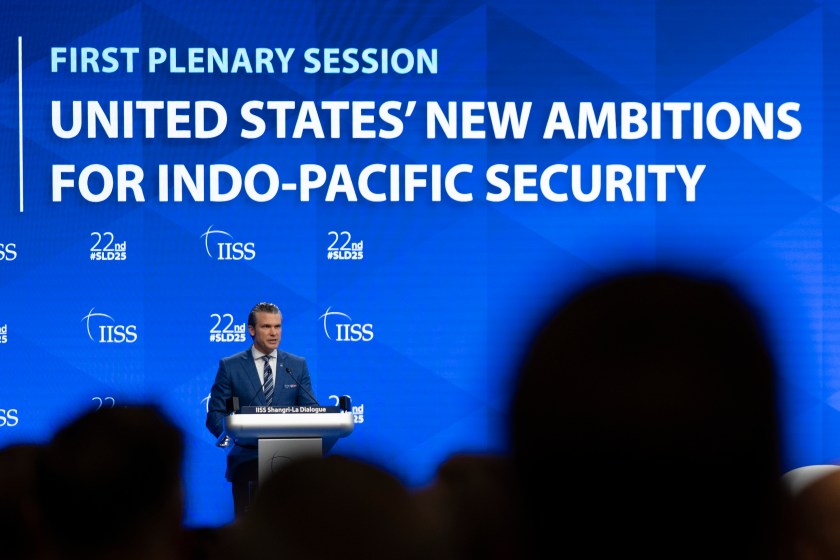
At the 2025 Shangri-La Dialogue in Singapore, tensions over Taiwan escalated. U.S. Defence Secretary Pete Hegseth warned that any Chinese attempt to conquer Taiwan would have devastating consequences and urged Indo-Pacific allies to boost defence budgets. China accused the U.S. of fostering regional discord with a Cold War mindset. Meanwhile, Taiwan’s President Lai Ching-te emphasised peace and respectful dialogue across the strait.
Diplomatic tensions escalated with rising brinkmanship. In May 2024, China’s People’s Liberation Army conducted its largest joint air-naval exercise, deploying numerous aircraft and warships around Taiwan, showcasing military strength. This followed Lai’s inauguration, during which he reaffirmed Taiwan’s commitment to democracy and rejected external pressure. The message from Beijing was evident, highlighting the risk of miscalculation.
The global response has focused on deterrence. In 2024, the U.S. provided military aid to Taiwan and improved joint training. Japan and Australia have also bolstered security cooperation in the Indo-Pacific, highlighting Taiwan’s defence as a regional issue. Yet, deterrence alone does not address collapsing political dialogue, eroding trust, or growing acceptance of military conflict.
Deterrence alone is not enough. It must be paired with a revival of pragmatic engagement: dialogue that is realistic, mutually respectful, and grounded in non-political cooperation. Engagement is not capitulation; it is strategic prudence. It does not weaken deterrence but complements it by reducing the ambiguity that fuels unintended escalation.
A Legacy of Stabilising Dialogue
History shows that dialogue, even without formal recognition, can lower tensions. The 1993 Wang–Koo summit initiated communication on practical issues, despite the unresolved sovereignty issue.
The high point came between 2008 and 2016 under President Ma Ying-jeou. Economic ties deepened through the 2010 Economic Cooperation Framework Agreement (ECFA), which boosted trade and lowered tariffs. The 2015 Ma–Xi meeting in Singapore symbolised a shared desire to stabilise the relationship.
By 2015, over 40% of Taiwan’s exports went to China, creating economic incentives for restraint. Institutionalised communication mechanisms reduced ambiguity. While imperfect, these frameworks offered predictability in a volatile environment.
Yet that era ended as China’s military budget surged past $230 billion and Taiwan’s identity shifted; by 2025, 60% identify as “Taiwanese only,” with under 20% supporting unification. Engagement cannot ignore these realities, but neither should it be abandoned.
Rhetoric, Risks, and Missed Chances
Dialogue remains possible, but space is shrinking. Lai emphasises the importance of peace in cross-strait relations, stating that war has no winners and positioning Taiwan as a responsible player in regional stability. He also stresses the need for Taiwan to strengthen its defences to deter aggression and uphold democratic values, arguing that security is essential for effective dialogue. Lai is open to practical exchanges with Beijing in areas such as trade and public health, provided that they respect Taiwan’s dignity and sovereignty. This balanced approach aims to reassure international allies, deter coercion, and keep the door open for engagement despite rising tensions.
In Washington and allied capitals, deterrence dominates. Think tanks such as the Centre for Strategic and International Studies (CSIS) advocate for “strategic clarity” or “constructive ambiguity” to manage risk without inviting conflict. However, even these analysts acknowledge that the absence of communication channels can lead to misunderstandings spiralling into crisis. A stark example came in 2023 when a Chinese J-11 fighter jet flew within 10 feet of a U.S. B-52 bomber over the South China Sea, a near miss that underscored the dangers of escalating misunderstandings.
While the U.S. and China maintain limited military hotlines, such as the Defence Telephone Link established in 2008, these are not tailored to the dynamics of the Taiwan Strait and are underutilised. Unlike Cold War-era protocols, no dedicated crisis mechanisms exist for cross-strait incidents, heightening the risk of escalation.
Beijing insists on the “one China” principle as a prerequisite for dialogue. It blames the Democratic Progressive Party (DPP) for separatism. Yet Chinese officials continue to praise the economic benefits of ECFA, signalling some openness to selective engagement, especially in non-political arenas. This signals that space remains, albeit narrow and conditional.
In Taiwan, the Kuomintang (KMT) continues to support the 1992 Consensus, “one China, different interpretations”, as a foundation for cross-strait dialogue. However, public backing for the framework has declined. By early 2024, many Taiwanese expressed support for Lai’s rejection of the 1992 Consensus, reflecting growing scepticism toward Beijing. Alternative concepts, such as “mutual non-denial,” have been discussed in policy circles but have not gained significant traction. Still, history suggests that even imperfect arrangements have, at times, helped reduce tensions and preserve stability across the Taiwan Strait.
Constructive Paths Forward
Despite hardened rhetoric, modest steps remain feasible. Technical talks on issues like maritime safety, fisheries, or cross-border pollution could resume under the Association for Relations Across the Taiwan Straits–Straits Exchange Foundation (SEF–ARATS) framework, sidestepping political disputes while rebuilding trust. With over 1,200 Chinese air incursions into Taiwan’s Air Defence Identification Zone (ADIZ) in 2025 alone, establishing military communication mechanisms is not a luxury but a necessity.
Cultural and economic exchanges could also be revived. Before 2016, cross-strait tourism reached five million travellers annually. Restarting student exchanges and direct flights would help restore societal trust. During the 2003 SARS outbreak, health officials from both sides shared epidemiological data despite deep political rifts, demonstrating that functional cooperation is possible under pressure and can be potentially lifesaving.
Multilateral initiatives offer additional channels. A joint Taiwan–China–ASEAN public health initiative or climate resilience project could serve as a discreet entry point for rebuilding habits of cooperation. Taiwan’s recent participation in APEC health task forces and Track II forums, like those led by the Institute of Southeast Asian Studies (ISEAS), shows that engagement space still exists if it is approached with discretion and creativity.
Taiwan should continue strengthening its autonomy while enabling civil society, universities, and businesses to pursue unofficial exchanges. Beijing could ease economic coercion and show flexibility on dialogue conditions. While sceptics argue that China uses engagement to divide or delay, structured and transparent exchanges, especially in multilateral or Track II formats, can mitigate such risks and maintain alignment with democratic values.
Meanwhile, Western actors should go beyond deterrence and actively support dialogue through informal diplomacy, cultural forums, and regional initiatives. Encouraging conversation, not just confrontation, is in everyone’s long-term interest.
Obstacles and Realities
Major challenges remain. China’s adherence to the “one China” principle is fundamentally at odds with the DPP’s platform and Taiwan’s evolving identity. Nationalism is rising on both sides of the strait, amplified by state media and social networks.
Economic coercion has intensified. Beijing has targeted Taiwanese exports, from pineapples to mangoes, for political retaliation. Although 42% of Taiwan’s exports still go to China, overreliance now feels more like vulnerability than leverage.
Generational shifts further complicate engagement. Among Taiwanese under 30, 80% identify as “Taiwanese only.” Any overture that appears to compromise sovereignty is politically toxic. Future engagement must move beyond outdated frameworks and focus on common interests such as public health, climate adaptation, and scientific cooperation where benefits are tangible and political baggage is minimal.
Dialogue as Strategic Prudence
Engagement cannot eliminate deep political differences. However, it can reduce the risk of miscalculation, build habits of communication, and create buffers against escalation. Cross-strait tourism, student exchanges, and trade once served as a stabilising function, even amid rising tensions.
Strategic engagement should not be viewed as a panacea but rather as a crucial complement to deterrence. In a theatre where misreading signals can trigger conflict, communication is not a luxury but a lifeline.
Conclusion: A Choice Between Dialogue and Drift
The Taiwan Strait does not have to be a zero-sum battlefield. The choice is not between surrender and standoff but between paralysis and prudence. History shows that even modest engagement can yield outsized returns in stability and predictability.
Now is the time to invest in new frameworks for dialogue. Taipei and Beijing must summon the political courage to rebuild contact, starting with low-risk, non-political initiatives. The United States, Europe, and ASEAN should not just arm Taiwan, but they should help reconnect it.
With regional summits like APEC 2025 and expanding global health cooperation, there are concrete openings to restart dialogue, however quietly. Peace in the Taiwan Strait will not be negotiated overnight, but it begins when silence gives way to speech and confrontation yields to communication.
Tang Meng Kit is a Singaporean freelance analyst and commentator who works as an aerospace engineer. He graduated from the S. Rajaratnam School of International Studies (RSIS), NTU, Singapore in 2025.
 Taiwan Insight
2 comments