
Written by Thomas Ching-Wei TU.
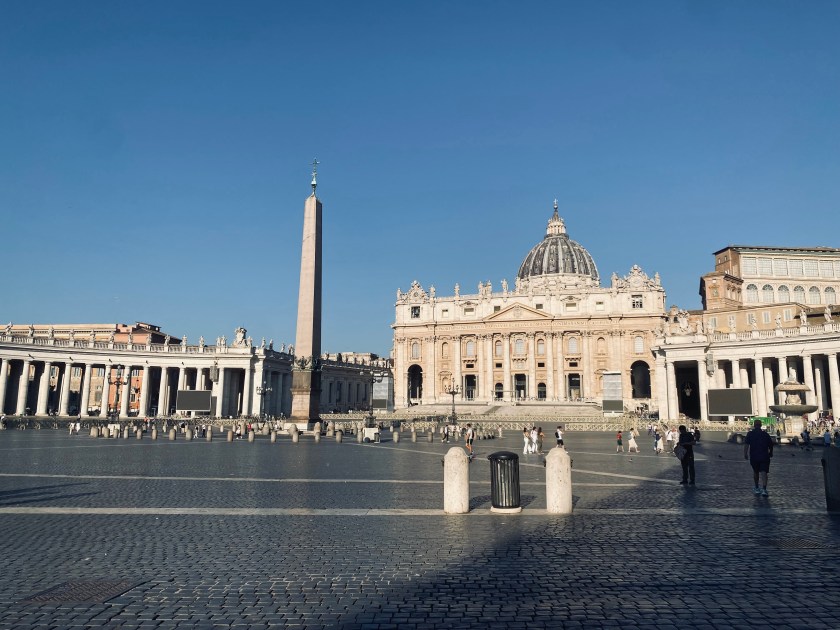
Image credit: Vatican Z 01 by Zakarie Faibis/ Wikimedia Commons, license: CC BY-SA 4.0.
After the pandemic, I had several field trips to Rome, including visits to the ‘Embassy of the Republic of China (Taiwan) to the Holy See‘ and the Vatican staff. During the same period, I also returned to the forefront of foreign affairs in the Taiwanese government. These experiences have made me understand that diplomacy is not only about “national strategies” and “how to interact with foreigners”. Sometimes, the critical point lies in the attitude of senior government officials, domestic cross-departmental coordination, and even the adjustment of conflicts between departmental powers and responsibilities.
In this article, I would like to reflect on Taiwan’s diplomacy with the Holy See from a high-level politics perspective and see how we can enhance cooperation. Here are two key findings:
1. ‘Religious Freedom’ does not equal harmonious relations between Church and State. Religious freedom is a required foundation and starting point. However, harmonious Church-State relation requires attention and management from the top, as well as communication and coordination from the executive level.
2. The Vatican’s diplomacy is primarily aimed at “promoting the pastoral needs and evangelisation”, also “resolving the world’s conflicts and building peace”, but “NOT” at domestic or international politics. People in Taiwan are only aware of the special nature of Vatican diplomacy, but have not delved into the special connotations of Vatican diplomacy – the difference compared with secular states’ diplomacy, or whether there is an essential difference between Vatican diplomacy and Taiwan’s other diplomatic allies. The Taiwan government does not seem to have made it clear.
▌China, Vatican, Taiwan: triangular competition, or triangular collaboration?
First, on religious freedom. Over the past few years, whenever the Holy See renewed its provisional agreement with the People’s Republic of China, the Taiwan government and media always reminded the Holy See: “China persecutes faith and China does not keep its word” – these reminders are facts, and the Holy See understands them. However, such a Sino-Vatican agreement is not the result of the arbitrary decree of one person or one team, but rather the result of the Vatican’s long-term and continuous policy toward China.
During Pope Francis’ era, his unique decision in China Policy is actually to “make it public” the communication and interaction between the Holy See and the People’s Republic of China. The reason why I mentioned the idea of “making it public” is mainly to remind readers that the Holy See has never given up on engaging with communist China and has never given up on the Chinese Catholic Church.
Pope Francis’ strategy may give China a symbolic meaning and attract the Chinese Communist regime to be willing to interact with it. However, there are also criticisms within the Church about Pope Francis’ strategy: critics believe that he ignores the suffering of the underground and loyal Church, and doubt whether the Pontiff has made unnecessary concessions in the non-disclosure agreement. These discussions within the Church should be taken seriously and should inspire us to reflect.
The Vatican’s efforts towards the Chinese Communist Party began with Pope Pius XII‘s “Stand firm” policy. Pope John Paul II continued Ostpolitik to guide engagements with communist countries, until Pope Francis, who came from the Jesuits, promoted the signing of a provisional agreement with the People’s Republic of China. This is a continuous policy.
It is worth reminding readers that in the 1970s, Pope Paul VI entrusted the work of “building a bridge” to the Catholic Church in Taiwan. He hoped that Taiwan could play the role of “bridging” between communist China and the global Catholic Church. The work exists today, and there are many wise individuals who continue to play their roles consistently.
▌In addition to calling for ‘religious freedom’ in China, what could be done?
The purpose of contemporary Holy See diplomacy is not to interfere in politics, but to seek lasting peace and pastoral evangelisation. If we want to enhance the diplomatic relations between Taiwan and the Holy See, we need to consider “what more can the Taiwan government do” from the perspective of Church-State relations? What kind of cooperation can Taiwan promote based on the needs of pastoral evangelisation?
The Republic of China (Taiwan), which implements a free democratic system, is indeed a country with greater religious freedom compared to the People’s Republic of China. For example, Taiwan has a thriving folk religion, and the Dajia Mazu pilgrimage (大甲媽遶境) is one of the three major religious events in the world. Taiwan’s religious freedom ensures that the government will not interfere with individual beliefs, and everyone has the freedom to hold their own beliefs.
However, beyond the guarantee of religious freedom, what can be done to consolidate the collaboration between the Holy See and the Taiwanese government? Many times, the needs of religious operations are wrapped up in governmental administrative powers and do not fall under the purview of religious freedom.
Therefore, on the surface, society enjoys freedom of belief and religious groups can preach freely to the public. However, the necessary needs of the religious groups may remain unmet, for example, missionaries’ visa applications and the dissemination of religious knowledge through compulsory education.
Furthermore, does the government proactively support the Church’s evangelisation, even willing to support the extension of the mission to the whole Chinese cultural society? It is a good question to reflect on regarding Taiwan-Vatican relations and the prospects for the relationship.
Despite Taiwan’s society enjoying freedom of belief, it does not mean that the tension between the government and religion has been eliminated. To consolidate relations between the Holy See and the Republic of China (Taiwan), Taiwan’s leaders should not only consider domestic political needs and Taiwan’s diplomatic habits but also consider the Vatican’s unique diplomatic essence, as Vatican diplomacy differs from secular diplomacy, as mentioned earlier.
Thomas Ching Wei Tu (凃京威), PhD Fellow at the Graduate Institute of East Asian Studies at National Chengchi University, Taiwan. His research interests include religions, church-state relations, and international politics. And the major highlights are on ‘religion and politics’ in international relations, including Vatican diplomacy. He can be reached at <thomas.cw.tu@gmail.com>.
 Taiwan Insight
