
Written by Thomas Ching-Wei TU.
Image credit: Public domain.
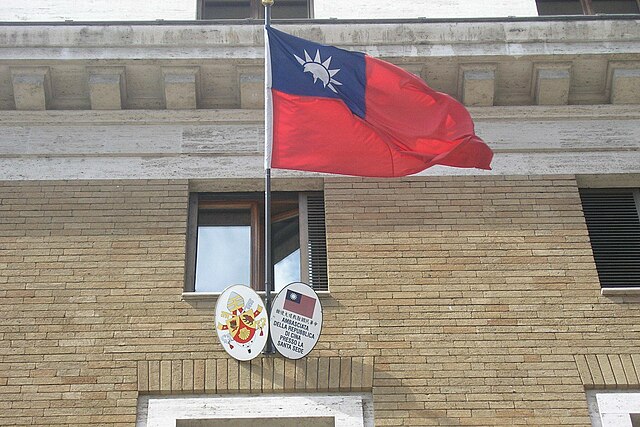
After the pandemic, I had several field trips to Rome, including visits to the ‘Embassy of the Republic of China (Taiwan) to the Holy See‘ and the Vatican staff. During the same period, I also returned to the forefront of foreign affairs in the Taiwan government. These experiences have made me understand that diplomacy is not only about “national strategies” and “how to interact with foreigners”. I learned that diplomacy requires prudence and skilful statecraft. For example, the trade negotiations between Taiwan and the United States are not just about diplomatic goodwill, but also about how to implement ‘issues of concern’ – a point that I believe many people understand.
Following my previous article, “What I saw and heard: Triangular relations among Taiwan, China, and the Holy See,” I will provide a few policy recommendations on Taiwan’s diplomacy with the Holy See in this piece.
▌Brainstorming Taiwan-Vatican relations through the Church-State perspective
Many things can be done to promote diplomatic relations between Taiwan and the Holy See; however, the authority does not lie with the Ministry of Foreign Affairs (MOFA) or the Embassy to the Holy See. These matters require the attention of top leaders so as to extend coordination and cooperation among various ministries and councils.
Taiwan is currently promoting value diplomacy and economic diplomacy. It is by upholding the free and democratic system and demonstrating its high-tech economic physique to implement comprehensive diplomacy. However, it is challenging for us to promote the same thing to the combination of the Holy See (La Santa Sede) and the Vatican City State (La Città del Vaticano) directly using the various diplomatic practices of our past experiences.
For instance, the Holy See adopts an absolute monarchy (il monarchia assoluta), discussing the democratic system with the Holy See and the Vatican City State do not seem to be a routine; Taiwan’s agricultural trade, agricultural technology exports, trade tariffs, economic investment, etc. with its diplomatic allies do not fall within the direct scope of the Vatican’s diplomacy. Therefore, Taiwan needs to explore issues for communication with the Vatican, and the best approach is to start with Church-State relations.
Taiwan implements a free democratic system and is indeed a country with religious freedom. The society enjoys freedom of belief, but this does not mean that the tension between the government and religion has been eliminated. Many times, the needs of religious operations are wrapped up in governmental administrative powers and do not fall under the purview of religious freedom. Therefore, on the surface, society enjoys freedom of belief and religious groups can preach freely. Yet, the religious groups’ necessary needs are still unmet. In particular, it is challenging for a religious group to obtain the essential personnel to preach in Taiwan due to the difficulties associated with applying for visas or residence permits.
Although border control is a means for a country to demonstrate its sovereignty and a necessary measure to protect Taiwan, the Catholic community in Taiwan, which is primarily Chinese-speaking, requires the assistance of foreign clergy and nuns who are proficient in Chinese to fill the gap in local vocations. Due to the tense Cross-Strait relations in recent years, many dioceses and religious orders have faced difficulties in applying for visas or residence permits. Moreover, such challenges not only affect clergy and nuns with People’s Republic of China nationality, but also now extend to some foreign clergy.
Taiwan has seven dioceses. Each diocese has smooth communication with the Ministry of Foreign Affairs (MOFA) and the Embassy to the Holy See. I believe some channels between them reflect the real needs of the Church. However, even if there are channels of communication with MOFA, when dioceses apply for personnel to preach in Taiwan, the authority belongs to the Ministry of the Interior, not MOFA. If the applicant is from China, it falls under the authority of the Mainland Affairs Council. Such cross-departmental coordination first needs to capture the attention of top leaders; then it can lead to a smooth collaboration.
In addition to visa applications, educational and technological cooperation has also been a focus of advocacy by Taiwan’s Catholic scholars and clergy since 2005.
For example, (1) strengthening academic exchanges and cooperation between Taiwan and the Vatican, such as encouraging foreign scholars to visit Taiwan or increasing the Taiwan-Vatican collaborative research through the National Science and Technology Council programs. (2) The Taiwan government should amend the law to allow Catholic elementary and secondary schools to offer religious courses. (3) Propose relevant policy suggestions, such as exchanging bilateral exhibits and jointly hosting events through cooperation between the Vatican Museums and the National Palace Museum in Taiwan, to attract the attention of the global cultural community and enhance Taiwan’s international reputation.
Among them, the third item was officially launched in 2015 during the Ma Ying-jeou administration. Treasures of Heaven: A Special Exhibition of Artefacts from the Holy See opened up a channel for cultural cooperation between Taiwan and the Vatican. However, other proposed matters have yet to be explored, with the most significant difficulty being the lack of a high-level policy design and cross-departmental coordination mechanism.
Therefore, while Taiwan enjoys religious freedom, significant issues remain for deeper discussion between the central government and the Vatican. The approach should emphasise listening rather than persuasion. If both sides work together to find a solution, it may eventually take the form of an agreement, which will be good for the Republic of China (Taiwan) as well as for the Vatican and the Catholic Church.
▌Pragmatic Policy Suggestions
First of all, the Holy See (La Santa Sede) and the Vatican City State (La Città del Vaticano) comprise two distinct entities, but under the same head of state. They are different from ordinary secular countries. Some international law scholars refer to them as a “sovereign entity” rather than a “sovereign state.” In addition, Vatican diplomats, like civil servants of international organisations, retain their native nationality and hold Vatican citizenship, which differs from the diplomatic practices of secular countries.
I often wonder, if we equate participation in Vatican diplomacy with membership in international organisations, would it be easier to understand the explanation frequently heard within the Church that “Vatican diplomacy is addition rather than subtraction”?
Over the past 30 years, Taiwan’s public opinion has consistently questioned whether the Vatican would sever diplomatic ties with the Republic of China (Taiwan). This has done little to deepen friendship but has instead increased suspicion. How do we understand the Vatican’s special diplomacy? If government experts can launch projects to raise public awareness, this will have a positive impact on the interaction between the Vatican and Taiwan.
Furthermore, I am curious about whether a current mechanism for Taiwanese scholars to conduct joint research with the Pontifical Universities. “Strengthen academic exchanges and cooperation between Taiwan and the Vatican” – is it possible to construct such a proposal within our government mechanism? Every year, the National Science and Technology Council solicits research projects from the Czech Republic, Germany, and the United Kingdom etc. These research grants are based on cooperation agreements signed with each country. Could the Holy See and the Taiwan central government also have such a mechanism?
Due to Taiwan’s geopolitical importance, the Initiative for the Study of Asian Catholics (ISAC) has recently approached scholars at the National Chengchi University, Taiwan, hoping that Taiwan can lead a research project on “ Asian Catholicism and International Relations .” Conducting research is our job, but we need to expand it. We hope that the government can lead the academic community in developing such research projects.
Over the past few years, I have had the privilege of participating in Taiwan’s foreign affairs initiatives. During a US-Taiwan dialogue, the topic of Taiwan-Vatican relations unexpectedly arose. Following the meeting, I was tasked with urgently analysing US-Vatican relations alongside the conference team. We were all very surprised. Why did the US suddenly mention the Holy See and social doctrine teaching, and what is the relationship between this and Taiwan?
At that time, the United States had not yet entered President Trump’s second term, and the Vatican had not yet elected the first American Pope in history. I believe that the Vatican’s diplomacy in the next decade deserves greater attention from Taiwan’s top leaders and government officials.
Thomas Ching Wei Tu (凃京威), PhD Fellow at the Graduate Institute of East Asian Studies at National Chengchi University, Taiwan. His research interests include religions, church-state relations, and international politics. And the major highlights are on ‘religion and politics’ in international relations, including Vatican diplomacy. He can be reached at <thomas.cw.tu@gmail.com>.
 Taiwan Insight