

Written by Renee Te-Jung Chen.
Image credit: _MG_8069 by weichen_kh/ Flickr, license: CC BY-NC-ND 2.0.
According to a 2024 Control Yuan report, Taiwan’s Small-Amount Remittance Services for Foreign Migrant Workers (SARSs) reached a milestone in the first half year of 2024 that officially surpassed private employment service agencies (colloquially known as labour brokerage agencies) as the primary remittance channel for the island’s growing migrant population (785,760 as of June 2024). This shift reflects a rebalancing of Taiwan’s legal remittance system that allows migrant workers — here specifically referring to Type B foreign workers (colloquially known as blue-collar workers), including fishing workers, care workers, and those in government-designated infrastructure projects — to send money home. This remittance system encompasses three channels: (1) SARSs-licensed companies operating via smartphone apps and convenience store networks, (2) labour brokers acting as intermediaries with banks, or (3) direct bank transactions handled by workers themselves.
SARSs is a regulatory framework designed to facilitate migrant workers’ outbound remittance and related foreign exchange services to their home countries. Introduced in 2021, with a steadily growing number of approved service providers (the fifth company was just approved by the Financial Supervisory Commission in late June 2025), companies operating under the SARSs framework specialise in offering lower fees and faster processing times than traditional methods while effectively addressing language barriers, restrictive work schedules, transportation difficulties, and complex administrative processes through their digital platforms where migrant workers can initiate transactions via mobile apps and complete them at nearby convenience stores.
Numbers reveal a fuller picture. SARSs captured 60.25 per cent market share by 2024, with annual transactions reaching TWD 84.2 billion and serving 707,007 users. Though introduced less than half a decade ago, this represents a remarkable transformation towards a digital-first platform from relationship-based agency intermediation that often lacks transparency and may involve questionable practices, seemingly a positive development for Taiwan’s financial inclusion goals.
Yet these encouraging numbers provide a cover for a more complex reality. The persistence of agency-mediated services — still maintaining nearly 40 per cent market share — suggests that the transition to digital-first remittance platforms may not be equally effective across all migrant populations. And here is what gets lost in the numbers: beneath these aggregate statistics lies a more complex story that may often be overlooked — one where gender weighs in shaping how migrant workers navigate Taiwan’s evolving financial landscape.
How Gender Shapes Migrant Workers’ Financial Experiences
Historically, female migrant workers have long comprised the majority of Taiwan’s migrant population, only being slightly surpassed by male migrant workers since 2022 (see Graph 1). Amongst these workers, a substantial proportion of well over 60 per cent of female migrant workers are consistently employed in social welfare services as caregivers or domestic workers (see Graph 2). The gender composition in the social welfare sector reveals a stark feminisation, with well over 99 per cent being female migrant workers. This division creates distinct financial ecosystems, particularly when considering sectoral wage disparities, legal protections, and living arrangement differences.
Graph 1
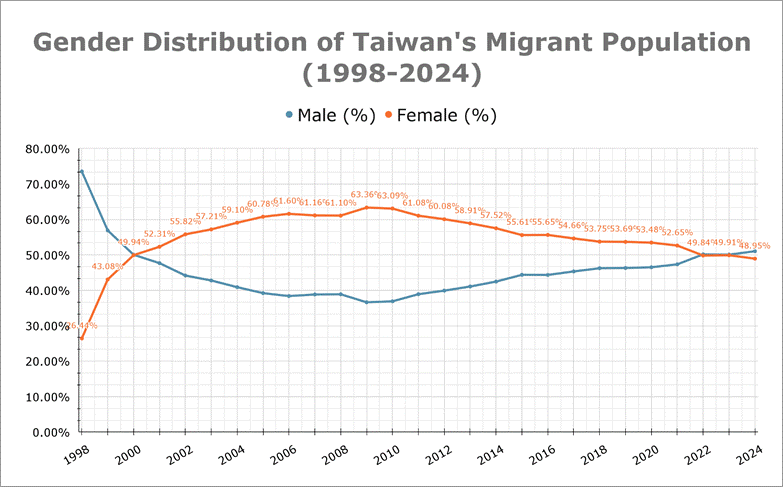
Source: Ministry of Labour (2025). Foreign Workers Statistics: Foreign Workers in Taiwan by Nationality and Sex; 勞動部勞動統計諮詢網 (2025). 引進移工在臺人數. Note: Migrant population specifically refers to Type B foreign workers employed in the productive and social welfare industries. Population figures are based on the “Employed” category rather than the “Grand Total” category, which excludes workers reported missing. Data before 1998 is unavailable. Data updated July 2025.
Graph 2
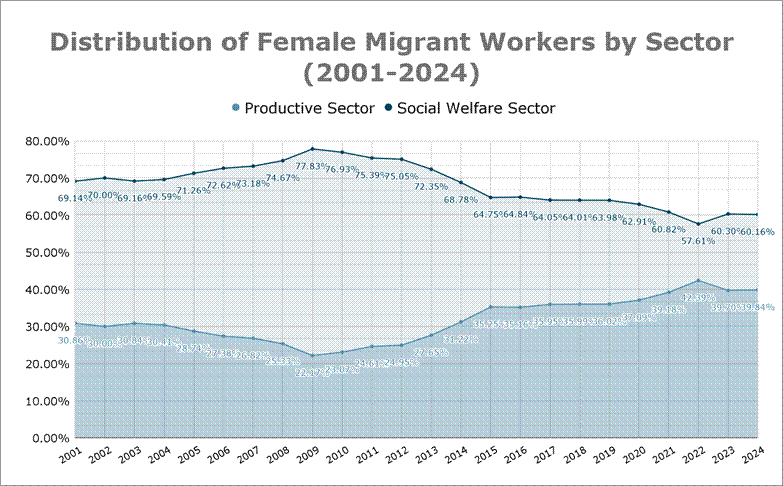
Source: Ministry of Labour (2025). Foreign Workers Statistics: Foreign Workers by Work Responsibilities and Foreign Workers in Taiwan by Nationality and Sex; 勞動部勞動統計諮詢網 (2025). 引進移工在臺人數. Note: Data before 2001 is unavailable. Data updated July 2025.
Based on the 2024 Ministry of Labour report, productive industry workers earn regular and supplemental wages (經常性薪資) at TWD 33,000 monthly, whereas social welfare sector workers receive TWD 21,000 monthly, representing a 57 per cent wage gap. Moreover, as social welfare workers are not protected under the Labour Standards Act, their wages remain vulnerable to fluctuation despite the basic government-stipulated minimum wage of TWD 20,000 (set in 2022), which many critics argue this figure inadequately compensates for workers’ excessive working hours. For the predominantly female migrant workforce in this sector, these conditions clearly limit financial flexibility and capacity.
In addition, female domestic workers typically live with their employers and, crucially, are excluded from direct Labour Standards Act protections, instead relying on Employment Service Act-stipulated contracts providing basic safeguards like weekly rest days. A June 2024 Ministry of Labour survey found that over 40 per cent of foreign caregivers lack regular time off monthly.
Together, these restrictive conditions where social welfare workers often encounter difficulties in securing regular leave and remain essentially on-call within their employers’ homes, limiting their mobility and financial autonomy compared to their counterparts in productive sectors, who benefit from stipulated minimum wage guarantees, dormitory-style factory housing, and regulated working conditions.
The Paradox of Platform Adoption
Given these constraints, one might expect female migrant workers to favour SARSs — with its lower remittance costs and freedom from location and time restrictions — yet reality may suggest the opposite.
A 2024 collaborative study between Taipei Fubon Bank and One-Forty indicates an average TWD 7,995 loss that migrant workers experience from financial fraud (nearly half of a social welfare worker’s monthly salary). Due to the nature of their work, female migrant workers may have fewer opportunities to meet people outside their networks, potentially limiting access to financial information from government sources. As a consequence, female migrant workers show a greater preference for familiar channels such as labour brokers or informal networks like South Asian-operated grocery stores, rather than adopting new technological innovations that might expose them to higher fraud risks.
Meanwhile, an average annual TWD 119,000 transaction amount through SARSs was calculated in the 2024 Financial Supervisory Commission statistics. This figure represents one-third or more of annual income, particularly for social welfare workers. As essential family support, female workers with limited financial flexibility may be especially risk-averse towards unfamiliar digital platforms for such critical transfers. That is, even under SARSs’ promising growth, the multiple disadvantages faced by female migrant workers could drive them away from SARSs as long as structural constraints remain. This pattern explains why around 40 per cent of migrant workers still rely on agency-mediated services despite SARSs’ apparent benefits.
Gender and Trust in Financial Learning Networks
This pattern of risk aversion and channel avoidance points to a crucial factor in understanding financial services. Research shows that financial literacy empowerment helps migrant workers better understand remittance costs and increases the adoption of different methods. The result was reinforced by the aforementioned 2024 Control Yuan report that identified limited financial understanding as a key barrier to improving SARSs coverage. With migrant workers often lacking financial literacy backgrounds in their origin countries and facing language barriers, they naturally gravitate towards relationship-based remittance channels that they understand and trust.
Rather than viewing these relationship-based channels as obstacles to financial inclusion, this pattern suggests an important insight: migrant workers’ financial education occurs through existing trust networks rather than formal institutional programmes. While government-level education programmes exist, more attention should be paid to how grassroots knowledge transfer actually functions within migrant communities.
Research findings from interviews with Southeast Asian female migrant workers (conducted as part of my 2024 MSc study on gender dynamics in remittance practices) reveal how this informal education operates in practice. Filipino participants specifically described learning financial literacy and management skills through networks with Taiwanese elderly women—typically their employers or care recipients. One participant explained how this knowledge transfer shaped her financial mindset:
“Participant C: ‘[H]ere I learned how to save my money. Now I have saved my money for my children and also have my own money. […] Just like my employer here in Taiwan, she is always telling me, ‘No money, no honey.’ That’s what I learned in Taiwan as a woman, we should also think about ourselves.”
This example reveals how meaningful financial education emerges from trusted relationships rather than institutional interventions. The intimate, daily nature of care work creates unique opportunities for financial knowledge transfer that top-down approaches typically cannot match.
Beyond Numbers: Policy Pathways for Inclusive Finance
Undoubtedly, SARSs’ expansion represents a remarkable fintech success story, with impressive transaction volumes and market penetration. Yet a critical blind spot emerges in policymaking when aggregate data, though valuable for demonstrating SARSs’ effectiveness, systematically excludes the very workers Taiwan depends upon, namely female migrants concentrated in care sectors who face structural constraints that efficiency-focused metrics cannot capture.
This suggests two critical policy shifts. First, a greater commitment to collecting, presenting, and examining sex-disaggregated data across all aspects of migration-related policy is necessary as Taiwan’s continued expansion into new migration corridors like India. Different gendered migration patterns require distinct service approaches, yet this remains evidently overlooked in current policy development. Second, to support inclusive remittance access, rather than imposing top-down financial education programmes, the government should facilitate existing trust networks between female migrants, their Taiwanese employers, and trusted community organisations by facilitating or incentivising these organic educational relationships through training resources and community partnerships.
More broadly, in Taiwan’s evolving migration landscape, moving beyond numbers matters more than ever. If Taiwan’s remittance innovation inadvertently sidelines the female caregivers who sustain its ageing society, we will be putting at risk our strategic positioning in regional competition for essential workers.
Renee Te-Jung Chen is an MSc graduate from the Institute for Global Prosperity, University College London. Her academic interests centre on migrant remittances, migrant governance, and regional migrant patterns.
This article was published as part of a special issue on ‘SOAS Taiwan Studies Summer School 2025‘.
 Taiwan Insight