
Written by Eloise Phillips.
Image credit: the author.
Led by Taiwan’s National Museum of Prehistory, the 2025 Taiwan–Guam exchange wove songs, seafaring, and shared moments into a living bridge across the Pacific.
A stick traced the star compass on the ground of a canoe house, a stone marking the boat’s position in relation to the horizon and constellations. As University of Guam’s master navigator Larry Raigetal spoke, one carver shaped a paddle while another prepared coconut-fibre rope. We huddled close, listening as he explained how stars and swells guide Pacific voyaging.
This was one of many vivid memories from the Taiwan–Guam 2025 cultural exchange, a ten-day program that brought together a Taiwanese delegation and communities across Guam. Coordinated by Taiwan’s National Museum of Prehistory – the first Ministry of Culture–affiliated museum to join the Guam Micronesia Island Fair (GMIF), the exchange ran under the theme The Island is Our Canoe, the Sea is Our Pathway. It aimed to amplify Austronesian voices, strengthen Pacific ties, and connect heritage to the present.
The delegation included musicians, artists, canoe builders, scholars, and cultural practitioners from Taiwan’s east coast: the Amis Polyphonic Youth Band (APYB), the Makotaay Eco Art Village, the Wind Voyagers of Changbin, students and professors from the Centre of Austronesian Culture at National Taitung University, and cultural leaders like Dumai Manaaki, and Sufin Paylang and Lakelaw of Dulan Marine Conservation Patrol. The itinerary spanned museums, villages, and canoe houses, but the most enduring moments emerged in unguarded moments – over a weaving table, through shared linguistic roots, while slinging stones together, mirroring dance steps, or huddling around a model boat.
GMIF: Harmony in the Rain
At Governor Joseph Flores Memorial Park, GMIF mixed local intimacy with tourist spectacle. Global brands stood alongside food stalls and diaspora vendors, while cultural delegations were scattered toward the back.
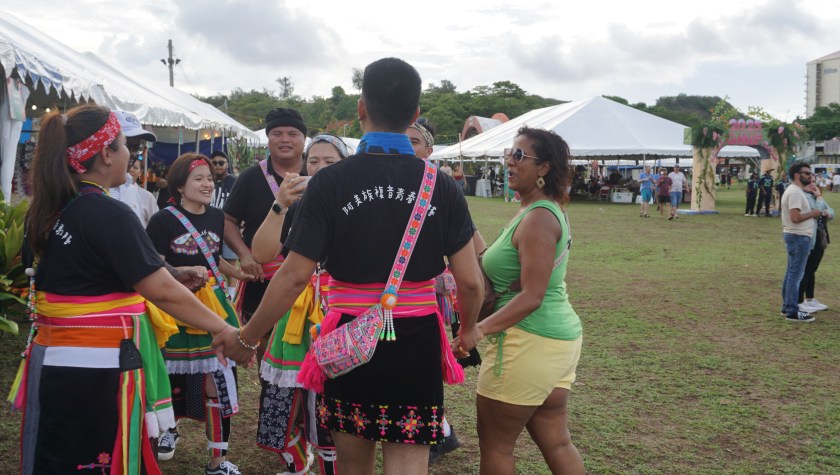
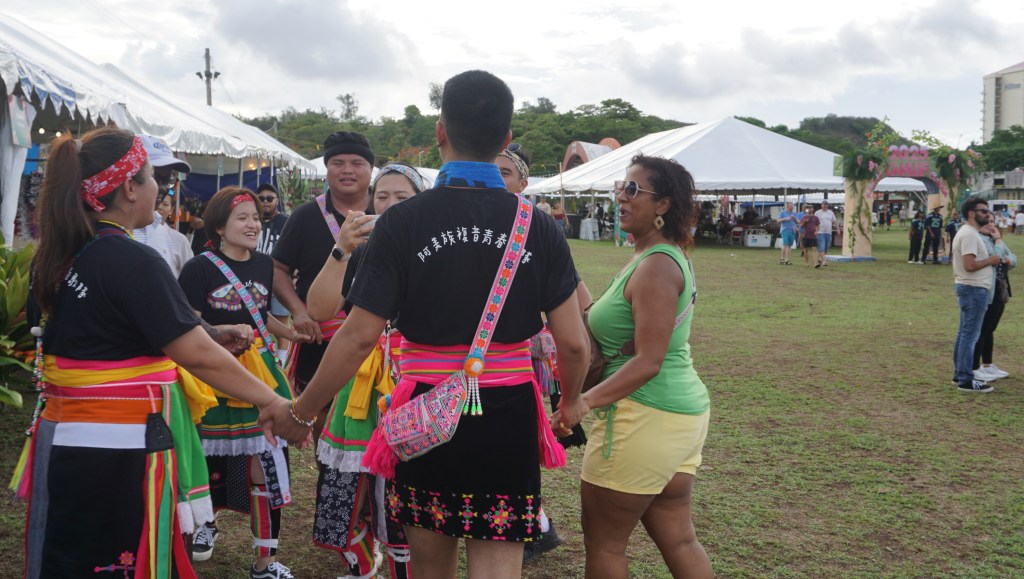
Taiwan’s booth, tucked in front nearest the stage, featured museum-style panels explaining their mission and was tended in turn by members of the delegation. The real draw was the APYB, an ensemble dedicated to reviving ancestral polyphonic songs through youth voices. The group invited passers-by to choose a song from a cardboard playlist. They then circled the guest, folding them into their harmonies, a small act that turned spectators into participants.
Elsewhere, amidst the vendor-heavy setup, Pohnpei’s kava ceremony and Guam’s and CNMI’s weaving workshops brought a rare sense of depth to the fair. One hundred thirty-five elementary through high school students from Saipan – many of whom were leaving their island for the first time – proudly demonstrated roof-weaving and beading techniques, as well as dance traditions, showing how cultural preservation is carried forward by the young.
Even as day two opened under heavy rain, and after a series of local bomb threats that week had subdued the mood and reduced participation, a striking image emerged: three barefoot dancers refused to stop. Their performance pulled sheltering onlookers into a shared joy, refusing to let the weather dictate the day.
Yona: Mutual Reclamation
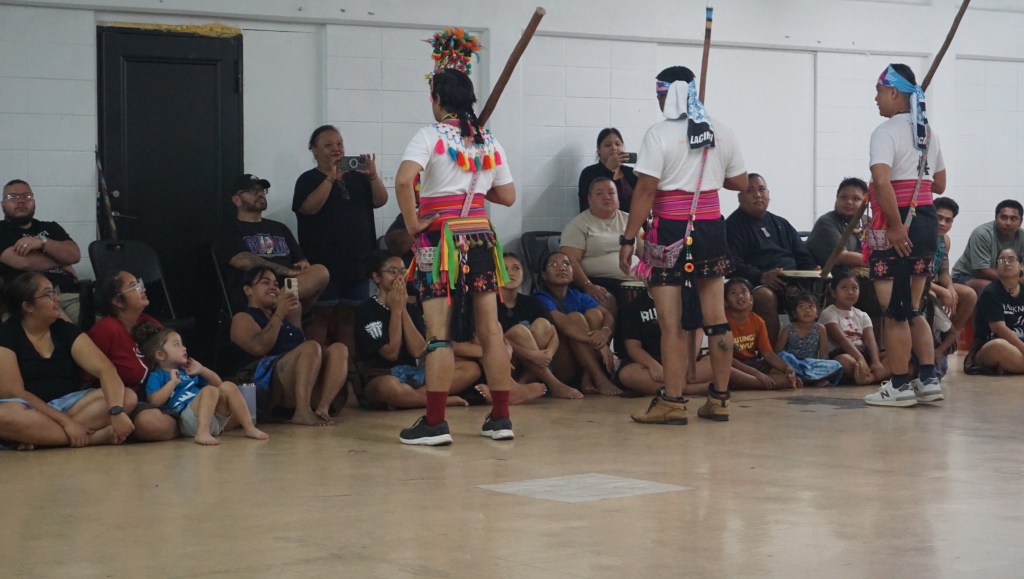
Away from the fairgrounds, the tempo slowed. In Yona village, the CHamoru community welcomed the delegation into their guma – a house of learning sustained for over two decades. The evening began with rhythm: coconut shells clapped in time as sticks struck the floor. Mayor Brian Terlaje moved among them, adjusting stances and encouraging precision, reflecting his title as Fáfa’na’gue. This legacy of mentorship, rooted in the arts but extending beyond it, is part of a wider educational mission: teaching young people to see the arts as one dimension of ancestral reconnection.
The APYB answered in song, inviting everyone into their communal circle dance. Then came a symbolic exchange: three Amis men were invited to use CHamoru sticks for a warrior dance. In Amis’ history, spears were banned under Japanese colonisation and replaced with umbrellas, which later became symbols of identity, even lending their name to an age class. The offering of CHamoru sticks resonated as mutual reclamation: two cultures acknowledging shared histories of colonial suppression and resilience.
Island Wisdom: Canoes as Knowledge
At the Island Wisdom program, Raigetal’s Carolinian canoe house unfolded in quiet integrity. Knowledge here was never abstract but measured in the body – hand spans and outstretched arms.
He spoke with deep reverence of Simion Hokule’a, the canoe built in the 1970s by Mau Piailug, which fell into disrepair in the 2010s but whose parts live on in today’s canoe Ininan Ilawol. Old breadfruit timbers, including the outrigger, bailer, and other small pieces, were reworked into the new vessel, carrying Mau’s memory and craftsmanship across generations and making the canoe itself a living archive of voyaging practice.
Futuru Tsai, Director of Taiwan’s National Museum of Prehistory and Professor of Austronesian Culture at National Taitung University, shared his vision of creating a hub for Austronesian reconnection where boats like Ilawol can sail between Guam, Taiwan, and Palau. Standing together, Raigetal and Futuru embodied two strands of revival: craft sustained by teaching, and institutions creating frameworks to support it.
As we watched the children’s racing canoe glide over the shallows, it was clear these vessels are more than cultural artefacts. They are technologies of survival, containers of philosophy, and blueprints for relating to the world with attention and interdependence—against the flattening logics of standardisation. This workshop invited us to learn not just about a culture, but with it.
Ulitao: Revival by Doing
At Ulitao, a CHamoru cultural and canoe-building centre founded by Ron Acfalle in 2008, exchange unfolded through language, material practice, and embodied memory. A CHamoru healer and her daughter compared Austronesian words with Amis participants, reflecting on Spanish and Japanese loanwords woven into both languages.
Jeremaine, who joined in 2014, explained canoe design not as a technical lecture but as a lived practice: revival through iterative building, youth participation, and imagining future voyages. Their long-term vision? Sailing from Guam to Taiwan, retracing ancestral routes.
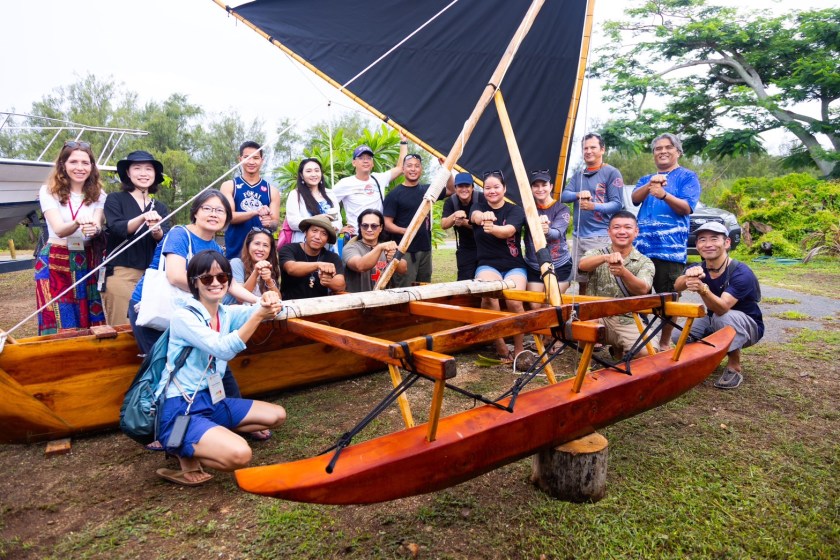
The crew’s main vessel is a 63-foot canoe built from local trees, blending ancestral methods with modern materials. Its asymmetric hull, single sail, and carved notches reveal a design built for efficiency—meant not to turn back but to keep gliding forward. A scaled model on-site became a teaching tool, breaking down canoe anatomy, navigation logic, and the rituals woven into every stage, from tree selection and ancestral guidance to blessings and chants before launch.
Nearby on-site, a slingstone (acho) workshop led by Bernard “BJ,” reframed the object not as a relic but as a continuity of survival – a tool of protection, hunting, and philosophy. Revival here was not performance but existence.
Fokai: Living Diplomacy
The final gathering at The Effect and Fokai Shop welcomed returning collaborators, businesspeople, and artists, blending performance and networking with appreciation and celebration. The space itself—layered with visual metaphors such as a single painted “yellow brick,” gold-sprayed coconuts, sling stones, and the motto “exhaust the body, cultivate the spirit, proceed the mind”—functions as a living studio rather than a gallery.
In contrast to more rehearsed and formal presentations at the University of Guam and Guam Museum in the days before, the narrow corridor as a “stage” between shops allowed for messier, more emotive, and responsive exchange. Sufin’s voice cut through business chatter; a sudden downpour punctuated Iyo’s song like a blessing. Fokai Shop owner Roman Dela Cruz described his mission as “connecting the dots,” whether from ancient jade or latte stones, to contemporary exchange.
Female Yona members demonstrated and explained gestures tracing the circle of life, then gifted the Taiwanese delegation hibiscus-shaped earrings. Small, unscripted moments like these carried big meaning. They embody the continuity behind Mayor Brian’s vision of a sister-city link with Taitung, not as a formal diplomatic act, but as a living relationship, built through regular visits, shared meals, and joint projects.
Once Roman had blown the conch to conclude the evening, the “Viva Taiwan, Viva Guam” slogan was reframed by the National Museum of Prehistory Director Futuru into “Viva everyone,” underscoring a broader, more inclusive kinship. It was a meeting of futures structured less by clear outcomes and more by relational textures.
Why It Matters
The exchange was not a series of events, but rather a tide moving between stages, workshops, and informal spaces. Formal diplomacy often prizes visibility and scale. This exchange showed that island-style diplomacy – rooted in shared practice, hospitality, and physical presence – can be just as powerful.
For Taiwan, these ties feed into a bigger question: what does it mean to be Austronesian in the 21st century? How can island communities help each other keep language, craft, and ecological knowledge alive? For Guam – shaped by colonial rule and a strategic location – the answer is familiar. Survival has always meant navigating between worlds.
Increasingly, cultural leaders see the revival of boatbuilding and navigation as the way forward. It is not only about skills. It is about retracing ancestral routes, passing on language and values, and renewing bonds with both people and the ocean.
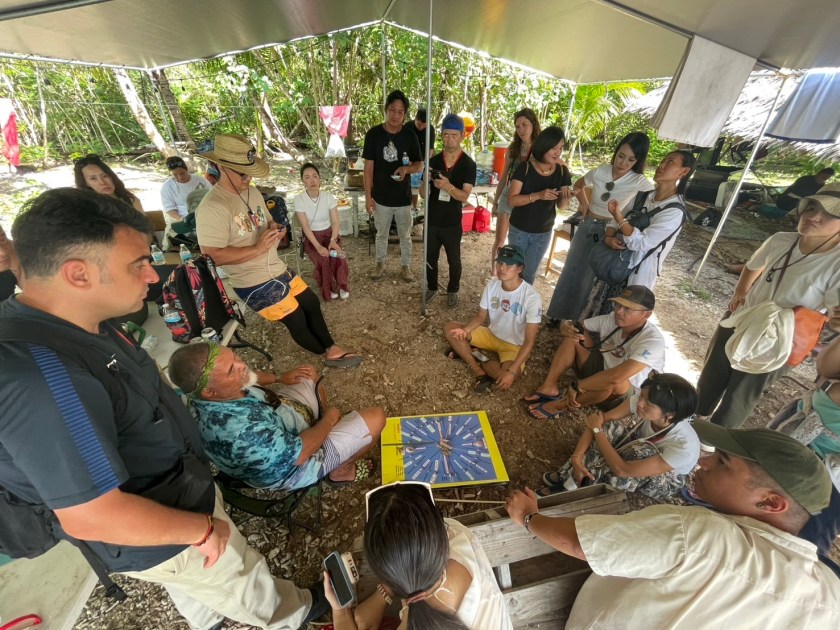
The real legacy of the 2025 exchange may not be in the speeches or official photos, but in the rhythm of carving paddles in a canoe house; the warmth of a shared song; and the questions and answers passed around a star compass and master navigator. These were not cultural showcases but living, improvised classrooms – a reminder that the island is indeed our canoe, and the sea our pathway.
Eloise Phillips recently completed her MA in Austronesian Culture at National Taitung University, where she explored Taiwanese Indigenous Bunun weaving traditions through apprenticeship-based fieldwork. In 2025, she participated in cultural exchange events in Guam, documenting encounters between a Taiwanese delegation and Micronesian communities for Taiwan’s National Museum of Prehistory. Her work bridges research and storytelling, highlighting lived experiences, embodied knowledge, and cultural transmission.
 Taiwan Insight