
Written by Meng Kit Tang.
Image credit: happydacome/ Thread.
A Nation’s Heart in the Midst of Mud
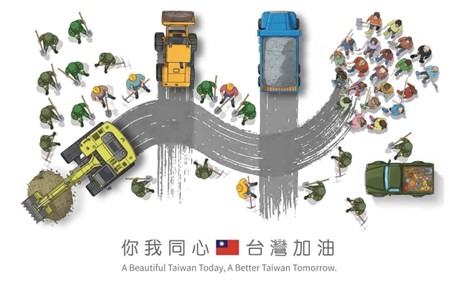
Natural disasters have long tested Taiwan, but they also reveal a deeper truth: the island’s true strength lies in its people’s compassion. The 2025 Ragasa floods in Hualien made this truth unmistakable. When a barrier lake burst and torrents of mud engulfed homes, lives were lost, and entire communities were cut off. Yet even before official rescue teams could mobilise, neighbours from every corner of Taiwan were already on the move: boarding trains, forming convoys, carrying shovels, food, and hope into the disaster zone.
What unfolded was not a government directive but a spontaneous outpouring of solidarity. From temples and churches turned into relief hubs, to strangers kneeling in mud to comfort survivors, the response embodied the viral phrase not all heroes wear capes「不是所有的英雄都穿披風」. In Taiwan, heroism often arrives in rainboots and muddy gloves, grounded in everyday people.
The Ragasa floods became a reminder of Taiwan’s enduring soul: when waters rise, so too does the empathy that binds its people together.
The Spark of Spontaneous Response
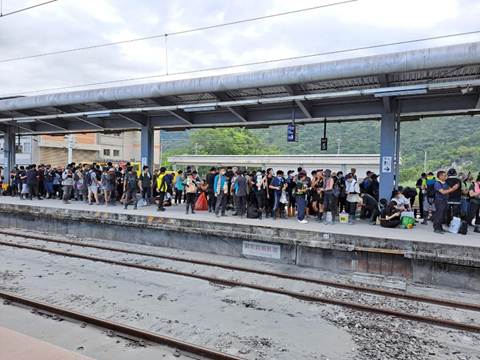
Picture: Scores of volunteers gathering at the Guangfu train station posted on Facebook, with caption ‘I don’t know you, But helping you makes me happy.’ Source: 李淑菁/Facebook.
The flood’s roar had barely subsided when social media lit up, igniting a wave of grassroots action. Urgent pleas from Guangfu Township「光復鄉」and the indigenous Fata’an Tribe (near Adomo) echoed across platforms, calling for “manpower miracles” to aid isolated elders and clear debris.
By September 29, more than 30,000 volunteers had converged, many clad in rainboots and wielding shovels, their numbers swelling daily in a testament to sustained solidarity. Young urbanites from Taipei and beyond heeded the call, boarding buses and trains with shared purpose, their journeys through rain-lashed windows buzzing with resolve.
Taiwan Railway Corp. added 10 special trains from September 26–28, transforming crowded cars into rolling hubs of humanity: passengers sharing water bottles, snacks, and encouragement, blending logistics with heartfelt connection. Off-road enthusiasts formed jeep convoys, slicing through mud-blocked paths to reach stranded residents, their rescues cheered in videos that bridged urban-rural divides. Faith and civic groups converted temples and churches into coordination centres.
This was a spontaneous surge proving Taiwan’s empathy ignites like wildfire in crisis.
Everyday Heroes: Shovel Heroes in Action
At the heart of Hualien’s flood relief stood ordinary Taiwanese transformed into extraordinary “shovel heroes” 「鏟子英雄」.
Construction workers, including Indonesian volunteers, led convoys of heavy machinery to clear debris-choked roads in Guangfu Township, reopening vital lifelines for aid and evacuations with calloused hands grounded in empathy. Their efforts restored access, enabling supplies to reach stranded communities.
Youthful “North Drifters” (北漂青年) returned from urban lives to form rescue squads, wading through waist-deep mud to carry elderly survivors to safety. By September 29, thousands persisted in cleaning up, their photos capturing intergenerational bonds forged in gruelling labour. These squads embodied Taiwan’s resilient spirit, undeterred by relentless conditions.
Retirees cooked homemade meals in makeshift kitchens, while drivers from southern Taiwan traversed long distances to deliver comfort food, their whispers of encouragement lingering like a warm embrace amid loss—earning some the nickname “Cooking Supermen.”
Military personnel, including New Taipei’s special rescuers with service dogs, integrated seamlessly with this citizen-led effort, amplifying the grassroots spirit. By September 27, teams extended cleanup to indigenous villages like the Fata’an Tribe, battling dam breach threats with unyielding resolve. These shovel heroes, neighbours united, channelled rivers of generosity, their selfless acts illuminating Taiwan’s soul.
Heartwarming Vignettes: Stories That Touch the Soul
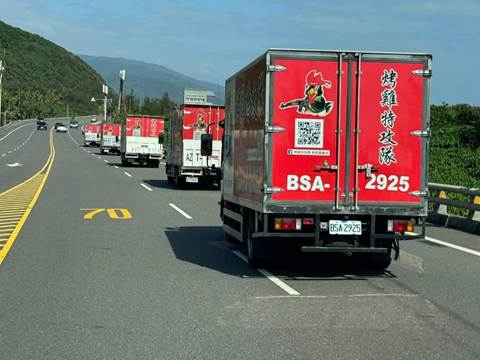
Picture: A convoy of roasted chicken delivery enroute to disaster site with an unmistakable message – If there are disaster victims in remote areas in urgent need of roasted chickens, please send me a private message with your phone number, address, and approximate quantity. I’ll do my best to prioritise them. 🙏🙏 Source: 烤雞特攻隊 高屏嘉義店/Facebook.
Amid mud and machinery, Taiwan’s human warmth 「人情味」shone through in quiet acts of sacrifice and solidarity. These were not headlines written by officials but stories carried in whispers, tears, and muddy embraces.
In Guangfu, six-year-old “Little Yi” survived because her honorary aunt and uncle lifted her onto a high beam as waters engulfed their home. Rescuers pulled her to safety, but the couple who shielded her were later found buried in silt. Their final act, unrecorded by cameras, became a living testament of 「真正的英雄不穿披風」— not all heroes wear capes.
Other families found both heartbreak and closure. After five days of digging through debris, rescue teams recovered 87-year-old Mrs Huang from her mud-buried home in Hualien County, devastated by Typhoon Ragasa’s floods. The operation, involving brave rescuers and military personnel, brought closure to Huang’s family, who expressed profound gratitude.
At dawn, when exhaustion pressed hardest, a breakfast vendor from Fenglin rose at 3 a.m. to cook danbing or egg crepes for survivors. Another donor from New Taipei City bought an entire batch of rice balls from a Ruisui vendor, not for profit, but to pass it forward, one warm bite at a time, ensuring 500 portions reached those in need.
These stories do more than illustrate survival, but they reveal how Taiwan’s people become real ‘shovel heroes’ in the truest sense: not with capes, but with calloused hands, quiet sacrifice, shared tears, and unspoken bonds. Even as mud hardened on the streets, the softness of spirit held firm.
The Great Flood Relief and the Great Recall Movement Compared
In July 2025, Taiwan’s Great Recall campaign drew a high turnout as citizens sought to unseat lawmakers accused of pro-Beijing ties. The effort highlighted democratic passion, but it also hardened partisan rifts. Supporters and opponents clashed in rallies and online, sharpening institutions yet leaving scars of distrust.
The flood relief in Hualien told another story. Here, civic energy rose without divisions. Canvassers knocking on doors became volunteers wading through mud; youth who once rallied for signatures now carried elders on their backs; churches and temples that had hosted debates became supply depots and kitchens.
The difference lay in the emotional current. The recall’s fervour refined democracy, but it was also combative, cooler in its resonance. The flood’s fervour radiated warmth: neighbours opening homes, strangers singing together in the ruins, migrant workers embraced as kin. These unscripted acts carried a human warmth that healed more deeply than politics ever could.
Taiwanese people will always step up. Both recall and relief proved it true, but in Hualien’s mud, the spirit glowed brightest, reminding the world that empathy, not ideology, binds this island together. This contrast reveals the essence of Taiwan’s civic spirit. When politics becomes a weapon, communities harden; when disaster strikes, hearts soften. One tested institutions, the other tested humanity. And in Hualien’s mud, Taiwan proved that empathy and not antagonism is its truest source of strength.
Lessons for the PRC/CCP: Taiwan’s Spontaneous Soft Power
Taiwan’s disaster response shows a kind of soft power no government can script. It is spontaneous, self-sacrificing, and transparent. In Hualien, over 30,000 volunteers are mobilised within days. Needs were shared openly, funds collected in real time, and mistakes corrected in public. The world saw sincerity, messy but genuine.
The CCP’s model, by contrast, leans on choreography. In the 2008 Sichuan earthquake, the state highlighted heroic soldiers and leaders at disaster sites, while independent reporting was tightly restricted. In the 2021 Henan floods, criticism of unpreparedness was swiftly censored, replaced with carefully produced footage of military rescues. Relief was swift, but heavily mediated. The emphasis lay not on everyday citizens rising, but on projecting the image of a capable party-state. Generosity was framed as loyalty, not as spontaneous solidarity.
This contrast reveals the essence of soft power. Taiwan’s warmth flows from the bottom up: messy, unpredictable, but deeply human. It wins sympathy abroad because people see themselves in the shovel heroes, the children’s drawings, the vigils for lost lives. The PRC’s model projects strength but struggles to evoke affection; its carefully curated narratives are too polished to stir genuine connection.
The lesson is clear: authenticity matters. Taiwan’s sincerity creates lasting attraction, precisely because it is free from political scripting. If the CCP sought to learn, it would loosen its grip, allowing citizens’ compassion to lead. Only then could it approach the raw resonance of Taiwan’s civic fire, where only sincerity moves hearts.
Taiwan’s Enduring Legacy of Warmth
If there is one thing Hualien’s flood did, it was not widespread destruction but a quiet and powerful revelation of its soul. Amid walls of mud and broken roads, a different current surged: the instinct to help, to show up, to carry strangers as kin. From the young wading through waist-deep silt, to the elders stirring pots in temple courtyards, to migrant workers who laboured as though the disaster were their own, each embodied the truth that in adversity, true feelings are revealed.
Disasters often expose the fractures of a society. In Taiwan, they reveal their bonds. Here, democracy is not only ballots and rallies but also muddy boots, shared meals, and open hands. When politics divide, empathy unites. When nature strikes, the people move as one.
The world has seen Taiwan through geopolitics and silicon chips; Hualien’s flood shows a truer face: a community whose greatest export is not technology, but compassion. In every “shovel hero,” in every candlelit vigil, Taiwan offers a living reminder that soft power is not crafted in ministries but born in human hearts.
As the waters recede and rebuilding begins, Taiwan’s light endures not as a victim of disaster, but as a teacher of humanity. Its spirit says to the world: when the waters rise, so too can we.
Meng Kit Tang is a Singaporean freelance analyst and commentator who works as an aerospace engineer. He graduated from the S. Rajaratnam School of International Studies (RSIS), NTU, Singapore in 2025.
 Taiwan Insight