
Written by Vanny El Rahman.
Image credit: all photos from the author.
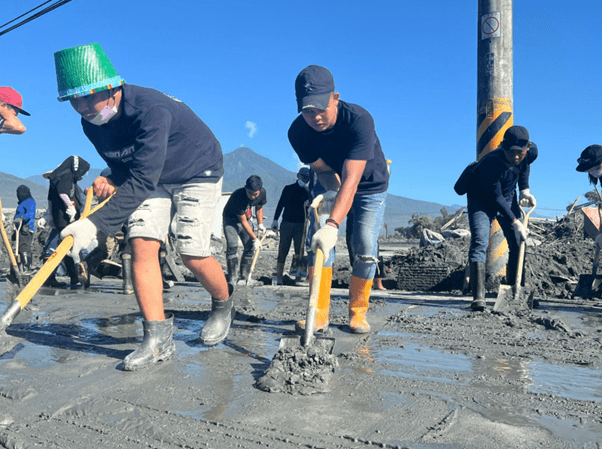
Wearing a black hip-hop cap, a long-sleeve sweater, and blue ripped jeans, Prayitno devoted himself to cleaning the flood mud from the street, back and forth, making sure everything looked clear. From time to time, he shouted “加油!” or “keep it up!” When an excavator was about to pass, he called out to his peers, “Move away!”
Prayitno is a migrant worker from Indonesia employed at a car bumper factory in Taoyuan. Since six in the morning, he had been in Guangfu, Hualien, helping the local community clear the remnants of Typhoon Ragasa that had devastated the village.
“We are here because of humanity. Even though we are Indonesians and the victims were mostly Taiwanese, we are still human beings,” said Prayitno when I asked why he came to Guangfu.
Not far away, another Indonesian migrant worker, Susilo, had already gone down into a culvert. Dressed in orange and wearing a black cap, he lifted chunks of mud blocking the water channel, while above him stood one male and two female volunteers wearing veils, helping to remove the sludge he brought up.
“This is what my religion, Islam, teaches me: that we must spread kindness and make ourselves beneficial to others, regardless of our different cultures, races, or religions,” Susilo said.
The story of Indonesian migrant workers’ voluntarism in Guangfu, following the collapse of the Matai’an River Bridge on September 24, has taken the internet by storm. Despite having only one day off each week, some having none at all, they chose to spend their precious rest time as volunteers. Many even paid their own way to travel from different cities across Taiwan to Guangfu.
Yet what becomes truly intriguing is this question: how did they coordinate such a collective effort?
Inspired by Social Media
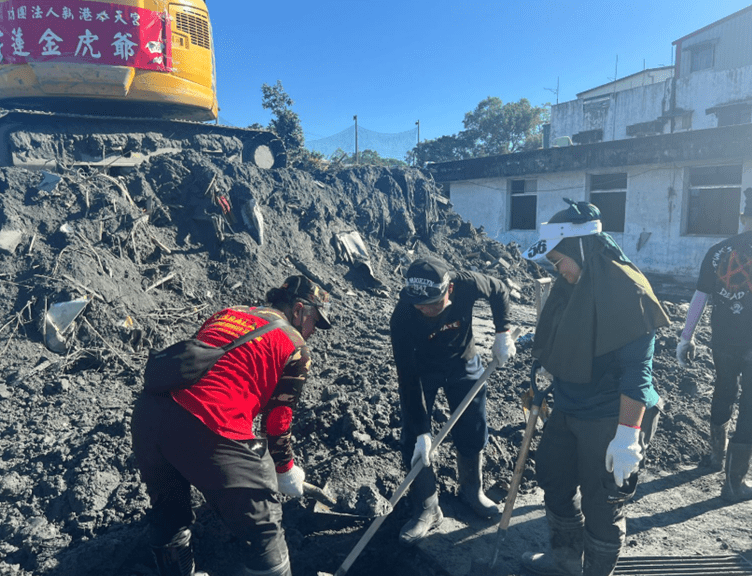
Prayitno did not come to Guangfu alone. He arrived with about a hundred others from Taipei and Taoyuan. They departed on Saturday night, October 4, and reached Hualien in the early hours of Sunday, October 5. They were members of Persaudaraan Setia Hati Terate (PSHT), a martial arts brotherhood based in Taiwan.
He told me that they left from Taoyuan and Taipei after renting two buses, each costing around NT$25,000. PSHT’s petty cash fund covered the transportation expenses, money voluntarily collected during the group’s previous events.
“We saw what happened through social media and also paid attention to the public’s response. That was what inspired us to come here,” said Prayitno, who also serves as the head of PSHT Taiwan.
“Then we shared the volunteering information in our group, and whoever was interested could simply write their name on the list.”
He smiled and added,
“I know renting two buses is quite expensive, but we do not regret the decision because the victims are also our brothers and sisters.”
Like Prayitno, Susilo had also departed from Taipei on Saturday night. He came with eleven others representing Bagana, a special disaster-response unit under Banser, part of the Nahdlatul Ulama (NU) network.
“We left Taipei by train, but some of us also rented cars to bring supplies and logistics for the people of Guangfu and fellow volunteers,” said Susilo.
NU itself is a socio-religious Islamic organisation in Indonesia with millions of members. It has numerous branches at both provincial and international levels, including the Special Branch Administrators of Nahdlatul Ulama (PCINU) in Taiwan. NU also has several semi-autonomous bodies, including LazisNU, which coordinates charitable donations and relief funds from its members.
“The assistance we provided included food and beverages; all of them were donations collected by LazisNU,” Susilo explained.
The Role of PCINU Hualien
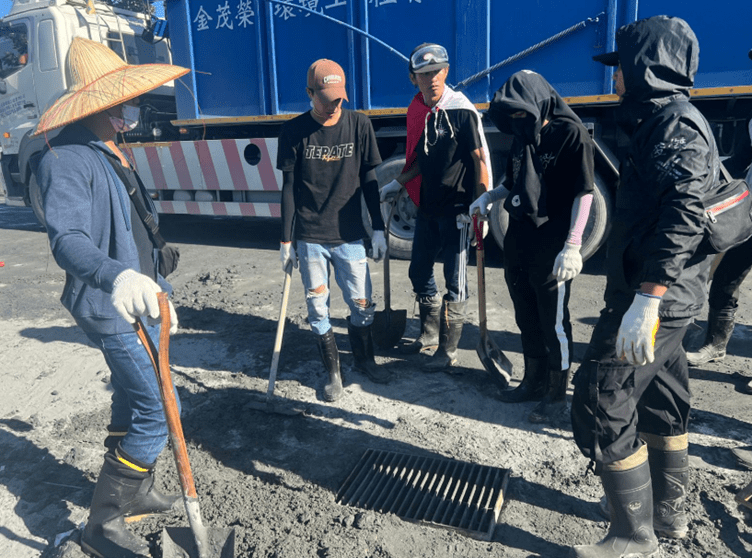
PCINU Taiwan has fourteen sub-branches spread across various cities, one of which is PCINU Hualien. It cannot be denied that PCINU Hualien deserves great credit in this movement. Several of its members had been assisting the Guangfu community since the very first day of the disaster, giving them a deep understanding of the local conditions.
Although information and photos of Guangfu’s situation had already circulated online, the volunteers still relied heavily on direct communication with PCINU Hualien to prepare everything. Even the Indonesian Economic and Trade Office (KDEI) in Taipei advised Indonesian migrant workers who wished to volunteer to coordinate through PCINU Hualien.
“At first, we told KDEI that we wanted to join the relief effort. Then KDEI told us to get in touch with PCINU Hualien. So we contacted them, we asked what we should prepare and how to get ready for the mission,” Prayitno said.
The PCINU Hualien secretariat, located just a five- to seven-minute walk from Hualien Station, is a modest three-story building. The first floor serves as a rest area and kitchen, the second as a prayer room, and the third as a sleeping space.
This humble space became a temporary place for volunteers from Taipei and Taoyuan before they departed for Guangfu in the early hours of Sunday morning. One PCINU Hualien member told me they were initially worried about whether the building could accommodate so many visitors arriving from the north.
But knowing the habit of many Indonesian workers to stay up late during weekends, and the fact that most would arrive in Hualien before dawn, they believed not everyone would need to sleep at once.
On Saturday night, the volunteers who had already arrived at the PCINU Hualien secretariat held a coordination meeting, facilitated by local PCINU members. They discussed logistics and planning: what time to leave for Guangfu, what to bring, what type of assistance to distribute, and when to return.
The meeting concluded that they would depart as early as possible, since the summer heat still lingered across Taiwan, and they expected to work in Guangfu only until around noon.
“We planned to leave Hualien around five or six in the morning. Because it’s still summer, and from our previous volunteer experience there, we know it’s best to start early so our energy can be used more effectively,” said one PCINU Hualien member.
We Will Always Be Ready!
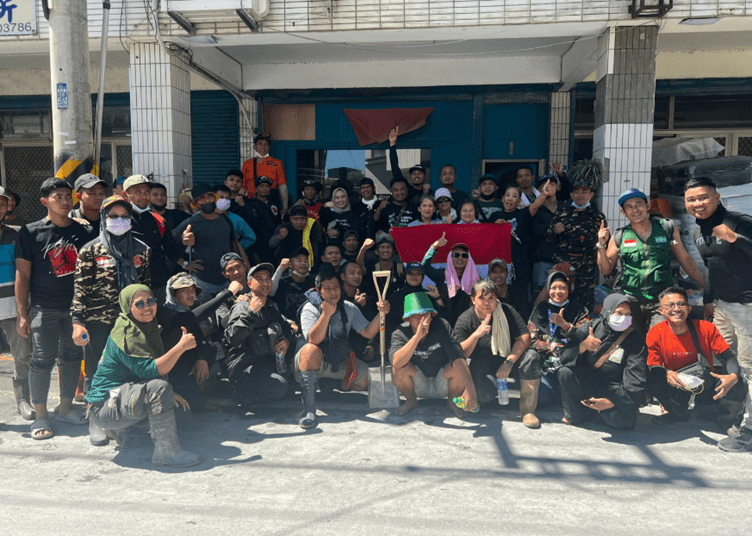
Susilo said this was the first time Bagana had directly gone to a disaster site. The organisation had existed in Taiwan for some time, but they were unsure how Taiwanese regulations treated the participation of migrant workers or civil society groups in volunteer activities.
“We had several concerns,” he said, “including how to deliver aid, how Taiwan’s laws would respond, and whether local people in the disaster area might wonder, ‘Why are these foreigners here?’ These were the things we worried about.”
“What happened in Guangfu was something different. Many people came together as volunteers. From Guangfu, we learned how to manage aid and prepare better for future volunteer work. After this, we will always be ready to help!” he added.
Negative stigma toward migrant workers remains an issue in Taiwan, especially against those from Indonesia. However, Susilo said he was warmly welcomed by Guangfu residents and never felt discriminated against.
The same impression was shared by Prayitno, who said that every time he passed by local residents, he was greeted with warmth and gratitude.
“Everyone was so kind. They gave us food and drinks and cheered us on. There was no discrimination at all toward migrant workers here,” he said.
Through their contributions, Susilo and Prayitno wish to show that the network of Indonesian migrant workers spread across Taiwan can become a reliable partner for the government and local communities. Their dedication also proves how easily they have adapted to local culture, even to the point of offering their time, energy, and money to help rebuild Taiwan after a disaster.
For them, Taiwan is more than just a workplace. It is a second home, one they also have a responsibility to care for.
Vanny El Rahman is a PhD student in Asia-Pacific Regional Studies at National Dong Hwa University, Taiwan. He has also been a journalist since 2017. His current research focuses on Indonesian migrant workers in Taiwan.
 Taiwan Insight