Written by Ssu-Han (Evelyn) Chiu.
Image credit: author.
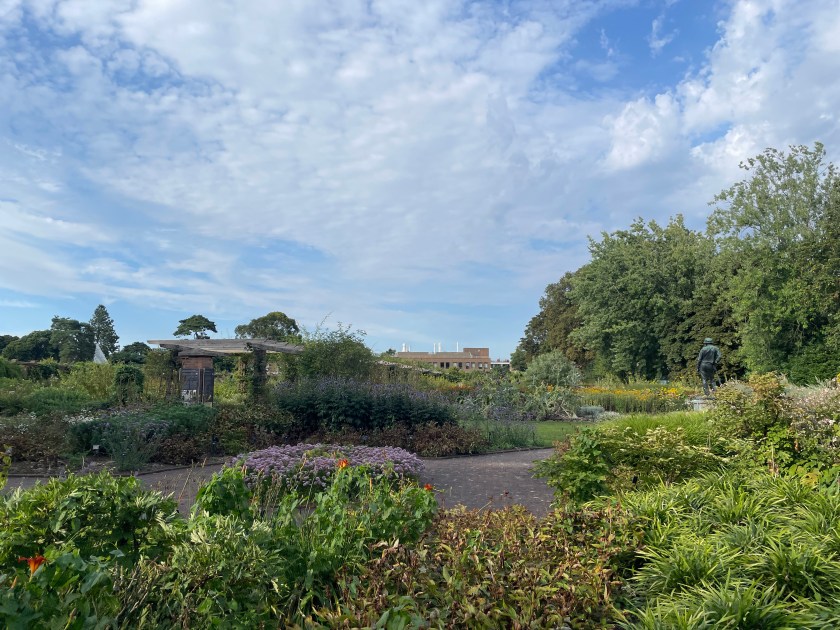
The Royal Botanic Gardens, Kew, a UNESCO World Heritage Site, has long been recognised as one of the world’s leading institutions for plant science, conservation, and education, as well as several worldwide historical buildings and well-organised gardens. Each year, Kew attracts millions of visitors—tourists enchanted by its landscape gardens, researchers drawn to its scientific collections, and students inspired by its role as a global centre for botanical learning. Behind its tranquil greenhouses and curated landscapes lies a complex organisation sustained by a finely divided yet interlinked network of departments. Among its eight divisions, three—Gardens, Science, and Wakehurst—form the core of Kew’s research and educational mission.
In 2024, the National Taiwan University (NTU) Overseas Internship Programme launched its second round of internships at Kew, continuing a collaborative effort to connect Taiwanese students with global institutions in environmental science. Four internship positions were offered that year, mirroring the previous round: two within the Science Directorate (the Herbarium and the Science Education Team), and two at Wakehurst, where interns joined research on seed banking and germination at the Millennium Seed Bank. Drawing upon my experience in herbarium and botanical guide—as well as my research data related to part of open-access biodiversity databases such as iNaturalist and eBird—I was placed in the Science Education Team (SET), a position to explore new approaches of incorporating citizen science initiatives into Kew’s public engagement and research.
Kew’s Science Education Team
The Science Education Team (SET) operates at the intersection of multiple ways of education, research, and training. It coordinates long- and short-term placements, postgraduate, field and lab training courses, and collaborations with universities worldwide. Its mission is to cultivate the next generation of plant scientists while also nurturing a culture of continual learning among staff. One fascinating aspect of Kew’s educational philosophy is its emphasis on “knowledge circulation”—knowledge not only flows outward to the public but also circulates internally, enabling researchers and staff to share expertise and develop new competencies. The team also supports staff training programmes, offering courses designed to strengthen both scientific and interpersonal skills.
Designing a collaborative space
Within this setting, my primary task was to assist in the early stages of a new citizen science initiative. My mentor, who they referred to as a line manager and also the head of the Science Education Team, encouraged me to begin by mapping all current Kew projects that could potentially involve public participation. The goal was not merely to document what existed, but to understand how citizen contributions might help fill data gaps, enhance outreach, or build bridges between researchers and society.
To achieve this, I reviewed internal research by reviewing Kew’s website and internal databases to identify relevant projects, contacting researchers to learn about their methodologies and data needs, and exploring how citizen scientists had been integrated—or could be integrated—into similar projects globally. At the same time, I surveyed case studies from other institutions and platforms, from the Cornell Lab of Ornithology’s eBird platform to SciStarter, to better understand how large-scale participatory science projects maintain data quality while fostering public engagement. Reading the growing body of academic literature on citizen science, I became aware of the delicate balance between inclusivity, accuracy, and sustainability in such initiatives.
As the research progressed, my mentor and I began to see an opportunity: rather than designing a top-down plan, why not create a collaborative workshop that could gather staff already engaged—or interested—in citizen science? The workshop could serve as a space to share ideas, compare experiences, and collectively identify what Kew needed to make citizen participation more effective. We decided that this event would form the central milestone of my placement.
The workshop timing was ideal. In early August, just after the XX International Botanical Congress (IBC) in Spain, most of Kew’s researchers would be back from presenting their work and exchanging ideas with peers worldwide. The Congress itself included several sessions on citizen science, demonstrating its growing importance in global biodiversity research. I was fortunate to attend the conference with my NTU lab group, representing our university and Kew’s evolving interest in participatory research. Listening to case studies from Africa, Europe, and Asia, I was struck by how citizen science could democratise research—making it more inclusive and community-driven, while simultaneously demanding careful design and ethical reflection.
Upon returning to Kew, I compiled a short report summarising the trends and methods I had observed at the Congress. This document became the foundation for structuring our upcoming workshop discussions, ensuring that global perspectives would inform Kew’s internal reflections.
The workshop and its lessons
The Citizen Science Workshop took place in a hybrid format, combining in-person and online participation. With support from my team, I helped with contacting, preparing discussion prompts, and moderating some sessions. We successfully gathered eight participants from different departments—researchers, curators, and educators—who shared their experiences with citizen participation in data collection, species monitoring, and educational outreach.
Discussions revolved around both opportunities and challenges: How could Kew better design projects that invite the public into meaningful scientific roles? What institutional barriers might prevent such collaborations from flourishing? How can citizen-generated data be validated and archived responsibly?
The conversation was remarkably open and creative. Participants highlighted pros and cons among various techniques and approaches. Others showed the need for clearer communication between scientists and participants, ensuring mutual understanding of research goals and data reliability. By the end of the session, we had sketched out a preliminary framework for cross-departmental collaboration—one that would allow Kew to harness citizen science more strategically while staying true to its scientific standards.
After the workshop, I compiled and circulated a summary of all discussion outcomes to participants. Though modest in scale, the workshop served as a valuable “pulse check” of institutional readiness—a reminder that innovation within large organisations often begins with small, well-facilitated conversations.
Reflections on my placement and work vibration
At first glance, my internship may seem to have produced no concrete deliverables. Yet in reality, it provided profound lessons about how large scientific organisations evolve and how collaboration unfolds across disciplines. Working at Kew taught me that effective science is as much about communication and curiosity as it is about data and discovery. Here, hierarchy mattered less than ideas; every voice, regardless of seniority or nationality, was invited to the table. Even casual tea-time chats could become fertile ground for new collaborations.
For me, this culture of openness was both inspiring and instructive. As someone coming from Taiwan—a place where research institutions are also striving to engage the public in science—I saw how an organisation’s willingness to experiment and listen could foster genuine innovation. It reminded me that scientific institutions, like gardens, require both structure and spontaneity: they must be well-tended, yet always ready to let unexpected seedlings grow.
There were, of course, moments of doubt. At times, I wondered whether my work would lead to measurable results or whether the discussions would fade without follow-up. But my mentor reminded me that growth takes time. Like the plants in Kew’s greenhouses, ideas bloom at their own pace. The key is to nurture them patiently and consistently.
Acknowledgement
Looking back, I am deeply grateful to my mentor, Richard, for his steady guidance and trust. He encouraged me to explore freely, even when I was uncertain, and believed that students from Taiwan could contribute meaningfully to global environmental science. This internship showed me that international collaboration is not just about exchanging knowledge—it is about cultivating shared responsibility for the planet’s future.
As I return home, I carry with me the conviction that research, education, and citizen engagement are inseparable parts of sustainable science. Like the diverse species thriving under Kew’s greenhouses, each idea—when nurtured with care and curiosity—will eventually find its season to bloom.
Ssu-Han (Evelyn) Chiu (邱思涵) graduated from the Institute of Ecology and Evolutionary Biology at National Taiwan University. Currently is an assistant in the NTU herbarium organising collections and storage. She participated in the 2024 NTU Overseas Internship Programme at the Royal Botanic Gardens, Kew. Her research interests include public engagement on botanical education, ethnobotany, herbarium management, and taxonomy. She can be reached at ssuhanchiu7325@gmail.com.
This article was published as part of a special issue on ‘Seeds of Exchange: Stories from the Kew-NTU Collaboration‘.
If you are interested in working at Kew, the Global Pathfinders initiative recently launched a program including six 6-month fully paid opportunities at Kew. More information can be found on page 6 of the website under codes G-8-34 to G-8-39: https://twpathfinder.org/overview1830.
 Taiwan Insight