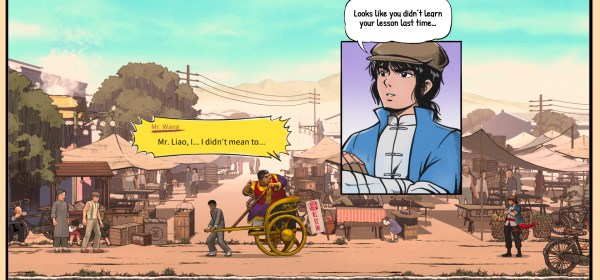
Digital Cultivation: How Taiwan’s Video Games Transform Wuxia into Cultural ‘Internal Power’ (Part 1) 

Written by Mark G. Murphy. This article explores how Taiwan’s video games use wuxia mythology to build cultural identity and soft power. The games weave local legends with historical events, focusing on themes of resistance, spiritual growth, and rootedness. The author argues that the practice of “cultivation” – developing inner strength – should be interpreted broadly, linking it to Taiwan’s cultural memory and landscapes. This allows players to engage deeply with Taiwanese culture, blending myth and real-world settings to reinforce collective identity and memory. Importantly, this means soft power becomes a kind of internal power, a key principle in wuxia philosophy.

On the Road:  A Taiwan Literary Scholar’s Routes’ of Worlding Taiwan Literature 

Written by Wei-ting Liou. This article focuses on the author’s experiences in “worlding” Taiwan literature through their academic work. This includes engaging with translation, examining Taiwanese American literature, and teaching English-taught courses on Taiwan literature and culture. The author believes these approaches can help reshape the conventional understanding of Taiwan literary studies.

Lolita Reimagined: Fang Si-Chi’s Voice in the Story of Sexual Violence

Written by Yixin Xu. This article argues that the novel Fang Si-Chi’s First Love Paradise can be considered a significant contribution to the #MeToo movement and a literary counterpoint to Vladimir Nabokov’s Lolita. It highlights the novel’s unique perspective by focusing on the victim’s experience of sexual abuse and the complexities of her emotional response. The author emphasises how the novel challenges the romanticized portrayal of the predator in Lolita and exposes the devastating reality of sexual violence.

Tell a Taiwan Story to an American: A Recap at the Creative and Collaborative Workshop

Written by Dah-Wei (David) Yih. This article describes a workshop hosted at the NATSA conference that aimed to empower participants to communicate Taiwan’s significance to American audiences. The workshop emphasised Taiwan’s multifaceted importance to the United States, ranging from economic and geopolitical ties to shared democratic values and technological cooperation. It used interactive activities and facilitated discussions to help attendees understand why Taiwan matters and how to communicate this understanding to others effectively.

Asian Migrants and Taiwanese Americans: A Dialogue on Identity, Activism, and History

Written by Panchen Lo, Pei-Chen Cheng, and Ssu-chieh Jessica Fan (University of Texas, Austin). This article details a panel discussion at the NATSA conference featuring three scholars who discussed the experiences and identities of Taiwanese Americans. The panel focused on the intersection of Cold War geopolitics, class, and the complicated process of identity formation. It critically examined how historical context, class, and racial narratives have shaped the lives and experiences of Taiwanese Americans.

Doing Taiwanese Indigenous Studies in North America: Politics of the Frontier(s)

Written by Aaron Su and Chao-Kai Huang. This article highlights the need to move beyond simply representing Indigenous voices and towards a transformative approach that centres Indigenous perspectives and experiences. It focuses on a roundtable discussion featuring three Taiwanese Indigenous scholars who share their experiences navigating Indigenous studies in both Taiwan and North America. The speakers emphasised the importance of building relationships and solidarity across disciplines and beyond institutions, advocating for a more equitable and comprehensive understanding of Indigenous peoples and histories.

(Re)Writing Taiwan Studies History​

Written by Yu-Han Huang and Li-Ting Chang. This article is about the 30th NATSA Conference’s closing forum, which discussed the historical development of Taiwan Studies as a field, particularly emphasizing its interdisciplinary nature and growing significance in global scholarship. The forum featured four experts who presented their perspectives on Taiwan studies, exploring its evolution through various disciplines such as history, anthropology, ethnomusicology, and medical history. It highlighted the increasing importance of understanding Taiwan within a global context, emphasizing the need to connect its history and experiences with broader international dialogues and discussions.

Is it the End for Taiwan and Pacific Regionalism? Controversy at the 53rd Pacific Islands Forum (PIF) Leaders Meeting in Tonga

Written by Jess Marinaccio. This article examines the 53rd Leaders Meeting of the Pacific Islands Forum, taking place from 26 to 30 August 2024. It highlights the several controversies that Taiwan was embroiled in during the Meeting, particularly in regard to Taiwan’s position as a PIF “development partner” despite objections from China.

1 4 5 6 7 8 14